
By Danny Andino, CEO, Arise Recovery Centers · Clinically reviewed by Nicholas Overbeck, LPC-S, LCDC · Updated August 2026
Update, October 2026: The federal 7-OH ban was reset on October 9, and the earliest it can now take effect is November 13, 2026. Here is what the new rule changes and what to do now.
You already know what the withdrawal feels like. You’ve already had the hard conversation with yourself in the car. What’s stopping you now isn’t willingness — it’s that nobody has told you what “getting help” actually means on a Tuesday when you have a job, a family, and no interest in disappearing for a month.
So here it is, without the brochure language. For most people dependent on concentrated 7-OH (7-hydroxymitragynine, often typed “7OH”), treatment happens in an outpatient setting. You keep working. You sleep in your own bed. You tell the people you decide to tell and nobody else. The picture in your head — 28 days away, everyone finds out, career over — describes a level of care most people in this situation are never asked to consider.
The 30-second answer
- Where it happens: Usually outpatient. Most people keep their job and their routine throughout.
- What’s at the center of it: Medication, not just talk therapy. Clinicians manage 7-OH dependence the way they manage opioid dependence.
- What the first appointment is: An assessment — about 20 minutes, free at Arise, no obligation and no commitment to enroll.
- What it costs: It’s billed as substance use disorder treatment, which most commercial health plans cover under federal parity rules.
- The thing that trips everyone up: A routine drug screen probably won’t show 7-OH. If you don’t say it out loud, nobody will find it for you.
The part nobody tells you before your first appointment
Standard urine immunoassays — the panel most doctors, employers, and even a lot of treatment programs run — do not reliably detect 7-OH. That’s stated plainly in a 2026 clinical review in Current Addiction Reports, which flags the screening gap as a real obstacle to diagnosis.
Two things follow from that
One: a clean drug test is not evidence that you’re fine. Plenty of people have used that result to talk themselves out of getting help for another year.
Two: you have to bring this in yourself, with a number attached. “I take a few tablets a day” and “I take a 30 mg shot four times a day” lead to genuinely different medication decisions. Bring the packaging, or a photo of it, if you still have it.
This is the single biggest difference between people who get the right care quickly and people who spend six months in the wrong lane: the first group said the real number out loud at the first appointment.
What actually happens, step by step
Step 1
The assessment
About 20 minutes, usually by phone. What you take, how much, how long, what stopping does to you, what else is in the mix.
Step 2
Stabilizing
If medication fits, a prescriber decides what and — critically — when. Days, not weeks. This is the part that makes the rest possible.
Step 3
The program
Group and individual sessions on a schedule built around work. Most people start in intensive outpatient and step down as things hold.
Step 4
The long tail
Lower-intensity sessions, medication management, and a relapse plan. This is where the outcome is actually decided.
At the assessment, you’re not being interviewed for admission — you’re being matched to a level of care. The ASAM Criteria that clinicians use ask about six things in plain terms: what you’re using and what happens when you stop, your physical health, what’s going on mentally, what the use is costing you, what home looks like, and what you’re actually willing and able to do. That last one isn’t a loophole. It’s written into the criteria, and it’s why “I can’t stop working” is information a good clinician wants, not an excuse they’ll argue with.
The levels of care, without the jargon
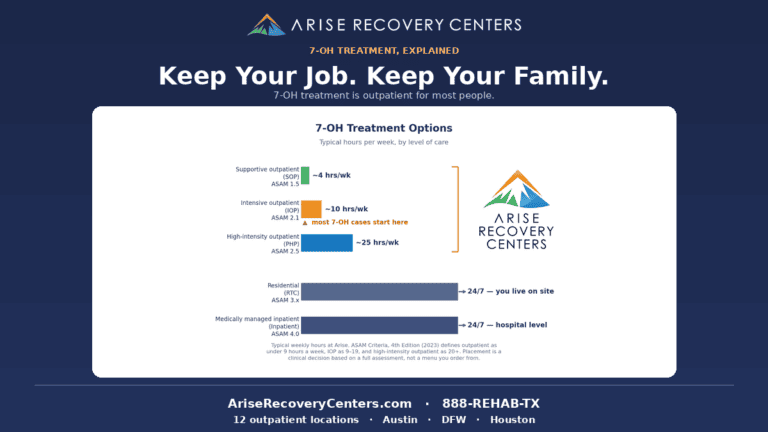
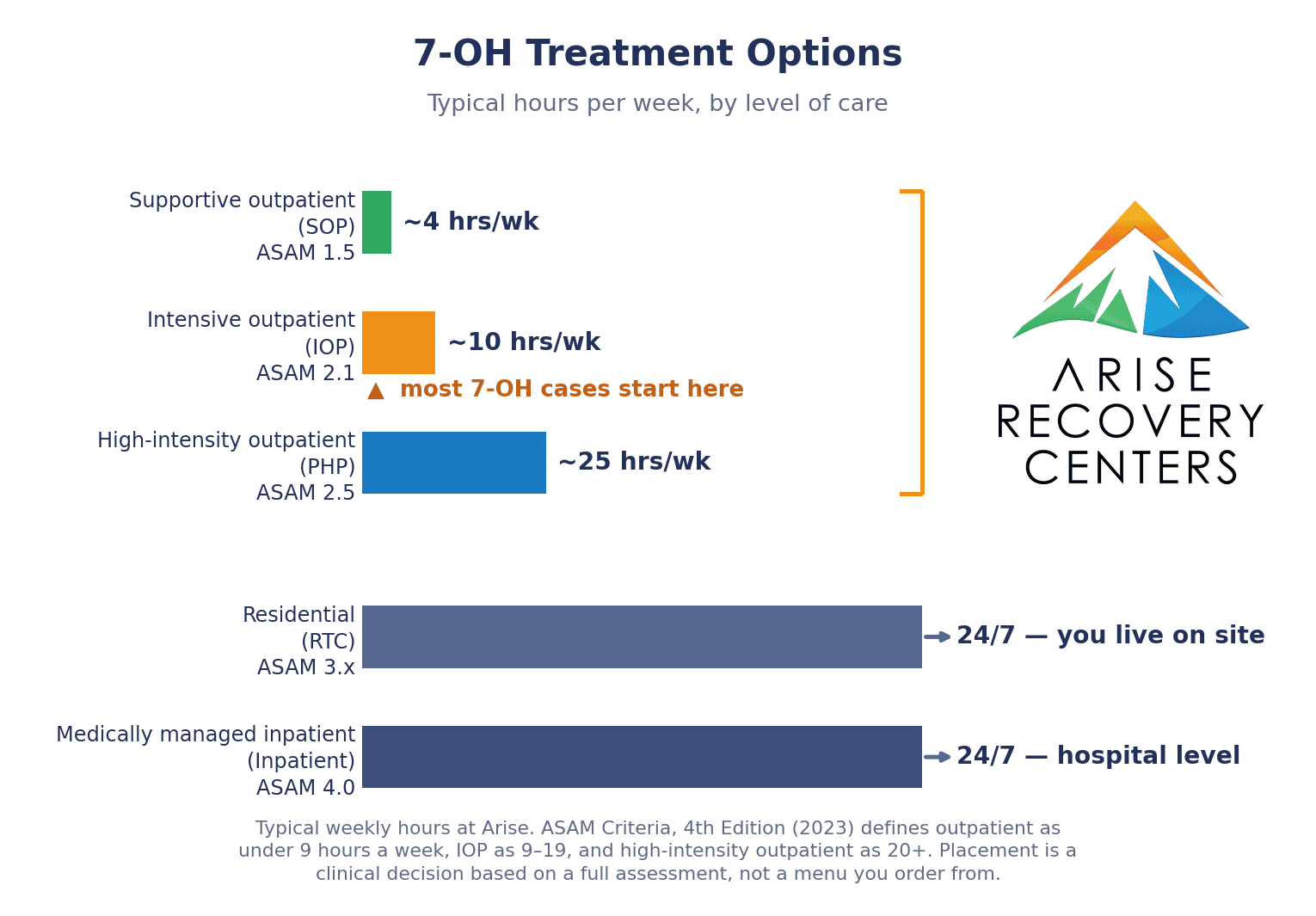
| Level | What it is | Hours/week | Who it usually fits | At Arise |
|---|---|---|---|---|
| Supportive outpatient (1.5) | One or two sessions a week. Arise calls this our Supportive Outpatient Program. | Under 9 (Arise: ~4) | Stable at home, medication going well, stepping down from something more intensive. | Yes |
| IOP (2.1) | Intensive outpatient — the most common starting point for 7-OH dependence. Here is what the first week actually looks like. | 9–19 (Arise: ~10) | Real physical dependence, a job you intend to keep, evenings available. | Yes |
| High-intensity outpatient (2.5) | Daily structure, still sleeping at home. This is what most programs — ours included — still list as a Partial Hospitalization Program (PHP); ASAM retired “partial hospitalization” as a misnomer in the 4th Edition. | 20+ (Arise: ~25) | More medical or psychiatric complexity; needs structure most of the day but doesn’t need to live on site. | Yes |
| Residential (3.x) | You live on site for the duration. | 24/7 | An unsafe or using household, significant co-occurring conditions, or repeated outpatient attempts that haven’t held. | — |
| Medically managed inpatient (4.0) | Hospital-level care with 24-hour medical management. | 24/7 | Acute medical or psychiatric instability requiring a hospital setting. | — |
ASAM Criteria, 4th Edition (2023). Arise provides the three outpatient levels — supportive outpatient, IOP, and PHP / high-intensity outpatient — across 12 Texas locations. If an assessment points to a level above those, we say so and help you find it rather than talking you into the one we happen to offer. Higher isn’t better; matched is better. Not sure where you land? Start here.
Medication is the center of this, not a side dish
Concentrated 7-OH is a high-affinity partial agonist at the mu-opioid receptor, more potent than mitragynine, the main alkaloid in traditional kratom leaf. That single fact drives the whole treatment approach: this is managed as opioid dependence, because that’s what the receptor pharmacology says it is.
There is no FDA-approved medication indicated specifically for 7-OH. What exists is a growing clinical literature — including a retrospective case series published in the Journal of Addiction Medicine in June 2026 — describing buprenorphine-based management of 7-OH use, and a 2026 review concluding that medications for opioid use disorder warrant consideration here. That’s real evidence, and it’s also early evidence. Any prescriber worth seeing will tell you both halves of that.
Why the timing of that first dose matters
Starting buprenorphine too soon after your last dose can trigger precipitated withdrawal — withdrawal that comes on hard and fast, worse than what you were trying to escape. This is the appointment you cannot wing or improvise from a forum post. Let a licensed prescriber set the timing.
And the standing rule from the withdrawal guide still holds: never bridge the gap with street pills. Counterfeit pills frequently contain fentanyl.
The other thing to know up front: medication for opioid-type dependence is measured in months, not days. Feeling better on day ten is the medication working — not a signal to stop it. When and whether to taper off is a separate decision, made later, when your life is stable.
Tapering: the option everyone asks about
Almost everyone’s first instinct is to taper — cut the dose gradually instead of stopping cold. It’s a legitimate clinical strategy, and for some people it’s the right one. But the reason tapers fail usually has nothing to do with the schedule.
| Approach | What it looks like | Where it breaks down |
|---|---|---|
| Self-taper | You cut your own dose on your own schedule, using product you already have. | The person in withdrawal controls the supply. On a bad afternoon the plan loses to the symptoms. This is where most self-tapers stall. |
| Supervised taper | A clinician sets the schedule; someone other than you holds the supply. | Requires a prescriber and a source. With concentrated 7-OH now being pulled from shelves, the product you were tapering on can disappear mid-plan. |
| Medication bridge | Switch to a prescribed medication such as buprenorphine, stabilize, then taper that later — or stay on it. | Induction timing matters (precipitated withdrawal). Needs a licensed prescriber, not a forum. |
Which of these fits you is a clinical decision, not a preference. Bring the real dose to the conversation — see the drug-screen problem above.
Two hard rules regardless of which route you take. Don’t taper alone if alcohol or benzodiazepines are also in the picture — withdrawal from those can be genuinely dangerous in a way opioid-type withdrawal usually isn’t. And don’t bridge a gap in your taper with street pills. Counterfeit pills frequently contain fentanyl; that substitution is the single most dangerous move available to you right now.
The swap risk is not unique to 7-OH. When Texas banned delta-8 in July 2026, the same pattern followed; here is what daily delta-8 users should expect.
Overrated and underrated in the first 90 days
Overrated
- Detox as the finish line. Detox handles days. Dependence is a months problem. Detox alone is the most common way people end up doing this twice.
- Facility shopping. The gap between two competent programs is far smaller than the gap between going and not going.
- Getting the label right. Whether it “counts” as addiction is a debate. Withdrawal every time you stop is a fact.
- Assuming inpatient is better. It’s more disruptive, not automatically more effective. Match beats intensity.
- Willpower. It was never the bottleneck, and treating it like one is why people wait years.
Underrated
- Saying the real number. No lab result is going to say it for you. The dose you admit to is the dose you get treated for.
- Who holds the supply. Self-tapering from your own stash is where most plans quietly die. Hand the schedule to someone else.
- Staying past the point it gets boring. The stretch where nothing dramatic is happening is the stretch that’s working.
- Sleep. It’s the last thing to come back and one of the most common reasons people go back — see post-acute withdrawal (PAWS).
- Telling one person. Not everyone. One. Zero is what makes relapse quiet and easy — and here is how to actually help someone who tells you.
“Participation for less than 90 days is of limited effectiveness, and treatment lasting significantly longer is recommended for maintaining positive outcomes.”
National Institute on Drug Abuse, Principles of Drug Addiction Treatment (3rd Ed.). The strongest, least glamorous predictor in this entire field is simply how long you stay.
What it costs — and the number people forget to run
Dependence on an opioid-receptor substance is a substance use disorder, and under federal parity rules most commercial health plans cover it. What varies is the specifics: your deductible, the level of care, whether the program is in network, and whether higher levels need prior authorization. You can verify your benefits in a few minutes, estimate the out-of-pocket range with our Cost of Treatment calculator, or read the fuller breakdown of what rehab actually costs.
Here’s the number almost nobody runs first: what the last twelve months of buying these products actually cost. Add it up before you decide treatment is the expensive option. For a lot of people that arithmetic ends the debate on its own.
What to say when you call
You don’t need the right words. You need three facts and one sentence.
- What and how much: “I’ve been taking 7-OH — [product], about [amount] a day, for [how long].”
- What stopping does: “When I stop, I get [sweats, aches, no sleep, cravings].”
- What else is in the mix: alcohol, benzodiazepines, anything prescribed — or nothing else.
“I need to keep working.” — Say this too. It’s not a caveat, it’s a scheduling requirement, and it changes what gets recommended.
One rule: you do not need to have stopped, cut down, or “gotten it together” before you call. Showing up still using is the normal way this starts, not a disqualification.
If you’re still working out what happened to these products and why, start with our breakdown of the 7-OH ban. If you’ve stopped and you’re in it right now, the withdrawal timeline is here. And if the question is whether a medically supervised start makes sense for you, here’s how detox placement works, or browse the full guide to outpatient rehab in Texas.
Ready to know what this would actually look like for you?
Tell us what’s been going on. We’ll tell you straight what it means and what to do next — in about 20 minutes. Free, confidential, no obligation. Twelve locations across DFW, Houston, and Austin. Reach out to us or our mental health partner, Saltwood Mental Health, today.
Frequently asked questions
Do I need detox for 7-OH, or can I go straight to outpatient?
It depends on how much you’ve been taking, how long, what else you use, and your medical history — which is exactly what the assessment is for. Many people with 7-OH dependence are managed in an outpatient setting with medication from the start. Others do better with a medically supervised start, particularly if alcohol or benzodiazepines are also in the picture, since withdrawal from those can be dangerous in a way opioid-type withdrawal usually isn’t. Don’t decide this one on your own — this walks through how that call gets made.
Will 7-OH show up on a drug test?
Often not. A 2026 review in Current Addiction Reports states that standard urine immunoassays do not reliably detect 7-OH, and calls the screening gap a complication for diagnosis. Specialized testing exists but isn’t part of routine panels. Practically, this means two things: a negative screen doesn’t tell you that you’re okay, and your clinical team depends on what you tell them.
How long does treatment for 7-OH last?
The intensive part is usually measured in weeks and the whole arc in months. NIDA’s guidance is that participation under 90 days is of limited effectiveness. Medication, if it’s part of your plan, typically continues well past the point you feel normal — stopping it is a decision to make later, with a prescriber, once things are stable. There’s no fixed graduation date; there’s a step-down as you hold steady.
Can I keep working?
For most people, yes — that’s the entire design of intensive outpatient. Sessions are scheduled around work, commonly in evenings. Tell the assessment team your schedule constraints up front; under the ASAM Criteria, what you’re able to engage in is a formal part of the placement decision, not an afterthought.
Does insurance cover treatment for 7-OH dependence?
Generally yes. It’s treated and billed as a substance use disorder, which most commercial health plans cover under federal parity law. Coverage details — deductible, network status, prior authorization for higher levels of care — vary by plan. Verify your benefits to see what yours actually says.
Do I have to be off it before my first appointment?
No, and please don’t try to be. Showing up while still using is the ordinary way treatment begins. Timing the first medication dose is a clinical decision — stopping abruptly on your own beforehand can actually make the induction harder to schedule, and can push people toward exactly the substitutions that carry real risk.
Will my employer or my family find out?
Not from us. Substance use treatment records carry HIPAA protection plus, for federally assisted programs, the additional protections of 42 CFR Part 2 — a stricter standard than ordinary medical privacy. Information goes to your employer or your family only if you sign a release directing it, or in narrow legally defined circumstances. If you were referred through an employer program or a court, ask specifically what has been agreed to be shared before you sign anything.
Sources: 7-Hydroxymitragynine (7-OH): Clinical Implications of a Potent, Unregulated Opioid Partial Agonist Derived from Kratom — Current Addiction Reports, May 2026; Buprenorphine for the Management of 7-Hydroxymitragynine (7-OH) Use: A Retrospective Case Series — Journal of Addiction Medicine, June 2026 (PMID 42225057); Treatment of Kratom Withdrawal and Dependence With Buprenorphine/Naloxone: A Case Series and Systematic Literature Review (PubMed); U.S. FDA — Products Containing 7-OH Can Cause Serious Harm; National Institute on Drug Abuse — Principles of Drug Addiction Treatment, 3rd Edition (PDF); American Society of Addiction Medicine — The ASAM Criteria, 4th Edition; 42 CFR Part 2 — Confidentiality of Substance Use Disorder Patient Records. Compiled August 2026; clinical and regulatory information verified at time of writing and subject to change.