

Medically reviewed by Chelsea Petty, LMFT — Clinical Director of DFW & Family Programming, Arise Recovery Centers · Last reviewed: June 2026
Outpatient rehab lets you get structured, professional treatment for drug or alcohol addiction while you continue living at home, working, and caring for your family. For many people in Texas, it’s the right level of care — more support than weekly therapy, without the cost and disruption of an overnight stay. This guide covers how it works, the levels of care, what it costs, and how to choose the right program.
What is outpatient rehab?
Outpatient rehab is addiction treatment you attend on a scheduled basis — typically several hours of group and individual therapy each week — while living at home rather than staying overnight at a facility. It’s designed for people who are medically stable and have a safe, supportive home environment. It’s often used either as a step down from inpatient or detox, or as a starting point for people whose situation doesn’t require 24/7 supervision.
The levels of outpatient care
Outpatient treatment is a continuum, and people often move from a more intensive level to a lighter one as they progress.
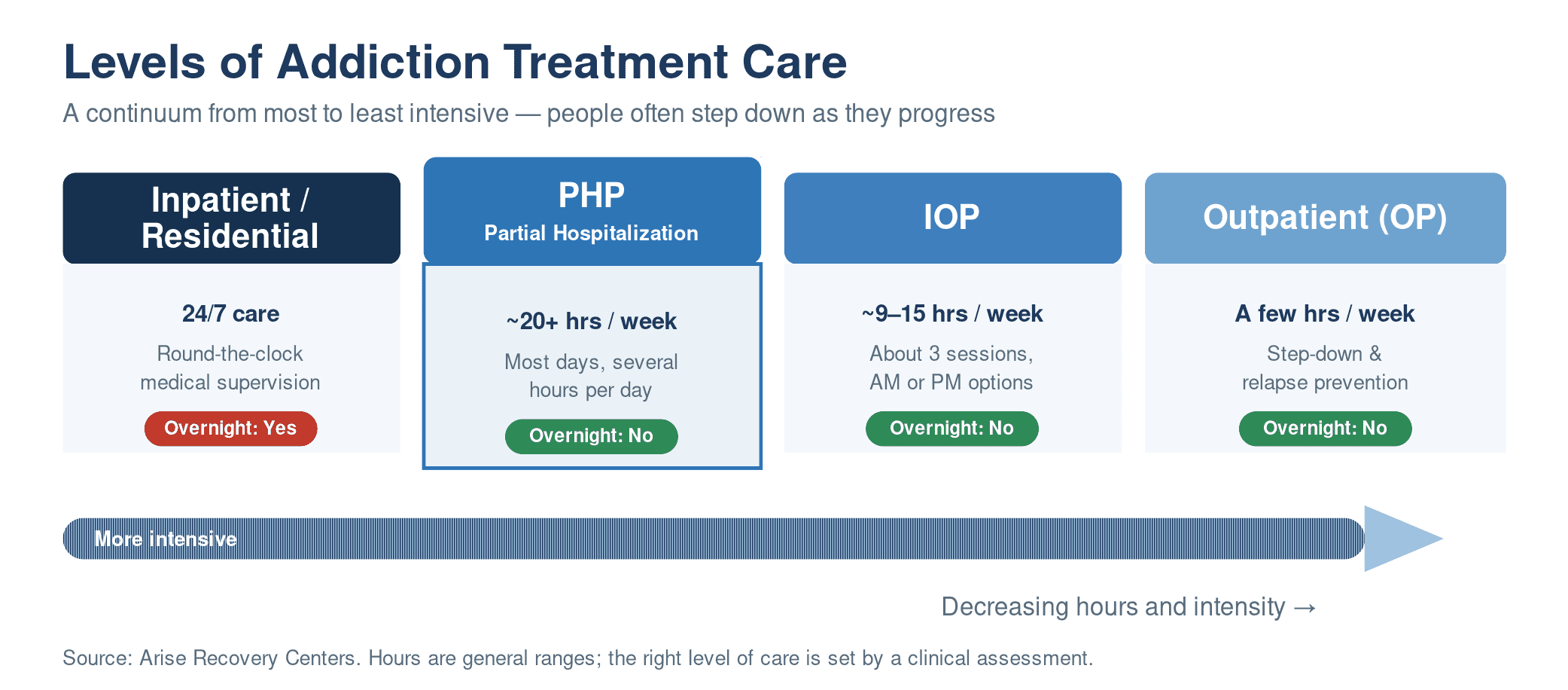
| Level of care | Typical hours | Overnight? | Best for |
|---|---|---|---|
| Inpatient / residential | 24/7 | Yes | Medical instability, detox, unsafe home |
| PHP (partial hospitalization) | ~20+ hrs/week, most days | No | Intensive daily structure, but home is safe |
| IOP (intensive outpatient) | ~9–15 hrs/week | No | Solid support while working or in school |
| SOP (supportive outpatient) | A few hrs/week | No | Step-down, maintenance, relapse prevention |
Partial Hospitalization Program (PHP)
The most intensive outpatient level — usually around 20+ hours per week, often five days a week. Some providers now also call this a High Intensity Outpatient Program (HIOP). It suits people who need substantial daily structure but can safely return home each evening. Learn more: What is a PHP?
Intensive Outpatient Program (IOP)
The most common outpatient level — generally 9–15 hours per week across about three sessions, with morning or evening options so you can keep working or attending school. Learn more: What is an IOP? and IOP vs. PHP.
Supportive outpatient (SOP)
The lightest level — a few hours per week — typically used as a step-down to maintain progress and prevent relapse after IOP. Learn more: Supportive Outpatient Program (SOP).
Who is outpatient rehab right for?
- You’re medically stable and don’t need 24/7 monitoring or medically supervised detox
- You have a safe, stable place to live during treatment
- You need to keep working, studying, or caring for family while in treatment
- You’re stepping down from inpatient care or completing detox
- You want support stronger than weekly therapy
A clinical assessment is the only reliable way to know which level fits. If a higher level of care is needed, a good program will tell you.
To match yourself to a specific level, see PHP, IOP, or outpatient — which one are you? If withdrawal is part of the picture, start with do you need detox first?
What conditions does it treat?
Arise’s outpatient programs address alcohol and drug addiction, including co-occurring mental health conditions:
Not sure whether what you’re seeing rises to the level of treatment? Two related reads: why alcohol quietly kills more Texans than every illicit drug combined, and whether a DUI is a sign of alcoholism — which covers what an alcohol assessment actually involves.
- Alcohol use — Dallas, Fort Worth, Austin, Houston
- Drug and substance use — Dallas, Fort Worth, Austin, Houston
- Co-occurring (dual diagnosis) conditions such as anxiety, depression, and trauma alongside substance use
Therapies & services
Outpatient programs combine group therapy with one-on-one support and optional add-ons, tailored after a clinical assessment:
- Individual counseling — weekly one-on-one therapy, also available as a standalone service
- Medication management — optional, prescriber-led support for co-occurring mental health conditions
Virtual outpatient rehab in Texas
Virtual IOP delivers the same structured group and individual therapy over secure video, so you can take part from anywhere in Texas. It’s a strong option if you live far from a center, have transportation barriers, or need maximum scheduling flexibility. Learn more: Virtual IOP in Texas.
What does it cost, and does insurance cover it?
Outpatient rehab is generally far less expensive than inpatient care because there’s no room-and-board component. Most major health plans cover addiction treatment — including IOP and outpatient care — though your specific coverage, deductible, and copay vary by plan. Federal parity law requires most plans to cover behavioral health comparably to medical care. The most reliable next step is a free, confidential benefits check. Related: Outpatient rehab cost in Texas and Does insurance cover IOP & outpatient rehab?
How to choose an outpatient rehab in Texas
Check state licensing and accreditation, whether they treat co-occurring conditions, the credentials of the clinical staff, whether they offer the level of care you need (PHP/IOP/SOP), in-person vs. virtual options, and whether they verify your insurance up front. More: How to choose an outpatient rehab in Texas.
Getting started
Starting outpatient rehab usually begins with a quick, confidential phone call and an insurance check, followed by a clinical assessment that determines the right level of care.
Researching for a loved one, not yourself? Start with our frank family guide to helping vs. enabling a loved one’s addiction — a side-by-side matrix, a 6-question “Am I enabling?” self-check, and word-for-word scripts for the hard conversations.
Frequently asked questions
What is outpatient rehab?
Addiction treatment you attend on a set schedule — usually several hours of group and individual therapy per week — while living at home. It suits people who are medically stable with a supportive home environment.
What’s the difference between PHP, IOP, and outpatient?
They’re levels of intensity: PHP is roughly 20+ hours a week, IOP about 9–15 hours a week, and standard outpatient a few hours a week, often used as a step-down.
Does insurance cover outpatient rehab in Texas?
In most cases, yes — most major plans cover IOP and outpatient care, though specifics depend on your plan. A quick benefits check confirms coverage, deductible, and copay.
Can I keep working while in outpatient rehab?
Usually, yes. Programs offer morning and evening sessions so you can keep working, attending school, or caring for family.
Is outpatient rehab available online in Texas?
Yes. Virtual IOP delivers the same therapy over secure video to Texas residents statewide.
The licensee providing these services is licensed by the State of Texas. This page is for informational purposes and is not medical advice. Treatment recommendations are made only after a clinical assessment.