

By Danny Andino, CEO, Arise Recovery Centers · Clinically reviewed by Nicholas Overbeck, LPC-S, LCDC
Every treatment website will tell you what PHP, IOP, and outpatient are. Almost none of them will tell you which one you are — they all stop at “a clinical assessment will determine the right level of care.”
That’s true, and it’s also a cop-out. A clinician does make the final call, but the logic they use isn’t secret. It’s a published framework, it’s six questions long, and you can walk through it yourself in about five minutes. Here’s how it actually works.
The 30-second answer
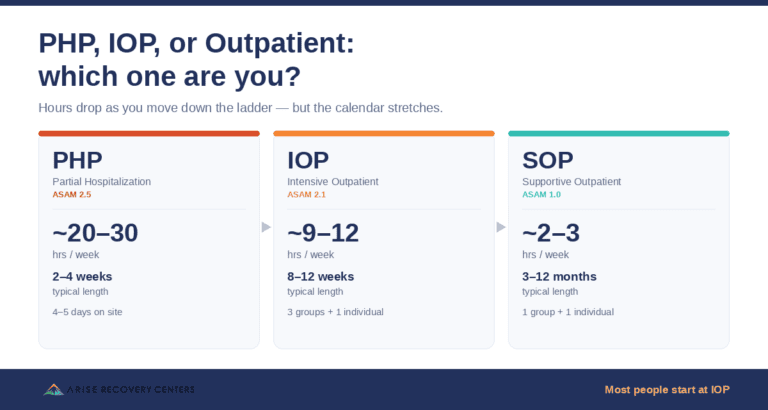
- PHP (~20–30 hrs/week) — you need daily structure and medical eyes on you, but your home is safe to sleep in.
- IOP (~9–12 hrs/week) — you’re medically stable and need real accountability that fits around a job or school. This is where most people start.
- Supportive outpatient (~2–3 hrs/week) — you’ve built something and you’re protecting it. Almost never the starting point.
- The heuristic: the right level is the least restrictive one where you can realistically stay sober and keep showing up. Not the cheapest. Not the most impressive.
The ladder, in plain numbers
| Level | Hours/week | Typical length | You sleep | Best for |
|---|---|---|---|---|
| InpatientASAM 3.x | 24/7 | 2–4 weeks | At the facility | Medical instability, active withdrawal, or an unsafe home |
| PHPASAM 2.5 | ~20–30 4–5 days |
2–4 weeks | At home | High acuity, needs daily structure, home is safe |
| IOPASAM 2.1 | ~9–12 3 groups + 1 individual |
8–12 weeks | At home | Medically stable, working or in school, needs real accountability |
| SOPASAM 1.5 | ~2–3 1 group + 1 individual |
3–12 months | At home | Step-down, maintenance, long-term relapse prevention |
Hours shown are Arise’s typical schedules. The ASAM Criteria set the boundaries more broadly: Level 2.1 (IOP) is defined as 9–19 hours of clinical services per week, Level 2.5 as 20 or more, and Level 1.5 (outpatient therapy) as fewer than 9. See our full breakdown of outpatient hours and length of stay.
A note on names and numbers. The ASAM Criteria were updated to a 4th Edition in 2023, and the labels shifted. What most people still call PHP is now formally High-Intensity Outpatient (Level 2.5); standard outpatient therapy moved from Level 1.0 to Level 1.5; and the new Level 1.0 is Long-Term Remission Monitoring — a maintenance level for people already in stable recovery, not an entry point. Many states, insurers, and programs are still mid-transition, so you’ll see both sets of numbers in the wild. We use the 4th Edition here.
Notice the shape: as you move down the ladder, hours drop but the calendar stretches. Intensity tapers; support lasts longer. The total number of care hours across levels is closer than people expect.
The six questions clinicians actually ask
The standard used across the industry is the ASAM Criteria (4th Edition, 2023), and it assesses you across six dimensions. Diagnosis alone doesn’t determine placement — the combined picture does. Worth knowing how the six split: dimensions 1 through 5 produce the level-of-care recommendation; dimension 6 is where the clinician works out which level you’re actually willing and able to do. That last one isn’t a formality — a perfect recommendation you won’t attend is worth nothing.
Here they are, translated out of clinical language, with what each answer tends to push you toward.
Walk through it yourself
1. What happens to your body when you stop? Withdrawal
Severe — shaking, sweating, seizure history, daily heavy alcohol or benzo use → detox first, then PHP or IOP
Moderate — uncomfortable but manageable, no medical danger → PHP or IOP
Minimal — cravings and low mood, no physical symptoms → IOP
2. What else is going on with your physical health? Biomedical
Unstable — liver disease, uncontrolled diabetes, pregnancy, recent hospitalization → higher level, medical oversight
Stable — managed conditions, nothing acute → IOP or SOP
3. What’s happening with your mental health? Psychiatric
Acute — suicidal thoughts, psychosis, severe untreated bipolar or PTSD → higher level, integrated care
Present but managed — depression or anxiety alongside the use → PHP or IOP with dual-diagnosis capability
Minimal → IOP or SOP
4. How risky is your current pattern of use? Risk
High — recent overdose, driving impaired, using alone, escalating amounts → PHP or higher
Moderate — regular use with real consequences, no immediate danger → IOP
Lower — early pattern, consequences still contained → IOP or SOP
5. What are you going home to every night? Environment
Unsafe — people using in the house, violence, homelessness, no transportation → residential or sober living alongside outpatient
Neutral or supportive — stable housing, at least one person in your corner → PHP, IOP, or SOP
6. What do you actually want, and what’s in the way? You
Ambivalent — here because someone else made you → more structure helps, not less
Motivated but constrained — job, kids, no childcare, no ride → IOP evenings or virtual IOP
Committed with a plan → the level that fits the other five answers
How to read your answers
Any single “higher level” answer outranks the rest. Placement isn’t an average — one severe dimension, especially withdrawal risk or acute psychiatric symptoms, sets the floor on its own.
Mostly middle answers? That’s IOP, and that’s most people who come straight to outpatient.
This is a map, not a diagnosis. It’s the same logic a clinician uses, but they’re trained to weigh it and you’re not. Use it to walk into the conversation informed — not to skip the conversation.
Three profiles, honestly drawn
You’re probably PHP
~20–30 hrs/week · 2–4 weeks
- You just finished detox or inpatient and you’re not steady yet
- Unstructured time is when things go wrong for you
- You have a psychiatric condition that needs frequent monitoring
- You’re on medical leave, between jobs, or can clear your calendar
- Home is safe — you just can’t be there alone all day
You’re probably IOP
~9–12 hrs/week · 8–12 weeks
- You’re medically stable and don’t need supervised withdrawal
- You have a job, school, or kids you’re not walking away from
- You’ve tried cutting back alone and it hasn’t held
- You have somewhere safe to sleep and at least one supportive person
- You need accountability three times a week, not five
You’re probably SOP
~2–3 hrs/week · 3–12 months
- You’ve completed PHP or IOP and you’re protecting the gains
- You’ve got months of stability, not weeks
- You want a standing check-in before small slips become big ones
- Your triggers are known and your coping plan is built
- Rarely the right starting point — it’s the tail, not the front door
The mistake almost everyone makes
People choose based on schedule convenience, then quietly discover the level was too light — and by then they’ve lost weeks and some confidence. It’s the most common self-selection error we see, and it’s understandable: nobody wants to disrupt their life more than necessary.
The overcorrection is just as costly, though. Choosing a level so intense you can’t sustain it — quitting your job for PHP when IOP would have worked — often ends in an early exit for reasons that have nothing to do with recovery.
The rule that resolves it
Pick the least restrictive level where you can honestly say you’ll stay sober and keep showing up. Both halves have to be true. If you can’t say both with a straight face, go up one.
And remember: levels are designed to move. Stepping up isn’t failure, and stepping down isn’t graduation. Roughly 4–6 months across the continuum is normal.
What matters more than the level you pick
Here’s the finding that should reframe this whole decision: the strongest predictor of a good outcome isn’t which rung you start on. It’s how long you stay on the ladder.
90 days
NIDA’s benchmark, stated plainly: “participation for less than 90 days is of limited effectiveness, and treatment lasting significantly longer is recommended for maintaining positive outcomes.”
And attrition is heaviest right at the front. Across psychosocial substance use treatment, roughly 30% of people leave before completing, with some studies finding more than half gone within the first month — which is to say, most dropout happens before the 90-day mark where the benefit starts compounding.
You’ll see specific one-year success percentages quoted all over this industry. We’re going to skip them, because no credible national figure exists: outcomes vary enormously by substance, co-occurring conditions, and how “success” gets defined, and most of the numbers circulating online trace back to marketing copy rather than research. What the evidence does support is directional and useful — staying longer is better, and leaving early is the main risk.
Which means the level of care that keeps you engaged for six months beats the more intensive one you abandon in three weeks. That’s not an argument for going light — it’s an argument for going honest about what you can actually sustain. Our deeper dive: does longer treatment actually work?
Medication is a separate lever from the level you pick — it can run alongside any rung on this ladder, and most people are never offered it. Only about 1.6% of adults with alcohol use disorder receive one of the three FDA-approved medications. A newer question is whether GLP-1 drugs belong in that conversation: here is what the 2026 research actually found.
Overrated vs. underrated: choosing a level
↓ Overrated
- Starting as high as possible. More hours isn’t more recovery if you can’t sustain them. Fit beats intensity.
- The facility’s amenities. Gyms and chef-prepared meals don’t appear in any outcome literature.
- The 30-day number. It’s an insurance and cultural artifact, not a clinical finding.
- Picking based on price. With insurance, your out-of-pocket max usually caps the difference anyway.
↑ Underrated
- Distance from your house. Proximity is one of the strongest predictors of who completes 40+ visits.
- The schedule that survives real life. An evening IOP you can attend beats a morning PHP you’ll miss.
- Dual-diagnosis capability. If depression, anxiety, or trauma is in the picture, treating one and not the other rarely holds.
- The step-down plan. What happens in month four is where most programs quietly stop caring — and where relapse lives.
What the actual assessment looks like
It’s a conversation, not a test. About 20 minutes, usually by phone. A licensed clinician asks about what you’re using and how much, your medical and psychiatric history, previous attempts to stop, your living situation, and your work or school schedule. Then they tell you the level they’d recommend and why.
Two things worth knowing going in. First: understating your use is the most common thing people do, and it’s the one thing that can produce a genuinely unsafe recommendation. The clinician isn’t grading you. Second: the recommendation is a recommendation. You can disagree, ask why, and ask what would change it.
If withdrawal risk is in the picture, that gets handled first — see do you need detox first?. Arise doesn’t run its own detox facility; we assess and place into a vetted network, then take over for the outpatient work afterward.
Arise has 12 locations across Dallas–Fort Worth, Houston, and Austin, plus virtual IOP for anyone whose nearest option is still too far. Given how much proximity affects completion, that’s not a small detail.
Still not sure which level fits?
A 20-minute call with a licensed clinician will tell you. Free, confidential, no obligation.
Level of care decides the schedule; your insurance decides the bill. Does rehab count toward your deductible and out-of-pocket max? covers what you actually owe at each stage and when your plan takes over completely.
Levels of care are a dial, not a ladder. After a slip, stepping up for a few weeks and then back down is the normal move; the three stages of relapse explains when to make that call.
Frequently asked questions
What level of care do I need for addiction treatment?
It depends on six factors clinicians assess together: withdrawal risk, physical health, mental health, how risky your current use pattern is, your living environment, and your own goals and obstacles. Most people who come straight to outpatient start at IOP — defined by ASAM as 9–19 hours a week, and typically 9–12 at Arise. PHP (20+ hours) is for higher acuity or step-down from detox or inpatient. Supportive outpatient (under 9 hours, typically 2–3) is almost always a step-down, not a starting point.
What’s the difference between PHP and IOP?
Hours and intensity. PHP (ASAM Level 2.5) requires at least 20 hours a week — typically 20–30 across 4–5 days for 2–4 weeks. IOP (Level 2.1) is defined as 9–19 hours a week; at Arise it runs about 9–12, across 3 group sessions plus an individual session, typically for 8–12 weeks. Both let you sleep at home. PHP suits people who need daily structure and closer monitoring; IOP is built to fit around work and school. Full comparison: IOP vs. PHP.
Do I have to start at PHP and work down?
No. That’s a common misconception. Most people entering outpatient directly start at IOP. The step-down sequence (detox → PHP → IOP → SOP) applies when you’re coming from a higher level of care or entering with high acuity.
Can I do IOP while working full-time?
Yes — that’s what IOP is designed for. Most programs, including ours, run morning and evening tracks so sessions fall outside standard work hours. PHP is harder to combine with full-time work and often pairs with short-term leave or FMLA.
How do I know if I’m choosing a level that’s too low?
Warning signs: you’re picking it mainly because it’s convenient rather than because it fits; you have withdrawal symptoms you’re minimizing; you’re going home to an environment where people are using; or you’ve already tried this level and it didn’t hold. Any of those is a reason to go up a level or ask for reassessment.
What is the ASAM Criteria?
The American Society of Addiction Medicine’s standard for matching people to levels of care, now in its 4th Edition (2023). It assesses six dimensions — withdrawal and medication needs, physical health, psychiatric and cognitive conditions, substance use-related risks, recovery environment, and person-centered considerations — rather than basing placement on diagnosis alone. Dimensions 1–5 drive the level recommendation; dimension 6 addresses what the patient is willing and able to engage in. Most insurers use it to authorize treatment.
Is PHP the same as ASAM Level 2.5?
Yes, though the name changed. The ASAM Criteria 4th Edition renamed Level 2.5 from “Partial Hospitalization” to “High-Intensity Outpatient,” because most programs at that level aren’t hospital-based. Level 2.1 remains Intensive Outpatient. Standard outpatient therapy moved from Level 1.0 to Level 1.5, and the new Level 1.0 is Long-Term Remission Monitoring — a maintenance level, not an entry point. Many payers and state agencies are still transitioning, so both numbering systems are currently in circulation.
Does insurance cover PHP and IOP?
Most commercial plans, Medicare, Medicaid, and TRICARE cover medically necessary PHP and IOP, typically authorized in increments with periodic review. Federal parity law requires substance use benefits to be comparable to medical benefits. Verify your benefits to see your specific coverage.
Can I switch levels once I’ve started?
Yes, and it’s normal. Levels are designed to move in both directions based on ongoing reassessment. Stepping up when things get harder isn’t failure — it’s the system working the way it was built to.
Sources: The ASAM Criteria, 4th Edition (2023) — continuum of care and the six dimensions of multidimensional assessment; SAMHSA TIP 47 — Intensive Outpatient Treatment; NIDA, Principles of Drug Addiction Treatment, 3rd Edition; CMS CY2024 OPPS Final Rule (PHP/IOP weekly-hour minimums); Lappan et al., Dropout rates of in-person psychosocial substance use disorder treatments: a systematic review and meta-analysis, Addiction, 2020. Compiled August 2026.