

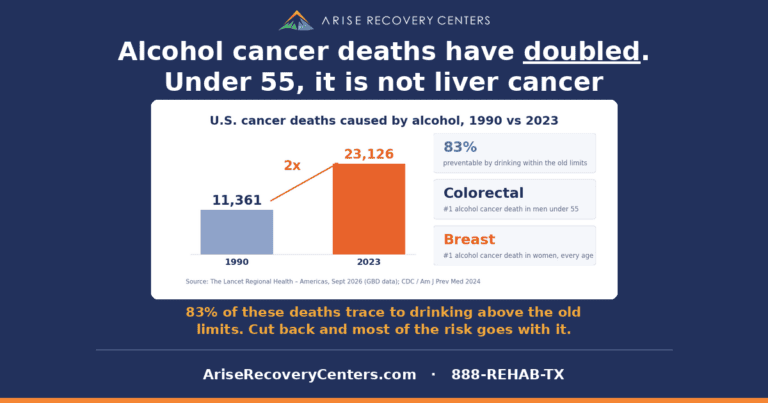
Ask most people which cancer alcohol causes and they will say liver. That answer is thirty years out of date for anyone under 55.
A study published September 2 in The Lancet Regional Health – Americas counted every U.S. cancer death that traces to alcohol from 1990 through 2023. The total doubled, from 11,361 a year to 23,126. And in adults aged 20 to 54, the cancer doing the killing is not liver. For men it is colorectal. For women it is breast.
The part worth reading to the end for: most of these deaths are preventable, and not by quitting. By drinking less.
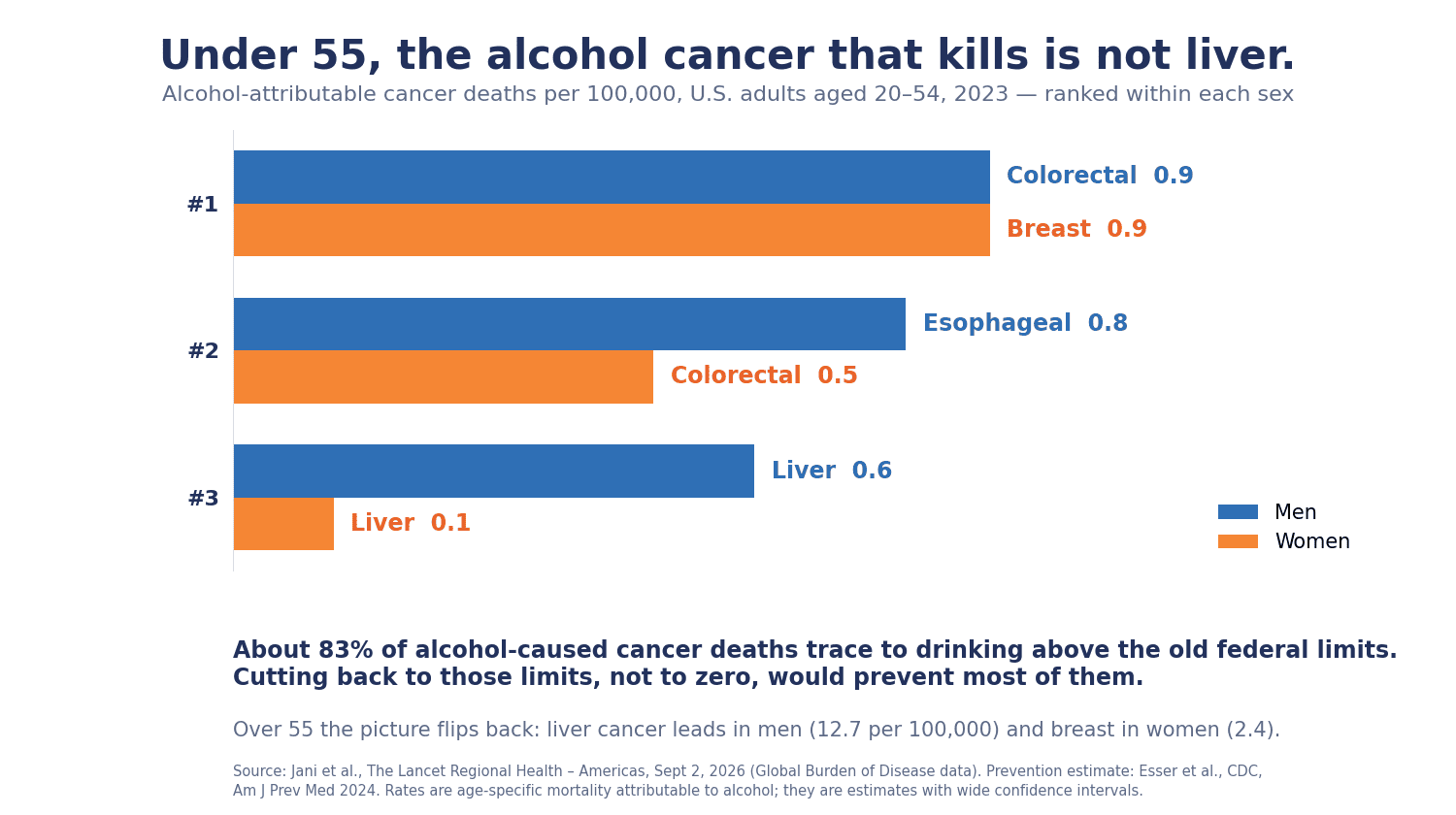
Alcohol-attributable cancer deaths per 100,000, ages 20–54, 2023. Source: The Lancet Regional Health – Americas, September 2026 (Global Burden of Disease data).
The short version
• U.S. cancer deaths caused by alcohol doubled between 1990 and 2023, from 11,361 to 23,126 a year.
• In adults under 55, colorectal cancer is now the leading alcohol-caused cancer death in men, ahead of esophageal and liver. In women under 55, breast cancer leads, with colorectal second.
• Liver cancer still dominates over 55, and men carry three-quarters of all these deaths.
• A CDC analysis estimates about 83% of alcohol-caused cancer deaths could be prevented if people drinking above the old federal limits cut back to them. Not to zero. To two a day for men, one for women.
• Fewer than half of Americans know alcohol causes cancer at all.
What the study counted
The research team, led by Dr. Chinmay Jani at the University of Miami’s Sylvester Comprehensive Cancer Center, used the Global Burden of Disease database to estimate how many U.S. cancer deaths each year are attributable to alcohol. They tracked ten cancers across 33 years, split by sex, by age (20 to 54 versus 55 and older), and by state.
“Attributable” means the share of deaths that would not have happened without alcohol, based on the known risk at each level of drinking. It is an estimate, and the authors say so. But the direction is not in doubt, and the 2023 figure lines up with a separate CDC estimate of about 20,000 a year.
11,361 → 23,126
U.S. cancer deaths attributable to alcohol, 1990 to 2023. Liver (7,686), esophageal (4,902), and colorectal (3,818) were the top three in 2023.
Three findings matter for anyone still working, raising kids, and assuming this is a problem for later.
Under 55, it is a different disease
The study splits every result at age 55. Above that line, the picture is what you would expect. Liver cancer leads in men by a wide margin, and older adults carry most of the total.
Below that line the ranking flips.
| Ages 20–54, 2023 | Men | Women |
|---|---|---|
| #1 alcohol-caused cancer death | Colorectal (0.9 per 100k) | Breast (0.9 per 100k) |
| #2 | Esophageal (0.8) | Colorectal (0.5) |
| #3 | Liver (0.6) | Liver (0.1) |
The authors put it plainly: colorectal cancer “was the leading alcohol-attributable cause of death among younger males,” and in younger women it “ranked second, surpassing liver cancer.”
This tracks with something oncologists have been watching for a decade. Colorectal cancer in people under 50 is rising, and the study notes alcohol has been “consistently linked” to it. Large cohort studies cited in the paper found that higher drinking in early adulthood, even below about one drink a day, raised colorectal risk later in life.
What this means practically
If you are 35 and drink, the cancer to think about is the one you are not thinking about. Colorectal screening now starts at 45. If you drink above the old limits, that is a conversation to have with your doctor earlier, not later.
Breast cancer, and why one drink a day matters
For women, breast cancer is the leading alcohol-caused cancer death at every age. The paper cites research showing risk rises at intake “as low as 5–15 grams a day.” A standard drink is 14 grams. In other words, the risk starts inside what used to be the recommended limit.
We wrote about this last week in the context of why the same drinking does more damage to women. This study is the mortality side of that story.
The number that should change behavior
Here is the fact that gets buried under the scary ones. A 2024 analysis by CDC researchers, published in the American Journal of Preventive Medicine, asked a simple question: how many of these deaths would disappear if the people drinking above the federal limits cut back to them?
The answer was about 16,800 of 20,216 deaths a year. Eighty-three percent.
Not by quitting. By coming down to two drinks a day for men and one for women. Going from two to one for men prevented only about 650 more. The damage is concentrated at the top of the curve, which is exactly where most of the people reading this can move.
That matches what the federal alcohol study the government shelved found days earlier: the risk curve is steep, so every drink cut from the heavy end counts more than the last.
Why nobody told you
In January 2025 the U.S. Surgeon General issued a formal advisory calling alcohol the third leading preventable cause of cancer, behind tobacco and obesity, and recommended a cancer warning on the label. Fewer than half of Americans knew there was any link. The label has not happened, and the 2025–2030 Dietary Guidelines released in January dropped the drink limits and never mention cancer.
So the awareness gap is real, and it is not your fault. Alcohol’s cancer risk has been established science for decades. It has simply never been printed anywhere you would see it.
What to actually do with this
- Know your number. Count a real week. If you are above 14 drinks as a man or 7 as a woman, you are in the group where 83% of these deaths come from.
- Cut from the top, not to zero. The data says the biggest gain is getting under the old limits. Zero is better still, but the first drinks you cut do the most work.
- Get the colonoscopy. Screening starts at 45 for everyone. If you drink heavily and have a family history, ask about earlier.
- Women: treat one a day as a ceiling. Breast cancer risk rises from the first drink.
- If cutting back keeps not working, that is information. Wanting to drink less and not being able to is the most common reason people call us, and it is very treatable without leaving your life.
One safety note that matters
If you drink heavily every day, do not stop abruptly on your own. Alcohol is one of the few drugs where unmanaged withdrawal can be dangerous. Talk to a medical professional first about how to come down safely. This guide to whether you need detox walks through the signs.
Age matters here too. A September 2026 study found heavy drinking among adults 50 to 64 rose more than 36% since 2018, even as it fell nationally. Here is what that study found, and why the same drinks hit harder after 50.
Where this leaves you
Twenty-three thousand people a year die of a cancer alcohol gave them, and for the ones under 55 it is increasingly a cancer they never associated with drinking. The same research says four out of five of those deaths trace to drinking above a limit most people could get under.
Frequently asked questions
Does alcohol cause colon cancer?
Yes. Alcohol is an established cause of colorectal cancer, and a September 2026 study in The Lancet Regional Health – Americas found colorectal cancer is now the leading alcohol-attributable cancer death in U.S. men aged 20 to 54 and the second in women that age. Cohort studies cited in the paper link higher drinking in early adulthood, even below one drink a day, to higher colorectal risk later in life.
How many cancer deaths are caused by alcohol in the U.S.?
About 23,126 in 2023, according to the Lancet Regional Health analysis of Global Burden of Disease data, up from 11,361 in 1990. A separate CDC analysis estimated about 20,216 alcohol-attributable cancer deaths a year in 2020–2021. Liver, esophageal, and colorectal cancers account for the most deaths overall.
Which cancers does alcohol cause?
The U.S. Surgeon General’s January 2025 advisory identified at least seven: breast (in women), colorectal, esophageal, liver, mouth, throat, and voice box. The Lancet Regional Health study also found rising alcohol-attributable deaths from pancreatic, stomach, and prostate cancers.
Can cutting back on drinking reduce cancer risk, or do I have to quit?
Cutting back helps substantially. CDC researchers estimated in 2024 that about 83% of alcohol-attributable cancer deaths, roughly 16,800 a year, could be prevented if adults drinking above the former Dietary Guidelines limits reduced to two drinks a day for men or one for women. Quitting lowers risk further, but the largest gain comes from leaving the heavy end.
Does one drink a day increase breast cancer risk?
Yes. The Lancet Regional Health paper cites research showing breast cancer risk rises at intakes as low as 5 to 15 grams of alcohol a day, and a standard drink contains 14 grams. Breast cancer is the leading alcohol-attributable cancer death in U.S. women at every age.
Why is liver cancer not the top alcohol cancer for younger adults?
Liver cancer from alcohol usually reflects decades of cumulative damage, so it dominates after 55. In adults 20 to 54, colorectal cancer in men and breast cancer in women cause more alcohol-attributable deaths, and early-onset colorectal cancer has been rising for reasons researchers are still working out, with alcohol among the consistent links.
Is it dangerous to stop drinking suddenly?
It can be for people who drink heavily every day. Alcohol is one of the few substances where unmanaged withdrawal can cause seizures and other medical emergencies. If you drink daily, talk to a medical professional before stopping so it can be done safely. That is not a reason to postpone. It is a reason to make one call first.
Can I get help cutting back without going to inpatient rehab?
For most people, yes. Outpatient treatment lets you keep working and keep parenting while you get care, with day and evening groups scheduled around your life. Arise Recovery Centers provides partial hospitalization, intensive outpatient, and supportive outpatient programs at twelve locations in Texas. An assessment determines the right starting level for your drinking history and medical picture.
Getting help
Arise Recovery Centers provides outpatient alcohol and drug treatment across Texas — day programs, intensive outpatient, and supportive outpatient — at 12 locations in DFW, Houston, and Austin, with evening groups so people can keep working and keep parenting. If you are not sure whether what you are describing is a problem, this guide to levels of care walks through it, and you can verify your insurance online in about two minutes. It is confidential and does not commit you to anything. If alcohol has become a problem, reach out to us, or our mental health partner, Saltwood Mental Health, today.
Sources
- Jani CT, et al. “Alcohol-attributable cancer mortality in the United States, 1990–2023: a secondary analysis of Global Burden of Disease data.” The Lancet Regional Health – Americas, published September 2, 2026. DOI 10.1016/j.lana.2026.101599.
- Esser MB, Sherk A, Liu Y, et al. “Reducing Alcohol Use to Prevent Cancer Deaths: Estimated Effects Among U.S. Adults.” American Journal of Preventive Medicine, 2024;66(4):725–729.
- Hur J, Smith-Warner SA, Rimm EB, et al. “Alcohol intake in early adulthood and risk of colorectal cancer: three large prospective cohort studies of men and women in the United States.” European Journal of Epidemiology, 2021;36(3):325–333.
- Office of the U.S. Surgeon General, Alcohol and Cancer Risk: The U.S. Surgeon General’s Advisory, January 3, 2025.
- U.S. Departments of Health and Human Services and Agriculture, Dietary Guidelines for Americans, 2025–2030, released January 7, 2026.
- University of Miami Miller School of Medicine, news release on the study, September 2, 2026.
This article is for general information and is not medical advice. If you are concerned about your drinking or someone else’s, speak with a qualified clinician.