

In 2023 the federal government hired a panel of scientists to answer one question: how much alcohol is safe? Their report was supposed to shape the 2025–2030 Dietary Guidelines.
It never got there. The study was shelved, a congressional committee called it biased, and when the new guidelines came out in January they contained no number at all.
On June 9, 2026, the scientists published it anyway, in the Journal of Studies on Alcohol and Drugs. Here is what the government did not want to print, and what to do with it.
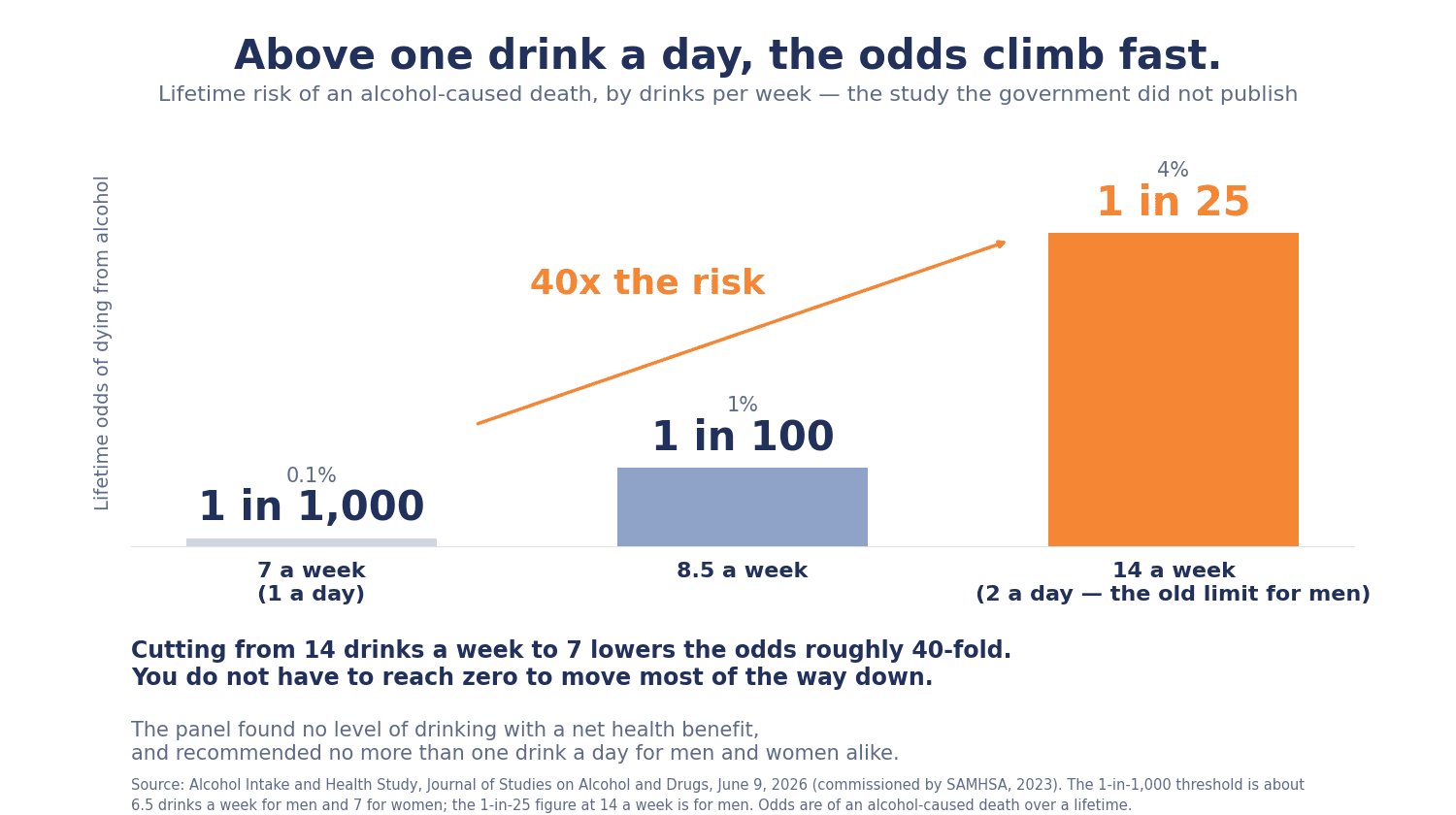
Lifetime risk of an alcohol-caused death at each level of drinking. The 14-a-week figure is for men. Source: Alcohol Intake and Health Study, JSAD, June 2026.
The short version
• The study found no level of drinking with a net health benefit. Not one a day, not red wine.
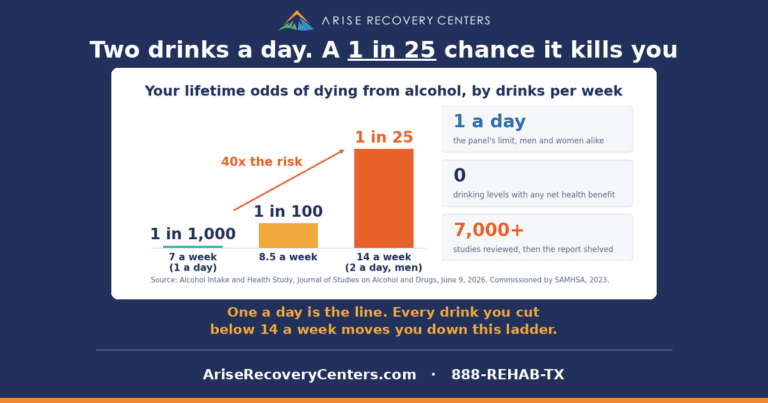
• At about 7 drinks a week, the lifetime odds of dying from alcohol are roughly 1 in 1,000. At 8.5 a week they reach 1 in 100. At 14 a week, the old “moderate” limit for men, they reach 1 in 25.
• The panel’s recommendation: no more than one drink a day, for men and women alike. That is half the old limit for men.
• The January 2026 Dietary Guidelines dropped every number and now say only “consume less alcohol.”
• The practical part: the risk curve is steep, which means cutting back pays off fast. Going from 14 drinks a week to 7 moves your odds from 1 in 25 to 1 in 1,000.
What the study actually did
The Alcohol Intake and Health Study was commissioned by the Substance Abuse and Mental Health Services Administration in 2023. A six-member panel screened more than 7,000 published studies on alcohol and disease, then applied the strongest evidence to national death records. The panel included Kevin Shield of the University of Toronto and Timothy Naimi of the University of Victoria.
The question they set out to answer was not “is alcohol bad.” It was narrower and more useful: at each level of drinking, what are your lifetime odds of dying because of it?
Three findings matter most.
There was no protective effect at low levels. For decades the idea that a daily glass of wine helps your heart shaped both public opinion and official limits. The panel found that any cardiovascular benefit at low doses was outweighed by cancer and other disease. Net effect: zero.
Risk starts climbing above one drink a day. The conditions driving it at that level were liver cirrhosis, cancers of the mouth and esophagus, and injuries. In women, breast cancer risk rose with each additional drink.
The curve is steep. For men, the difference between seven drinks a week and fourteen is not double the risk. It is roughly forty times the risk.
What this means practically
The steepness is the good news, not the bad news. Nobody has to get to zero to get most of the benefit. Someone drinking two a day who gets to one a day has moved from a 1-in-25 risk to about 1-in-1,000. That is the single biggest health improvement most heavy drinkers have available to them.
How the report got buried
- 2023 — SAMHSA commissions the study to inform the next Dietary Guidelines. Congress separately pays the National Academies of Sciences $1.3 million for its own review.
- December 2024 — The National Academies review comes out first. It finds moderate drinkers have a 16% lower risk of death from any cause than never-drinkers, and a 10% higher risk of breast cancer.
- January 2025 — The panel’s draft report is released for comment. Industry groups and several members of Congress had already accused the panel of an “anti-alcohol bent.”
- January 7, 2026 — Two things happen the same day. The House Oversight Committee publishes a report calling the study duplicative and biased. And the new Dietary Guidelines are released with the drink limits deleted.
- June 9, 2026 — The authors publish the study in a peer-reviewed journal, without government attribution. HHS says the published version differs from the draft it commissioned.
The two federal reviews reached different conclusions, and it is fair to say why. The National Academies review compared moderate drinkers with people who never drink, and measured death from any cause. The Alcohol Intake and Health Study measured deaths caused by alcohol specifically, at each dose. The first approach has a known weakness: many “never drinkers” are people who quit because they were already sick, which makes drinkers look healthier by comparison.
Reasonable scientists disagree about that. What nobody disputes is the direction: every review, including the one industry preferred, found that risk rises with each drink above a low level. The argument is about where the line sits, not whether there is one.
What the guidelines say now
From 1990 until this January, the federal limit was two drinks a day for men and one for women. The 2025–2030 Dietary Guidelines replaced that with one sentence:
“Consume less alcohol for better overall health.”
No number. No definition of a standard drink. No mention of cancer, which the U.S. Surgeon General had called out in a formal advisory a year earlier.
Reuters reported in January that HHS staff had drafted the opposite change, cutting the men’s limit to one drink a day, and that the proposal did not survive. That is the same number the buried study recommends.
We are a treatment provider, not a policy shop. But here is the practical problem with “less.” Less than what? When the official number disappears, people do not drink less. They keep drinking whatever they already believed was fine.
The number to use
Taking the buried study at face value, the line is simple:
- One drink a day, for everyone. Not two for men. Below that line, the study found the lifetime risk stays small.
- Count by the week. Seven is the ceiling. Fourteen is where the odds hit 1 in 25 for men, and the same study found women drinking at that level face more than twice the relative risk of dying from liver disease that men do.
- One drink means one standard drink. 12 oz of 5% beer, 5 oz of wine, 1.5 oz of spirits. A 16 oz craft IPA is two. A generous home pour of wine is often two.
- If you are over the line, every drink you cut counts. The curve is steep in both directions. You do not need to reach zero to move most of the way down it.
If you count your week honestly and land at 14 or more, that is worth taking seriously. It is also very treatable, and most people who address it do so without ever going to a hospital. These are the signs that drinking has moved past a habit, and here is why the same drinking does more damage to women.
One safety note that matters
If you drink heavily every day, do not stop abruptly on your own. Alcohol is one of the few drugs where unmanaged withdrawal can be dangerous. Talk to a medical professional first about how to come down safely. It is a conversation measured in days, and this guide to whether you need detox walks through the signs.
The cancer side of this curve is now measured too: U.S. cancer deaths caused by alcohol have doubled since 1990, and under 55 the killer is colorectal and breast cancer, not liver. That study is covered here.
One group is moving the wrong way. Heavy drinking among adults 50 to 64 is up more than 36% since 2018, even as the rest of the country cuts back.
Where this leaves you
The government paid for a number, did not like it, and deleted the old one instead of printing the new one. The number is still there. One drink a day. Above it the odds climb fast, and below it they fall just as fast.
That second half is the part worth remembering. The steepness of the curve is exactly why cutting back, or getting help to cut back, is worth doing this week rather than someday. For some people, non-alcoholic beer makes cutting back easier.
Frequently asked questions
How many drinks a week is safe?
The Alcohol Intake and Health Study, published in June 2026, found no level of drinking with a net health benefit, and recommended no more than one drink a day for adults who drink. At about seven drinks a week the lifetime odds of dying from alcohol were roughly 1 in 1,000. At 14 a week they reached 1 in 25 for men. Seven a week is the most defensible ceiling available.
Is one drink a day bad for you?
According to the study, one drink a day carries a small but real risk, roughly a 1 in 1,000 lifetime chance of an alcohol-caused death, with no offsetting benefit. Risk rises steadily above that level, driven at first by liver cirrhosis, mouth and esophageal cancers, and injuries. The panel treated one a day as a ceiling for people who drink, not a recommendation to drink.
What is the Alcohol Intake and Health Study?
It is a federal review commissioned by SAMHSA in 2023 to inform the 2025–2030 Dietary Guidelines. A six-member scientific panel screened more than 7,000 studies and modeled lifetime death risk at each level of drinking. The Trump administration did not release the final report. The authors published it independently in the Journal of Studies on Alcohol and Drugs on June 9, 2026.
Why did the government not release the alcohol study?
The House Oversight Committee issued a report on January 7, 2026 calling the study duplicative of a separate National Academies review and arguing the panel was biased toward an anti-alcohol conclusion. The alcohol industry had campaigned against the draft since it appeared in January 2025. HHS has said its guidelines are driven by evidence; the study’s authors say the findings are rigorous.
What do the 2026 Dietary Guidelines say about alcohol?
The 2025–2030 Dietary Guidelines, released January 7, 2026, removed the limits of two drinks a day for men and one for women that had stood since 1990. The only guidance now is to “consume less alcohol for better overall health,” with no numeric limit and no definition of a standard drink.
Does moderate drinking protect your heart?
The two most recent federal reviews disagree. The National Academies review found moderate drinkers had 16% lower all-cause mortality than never-drinkers. The Alcohol Intake and Health Study found any cardiovascular benefit at low doses was outweighed by cancer and other disease, for no net benefit. Both reviews agreed risk rises with each drink above a low level.
Is it dangerous to stop drinking suddenly?
It can be for people who drink heavily every day. Alcohol is one of the few substances where unmanaged withdrawal can cause seizures and other medical emergencies. If you drink daily, talk to a medical professional before stopping so it can be done safely. That is not a reason to postpone quitting. It is a reason to make one call first.
Can I get treatment for drinking without going to inpatient rehab?
For most people, yes. Outpatient treatment lets you keep working and keep parenting while you get care, with day and evening groups scheduled around your life. Arise Recovery Centers provides partial hospitalization, intensive outpatient, and supportive outpatient programs at twelve locations in Texas. An assessment determines the right starting level for your drinking history and medical picture.
Getting help
Arise Recovery Centers provides outpatient alcohol and drug treatment across Texas — day programs, intensive outpatient, and supportive outpatient — at 12 locations in DFW, Houston, and Austin, with evening groups so people can keep working and keep parenting. If you are not sure whether what you are describing is a problem, this guide to levels of care walks through it, and you can verify your insurance online in about two minutes. It is confidential and does not commit you to anything. If your relationship with drinking is becoming more challenging, reach out to us or our mental health partner, Saltwood Mental Health, today.
Sources
- Shield K, Naimi TS, et al. “Alcohol Intake and Health Study: No Protective Effect at Low Levels, With Mortality Increasing to 1 in 25 at 14 Drinks Per Week.” Journal of Studies on Alcohol and Drugs, Vol. 87, No. 4, published June 9, 2026. DOI 10.15288/jsad.25-00435.
- Public Health Institute, press release on the study, June 9, 2026.
- National Academies of Sciences, Engineering, and Medicine, Review of Evidence on Alcohol and Health, December 2024.
- U.S. House Committee on Oversight and Government Reform, report on the Alcohol Intake and Health Study, January 7, 2026.
- U.S. Departments of Health and Human Services and Agriculture, Dietary Guidelines for Americans, 2025–2030, released January 7, 2026.
- STAT News, “Suppressed federal report found no net health benefit from alcohol,” June 9, 2026. Associated Press, “Government-commissioned alcohol study released independently,” June 9, 2026.
- Reuters, “Exclusive: The Trump Administration killed a draft proposal to halve alcohol limits, sources say,” January 8, 2026.
- Centers for Disease Control and Prevention, standard drink sizes.
This article is for general information and is not medical advice. If you are concerned about your drinking or someone else’s, speak with a qualified clinician.