

By Danny Andino, CEO, Arise Recovery Centers · Clinically reviewed by Nicholas Overbeck, LPC-S, LCDC · November 2026 · In the News
At most checkups now, someone asks how much you drink. Maybe it is a line on the intake form. Maybe a nurse asks three quick questions. Then the visit moves on.
A new national study shows how often it stops right there. Most adults who see a doctor get asked about alcohol. Almost nobody who drinks heavily hears the next part: a short talk about cutting back.
The short version
- 69% of U.S. adults who saw a health care provider in the past year were asked about their drinking. That comes from a study of 139,532 adults published in the journal Addiction in October 2026.
- Only about 4% of people who drink heavily said a provider advised them to cut back. That is fewer than 1 in 20.
- Women were about half as likely as men to get that advice, even though women saw doctors more often.
- The short talk works. In trials reviewed by the U.S. Preventive Services Task Force, it usually took one visit and about 30 minutes, and 14% more people got their drinking back within recommended limits.
- Most health plans cover alcohol screening and counseling at no cost. You do not have to wait to be asked. You can bring it up yourself.
What the new alcohol screening study found
Researchers at RTI International used three years of the National Survey on Drug Use and Health, 2022 through 2024. It is the federal government’s largest survey on drinking and drug use. Their study covered 139,532 adults.
They tracked the steps doctors are supposed to follow, often called SBIRT: screening, brief intervention and referral to treatment. In plain terms: Were you asked about alcohol? If you drink heavily, were you told to cut back? Were you pointed to treatment? Did you get it?
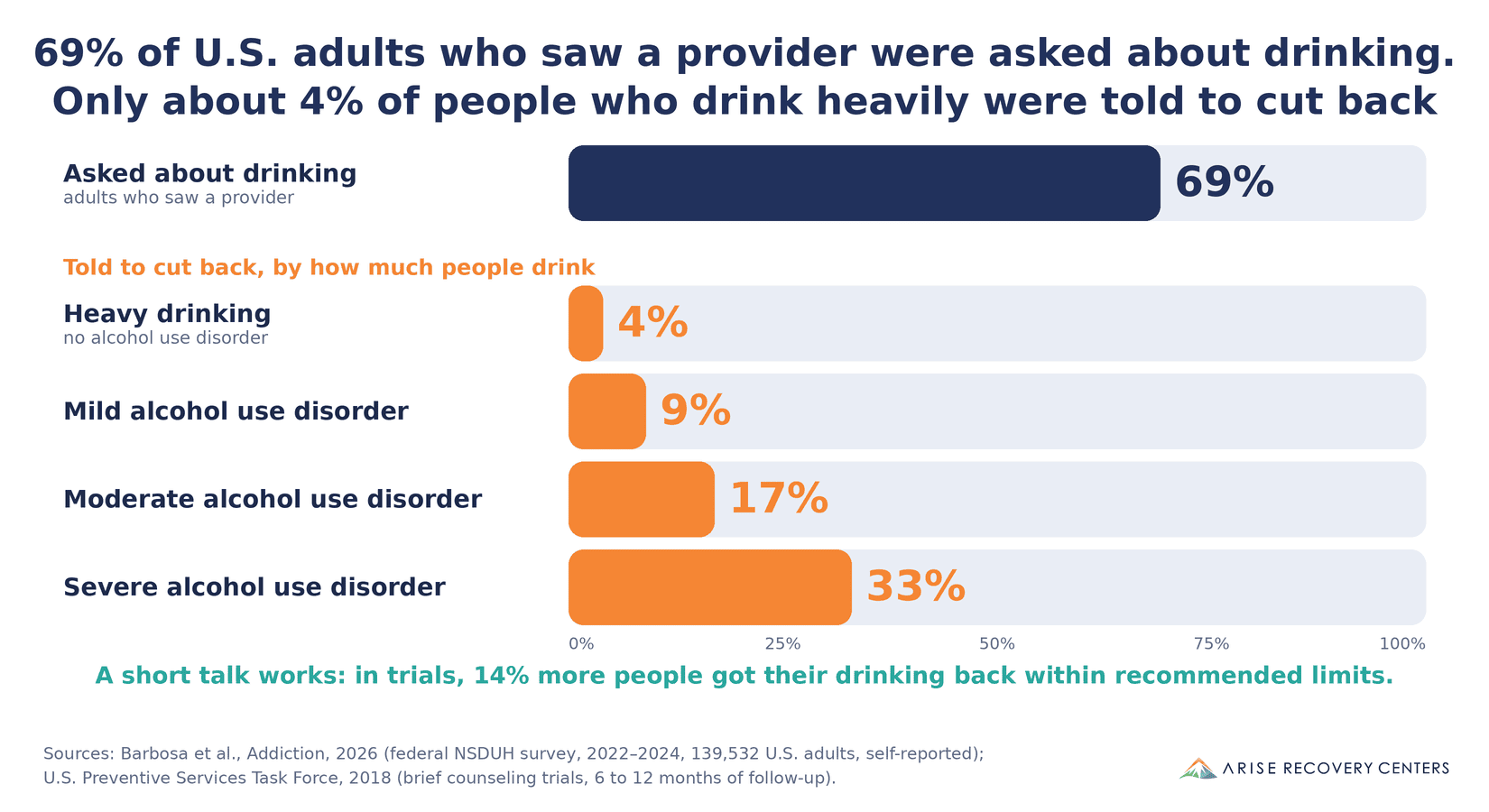
The first step mostly happens. About 81% of adults saw a provider in the past year, and 69% of them were asked about drinking. People with severe alcohol use disorder were asked most often, 89% of the time.
The second step is where it falls apart. Only about 4% of people who drink heavily, but do not have an alcohol use disorder, said a provider advised them to cut back. Even among people with a severe alcohol use disorder, only about 1 in 3 got that advice.
Who gets skipped most
- Women. Women saw doctors more often than men. They were still about half as likely to be told to cut back. Women with an alcohol use disorder were also less likely to be referred to treatment. That gap matters, because alcohol deaths among young women have climbed fast.
- Adults 50 and older. They were a little less likely to be asked about drinking at all.
- Black and Hispanic adults. Both groups were less likely to be screened than white adults, especially if they drank heavily.
The study measured the gaps, not the reasons. One of the study’s authors, Katherine Karriker-Jaffe of RTI, put it plainly: screening alone is not enough.
Why the skipped conversation matters
The talk that gets skipped is not a lecture. In the trials the U.S. Preventive Services Task Force reviewed, most were a single session. The typical total time was about 30 minutes.
It still works. Six to 12 months later, people who got it drank about 1.6 fewer drinks a week. They had fewer heavy drinking episodes. And 14% more of them were drinking within recommended limits.
Here is the rule of thumb. For every 7 people who get that short talk, about 1 more gets their drinking back within limits.
Timing matters too. The study’s authors called people who drink heavily, but do not yet have an alcohol use disorder, a key chance for prevention. That is exactly the group that almost never hears the advice.
One short talk can change how much you drink.
For every 7 people who get brief counseling about alcohol, about 1 more gets back within recommended limits (U.S. Preventive Services Task Force, 2018).
Overrated vs. underrated
Overrated
- Waiting for your doctor to bring it up. Fewer than 1 in 20 people who drink heavily hear the advice.
- Shaving a few drinks off your answer. The screen only helps if the numbers are real.
- “It’s only a problem if it’s every day.” In the federal survey, heavy drinking means binge drinking on 5 or more days in a month. Not daily.
Underrated
- Bringing it up yourself. One honest sentence opens the door.
- The three-question check. It takes about a minute, and you can do it before your visit. It is below.
- Your insurance. Alcohol screening and counseling are on the federal list of preventive services. Marketplace plans and many others cover them at no cost in network.
- Asking about medicine. Naltrexone and acamprosate are FDA-approved for alcohol use disorder, and few people who could use them get them.
Check yourself: the three alcohol screening questions doctors use
Many clinics use a short screen called the AUDIT-C. It is public, and you can score it yourself. Pick one answer for each question and add up the points.
| Question | Answer and points |
|---|---|
| 1. How often do you have a drink containing alcohol? | Never0Monthly or less12–4 times a month22–3 times a week34 or more times a week4 |
| 2. How many standard drinks containing alcohol do you have on a typical day? | 1 or 203 or 415 or 627 to 9310 or more4 |
| 3. How often do you have six or more drinks on one occasion? | Never0Less than monthly1Monthly2Weekly3Daily or almost daily4 |
Scoring: a total of 4 or more for men, or 3 or more for women, is a positive screen. It means your drinking is worth a conversation, not that you have a diagnosis. A standard drink is 12 ounces of beer, 5 ounces of wine or 1.5 ounces of liquor. Sources: Bush et al., Archives of Internal Medicine, 1998; U.S. Preventive Services Task Force, 2018; NIAAA.
What to say at your next visit
You do not need the perfect words. Any one of these works:
- “I’ve been drinking more than I’d like. Can we talk about it?”
- “I scored a 5 on that three-question alcohol check. What do you make of that?”
- “What would you suggest: cutting back on my own, medicine or a program?”
Your doctor can only respond to what they know. Starting the conversation yourself is the fastest way past the gap this study found.
When cutting back isn’t working
Advice to cut back is the right first step for a lot of people. If you have tried and it keeps sliding back, that is useful information, not a failure. It usually means you need more support than one conversation can give.
Outpatient treatment gives you that support while you keep working and living at home. Arise Recovery Centers provides outpatient drug and alcohol treatment at 12 locations in DFW, Houston and Austin: a day program, intensive outpatient and supportive outpatient.
Not sure where your drinking falls? Here are the signs of alcohol use disorder. This guide to levels of care explains the options. You can schedule a free consultation or verify your insurance online in about two minutes. Both are confidential and do not commit you to anything.
Safety note: If you drink heavily every day, talk with a doctor before you stop. Alcohol withdrawal can be dangerous, and medical support makes it safer. Here is why you should never quit alcohol cold turkey on your own.
Frequently asked questions
Why does my doctor ask how much I drink?
Because national guidelines tell them to. The U.S. Preventive Services Task Force recommends that primary care providers screen all adults for unhealthy drinking and offer brief counseling to people who drink at risky levels. In a 2026 national study, 69% of adults who saw a provider said they were asked.
What is the AUDIT-C alcohol screening test?
The AUDIT-C is a three-question alcohol screen used in many clinics. It asks how often you drink, how many drinks you have on a typical day, and how often you have six or more at once. Each answer scores 0 to 4. A total of 4 or more for men, or 3 or more for women, is a positive screen. It is a screen, not a diagnosis.
What counts as heavy drinking?
The federal survey used in the study defines binge drinking as 5 or more drinks for men, or 4 or more for women, on one occasion. Heavy drinking means binge drinking on 5 or more days in the past month. A standard drink is 12 ounces of beer, 5 ounces of wine or 1.5 ounces of liquor.
Does talking to a doctor about drinking actually help?
Yes. In trials reviewed by the U.S. Preventive Services Task Force, brief counseling usually took one session and about 30 minutes. Six to 12 months later, people drank about 1.6 fewer drinks a week, and 14% more were drinking within recommended limits.
Is alcohol screening covered by insurance?
Usually, yes. Alcohol misuse screening and counseling is on the federal list of preventive services. HealthCare.gov says Marketplace plans and many other plans must cover it at no cost when you see an in-network provider, even before you meet your deductible.
Why didn’t my doctor say anything about my drinking?
The 2026 study did not measure the reasons. It did find that silence is common: only about 4% of people who drink heavily said a provider advised them to cut back. If you want that conversation, you can start it.
How do I bring up my drinking with my doctor?
Keep it short and honest. Try: “I’ve been drinking more than I’d like. Can we talk about it?” Then ask what they would suggest, whether that is cutting back on your own, medicine or a treatment program.
Where can I get outpatient alcohol treatment in Texas?
Arise Recovery Centers offers a day program, intensive outpatient and supportive outpatient at 12 locations in DFW, Houston and Austin. A free consultation is confidential and does not commit you to anything.
This article is education, not medical advice.
Sources: Barbosa C, Dowd W, Rodriguez Borja I, Blakey SM, Delk J, Cance JD, Mulia N, Karriker-Jaffe KJ, “Alcohol Use Screening, Brief Intervention and Referral to Treatment Cascade of Care in the USA: Variation by Alcohol Use and Socio-Demographic Characteristics,” Addiction, published online October 24, 2026, doi:10.1111/add.70683. RTI International, “Screening Isn’t Enough: Study Finds Few Adults Who Drink Heavily Receive Interventions,” November 2, 2026. U.S. Preventive Services Task Force, “Unhealthy Alcohol Use in Adolescents and Adults: Screening and Behavioral Counseling Interventions,” November 13, 2018. Bush K, Kivlahan DR, McDonell MB, et al., “The AUDIT Alcohol Consumption Questions (AUDIT-C),” Archives of Internal Medicine, 1998;158(16):1789–1795. Substance Abuse and Mental Health Services Administration, National Survey on Drug Use and Health, definitions of binge and heavy alcohol use. HealthCare.gov, “Preventive Care Benefits for Adults.” National Institute on Alcohol Abuse and Alcoholism, “What Is a Standard Drink?”