

By Danny Andino, CEO, Arise Recovery Centers · Clinically reviewed by Nicholas Overbeck, LPC-S, LCDC · November 2026 · Overrated vs. Underrated
“I’ll deal with it after New Year’s.” If you have said that to yourself this month, you are far from alone.
A January start feels clean. But as a rule, waiting for it is overrated. What is underrated is booking your assessment now and picking your own start date. Rehab during the holidays is more doable than most people think.
The short version
- In 2025, about 47 million Americans needed treatment for drugs or alcohol. Only about 1 in 6 got any.
- The top reason people gave: they thought they should handle it on their own (82.5%). About two in three said they weren’t ready to stop, or to start treatment.
- You don’t have to feel ready. Federal treatment research says treatment doesn’t need to be voluntary to work.
- The fresh-start feeling is real, but it isn’t only on January 1. Researchers found it at the start of a new week and a new month, too.
- Outpatient care fits around the holidays. Intensive outpatient at Arise is about 10 hours a week, and you sleep at home.
- Start the first week of December, and by mid-January you could be six weeks in.
The January plan has a five-week problem
From Thanksgiving to New Year’s is about five weeks. It is also when alcohol sales spike, as an American Heart Association expert pointed out last December.
Office parties. Family dinners. Travel. Short days and long nights. Waiting for January means walking through all of it with no plan and no one checking in.
Here is the inside read. The trouble with a January plan is usually December. “After the holidays” has a way of turning into “after this weekend,” then “after this month.”
Why people who need help wait
Each year, the federal Substance Abuse and Mental Health Services Administration (SAMHSA) runs a large national survey on drug and alcohol use. The 2025 results came out in July.
They found 47.2 million people 12 and older needed substance use treatment. Only 16.0% got any. People who knew they needed help but didn’t get it were asked why. They could give more than one reason.
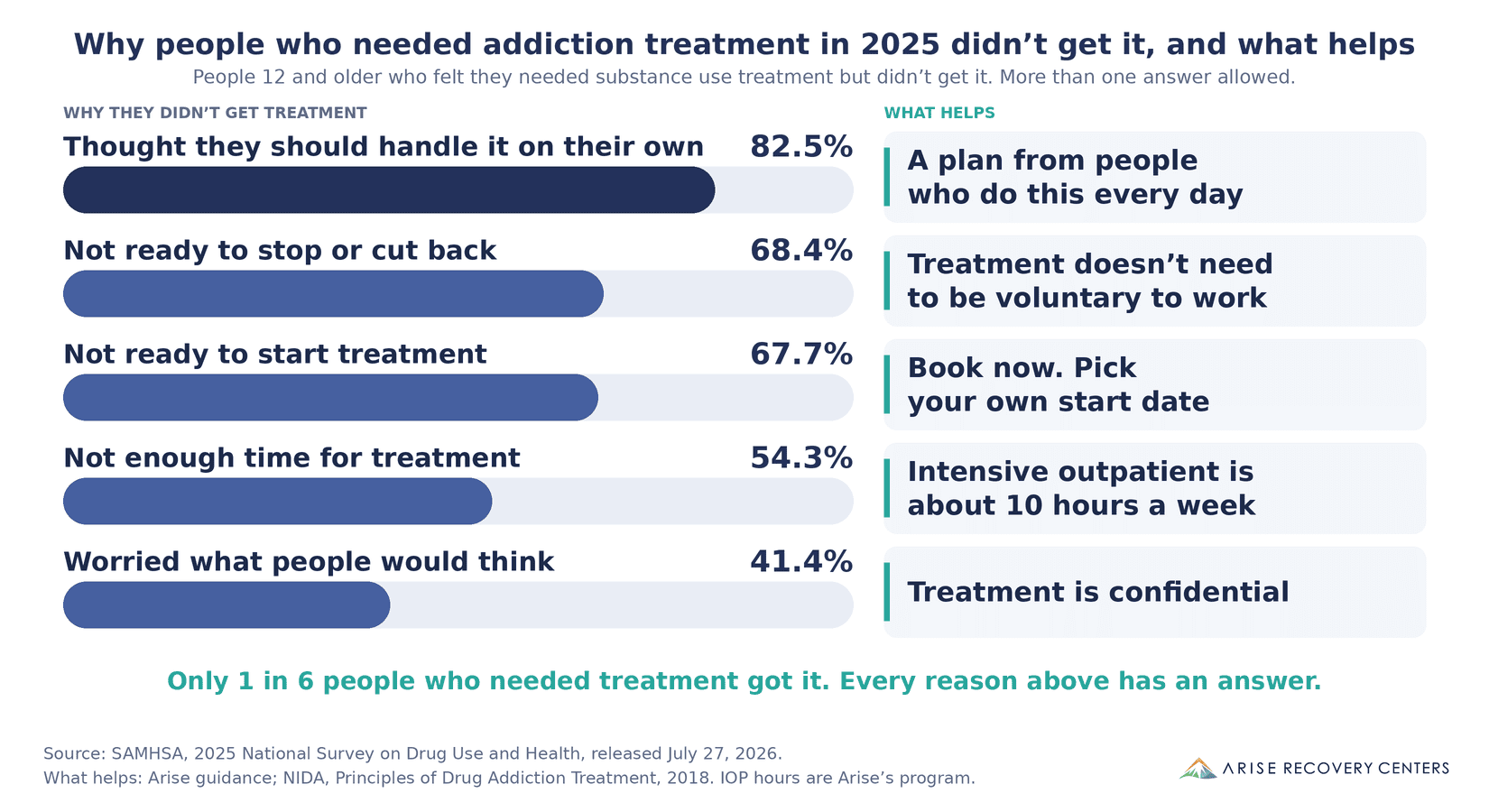
Look at the top of the list. Most people wanted to handle it on their own. About two in three said they weren’t ready, either to stop or to start.
Not feeling ready is normal. It is not a reason to wait. The National Institute on Drug Abuse’s research-based treatment guide says treatment does not need to be voluntary to be effective. People who start because a court requires it do about as well as people who walk in on their own.
The same guide says the earlier treatment starts, the better the odds of a good outcome. When someone is willing, even a little, that is the moment to use.
The fresh start is real. It isn’t only in January.
Researchers at the Wharton School have a name for the January urge: the fresh start effect. In their study, Google searches for “diet” jumped 82% at the start of a new year.
But they found the same pull at smaller landmarks. Gym visits rose 33% at the start of a new week and 14% at the start of a new month. People also made more commitments to goals after holidays.
So next Monday works. December 1 works. You don’t have to wait for the biggest date on the calendar to get the effect.
By mid-January, you could be six weeks in.
Intensive outpatient at Arise typically runs 6 to 12 weeks. Start the first week of December, and New Year’s lands in the middle of your program, with a counselor and a group behind you.
What outpatient care looks like in December
Most people who need treatment never need a hospital stay. Outpatient care lets you live at home, keep working and keep your holiday plans.
- Intensive outpatient (IOP): about 10 hours a week, in groups three days a week. Typically 6 to 12 weeks.
- Day program (PHP): 20-plus hours a week, mornings, Monday through Friday, for people who need more structure.
- Supportive outpatient: about 4 hours a week, for lighter needs or as a step down.
- Virtual IOP: from anywhere in Texas, if getting to an office is hard during the holidays.
You can still go to Christmas dinner. Your counselor and group help you plan it, the same way we laid out for Thanksgiving in recovery.
Not sure which level fits? This guide to levels of care explains the options. Here is what the first week of IOP looks like.
Overrated vs. underrated
Overrated
- Waiting for January 1. Five weeks of the holidays with no plan and no one checking in.
- Waiting until you feel ready. Most people who need help don’t feel ready. Treatment works anyway.
- Handling it on your own. It is the No. 1 reason people don’t get help.
- Quitting cold turkey on New Year’s Day. If you drink heavily every day, that can be dangerous.
Underrated
- Booking the assessment now. You still pick the start date.
- Next Monday or December 1. A smaller fresh start still works.
- Outpatient care. About 10 hours a week, and you sleep at home.
- Telling one person your date. A spouse, a friend or a sibling.
If you’re set on January, do this now
- Book the assessment this week. Put a real start date on the calendar, not “sometime after the holidays.”
- Tell one person the date. Someone who will ask you about it on January 2.
- Check your insurance now. It takes about two minutes. If you have already paid toward this year’s deductible, starting in December may cost less, not more.
- Don’t quit heavy daily drinking cold turkey on January 1. Ask whether you need detox first.
- Plan your hardest holiday night now. Drive yourself, keep your own drink in your hand, and set a time to leave.
Getting help in Texas
Arise Recovery Centers provides outpatient drug and alcohol treatment at 12 locations in DFW, Houston and Austin, plus Virtual IOP anywhere in Texas.
You can schedule a free consultation or verify your insurance online in about two minutes. Both are confidential and do not commit you to anything. Then pick your start date.
Safety note: If you drink heavily every day, stopping suddenly can cause dangerous withdrawal, including seizures. Talk to a doctor or ask about detox before you stop.
Frequently asked questions
Should I wait until after the holidays to go to rehab?
Usually no. The five weeks between Thanksgiving and New Year’s are packed with drinking occasions, and waiting means facing them without a plan. You can book an assessment now and still pick a start date that works for you.
Can I go to rehab during the holidays and still work?
Yes, with outpatient care. Intensive outpatient is about 10 hours a week, in groups three days a week, and you live at home. It is built so you can keep working.
What if I’m not ready to stop drinking or using?
Most people aren’t. In the 2025 national survey, about two in three people who needed help said they weren’t ready to stop. The National Institute on Drug Abuse says treatment does not need to be voluntary to work, so you can start before you feel sure.
Can I still spend Christmas with my family if I’m in treatment?
Yes. Outpatient programs meet a few days a week, and you sleep at home. Your counselor and group can help you plan the hard nights, like a family dinner or a New Year’s Eve party.
Is it safe to quit drinking cold turkey on New Year’s Day?
Not for everyone. If you drink heavily every day, stopping suddenly can cause dangerous withdrawal, including seizures. Talk to a doctor or get an assessment first. Some people need a short detox before outpatient care.
Should I wait for my insurance deductible to reset in January?
Usually not. If you have already paid toward this year’s deductible, starting now may cost you less. A two-minute online insurance check tells you where you stand.
How long is intensive outpatient treatment?
At Arise, intensive outpatient typically lasts 6 to 12 weeks. If you start the first week of December, you could be six weeks in by mid-January.
How do I start outpatient treatment in Texas before the new year?
Schedule a free consultation or verify your insurance online. Arise Recovery Centers has 12 outpatient locations in DFW, Houston and Austin, plus Virtual IOP anywhere in Texas. The consultation is confidential and does not commit you to anything.
This article is education, not medical advice.
Sources: Substance Abuse and Mental Health Services Administration, “SAMHSA Releases Annual National Survey on Drug Use and Health,” press release, July 27, 2026 (2025 National Survey on Drug Use and Health). National Institute on Drug Abuse, Principles of Drug Addiction Treatment: A Research-Based Guide, 3rd ed. (updated January 2018), Principles of Effective Treatment and Frequently Asked Questions. Dai H, Milkman KL, Riis J, “The Fresh Start Effect: Temporal Landmarks Motivate Aspirational Behavior,” Management Science 60, no. 10 (2014): 2563–2582. American Heart Association News, “Before you toast, know the risks of ‘holiday heart syndrome,’” December 15, 2025. Program hours and length: Arise Recovery Centers.