

Medically reviewed by Chelsea Petty, LMFT — Clinical Director of DFW & Family Programming, Arise Recovery Centers · Last reviewed: June 2026
Two outpatient levels of addiction care, compared — so you can understand which one fits.
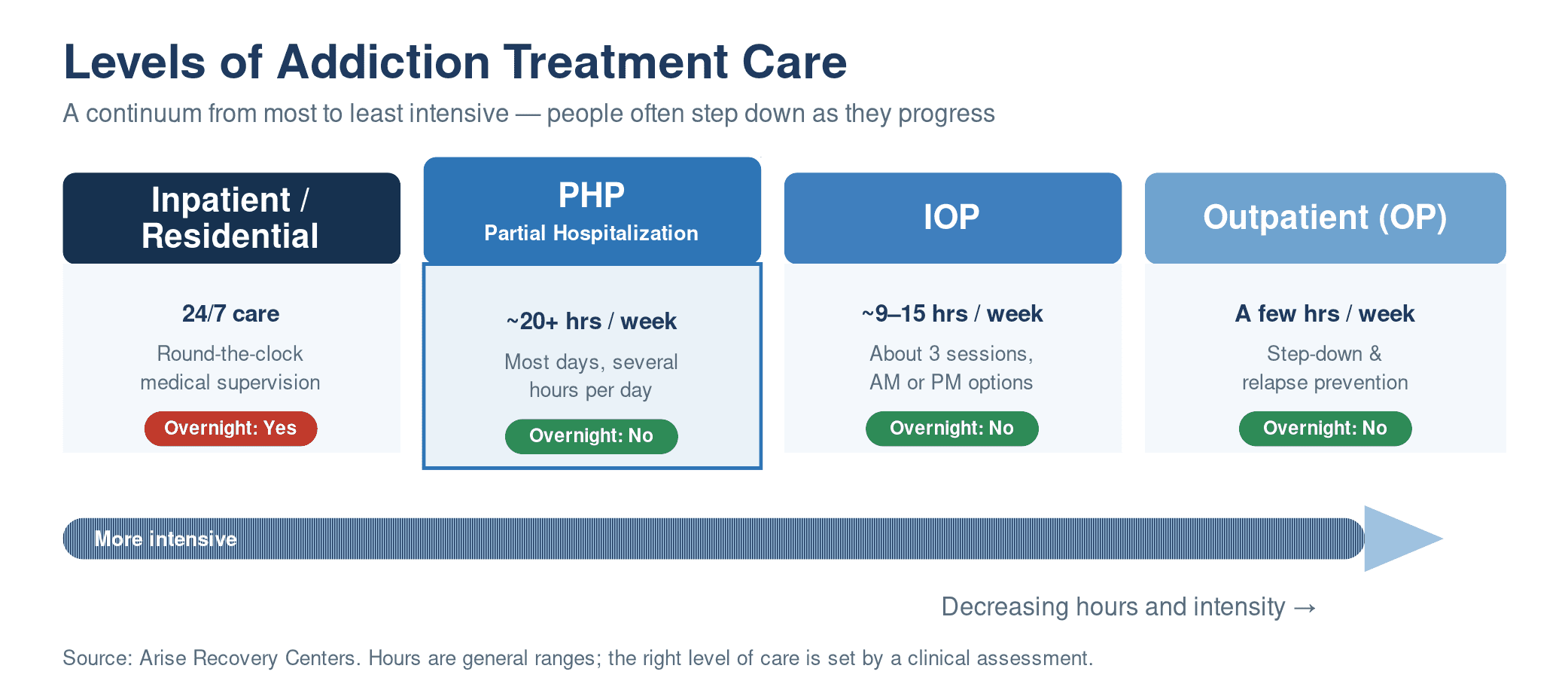
Short answer: A partial hospitalization program (PHP) is the more intensive option — usually about 20 or more hours of treatment per week, five days a week. An intensive outpatient program (IOP) is a step down, with about 9 to 12 hours per week across three sessions. Both are outpatient, meaning you live at home and aren’t admitted overnight.
| PHP (Partial Hospitalization) | IOP (Intensive Outpatient) | |
|---|---|---|
| Hours per week | ~20+ hours | ~9–12 hours |
| Days per week | About 5 days | About 3 days |
| Intensity | Higher — most structured outpatient level | Moderate — flexible structure |
| Live at home? | Yes | Yes |
| Best for | Stepping down from residential, or needing significant daily support | Keeping work/school while in structured treatment, or stepping down from PHP |
PHP suits people who need substantial, near-daily clinical support — often right after detox or residential care, or when symptoms are significant but 24/7 supervision isn’t required. It provides more therapy hours and closer monitoring than IOP.
IOP suits people who are more stable and want to keep working or attending school while still getting real structure — several hours of group and individual therapy a week. Many clients move from PHP to IOP as they progress.
The safest, most effective level of care is determined by a clinical assessment that looks at your medical stability, history, home environment, and support needs — not a one-size-fits-all rule. Many people step through levels over time: detox or residential, then PHP, then IOP, then standard outpatient and aftercare.
A free, confidential assessment will tell you honestly. Insurance verified up front. Call 888-REHAB-TX. You may also find additional resources and help at our mental health partner, Saltwood Mental Health in Dallas.
Verify your insurance
The licensee providing these services is licensed by the State of Texas. This page is for informational purposes and is not medical advice. Treatment recommendations are made only after a clinical assessment.