
Clinically reviewed by Nicholas Overbeck, LPC-S, LCDC
Medically reviewed by Nicholas Overbeck, LPC-S, LCDC, Arise Recovery Centers · Updated June 2026
The first question almost everyone asks about treatment is “What’s it going to cost?” It’s the right instinct and the wrong starting point. Here’s the insider truth most people never get told: for anyone using real insurance, the sticker price of a program is far less important than two numbers buried in your plan — your deductible and your out-of-pocket maximum. Once you understand those, “how much does rehab cost?” turns into a much smaller, much more answerable question.
This article is general education, not medical, legal, or financial advice. Dollar figures are national industry ranges — not Arise pricing — and your plan determines your actual cost. Verify your specific benefits before deciding.
The ceiling almost nobody tells you about
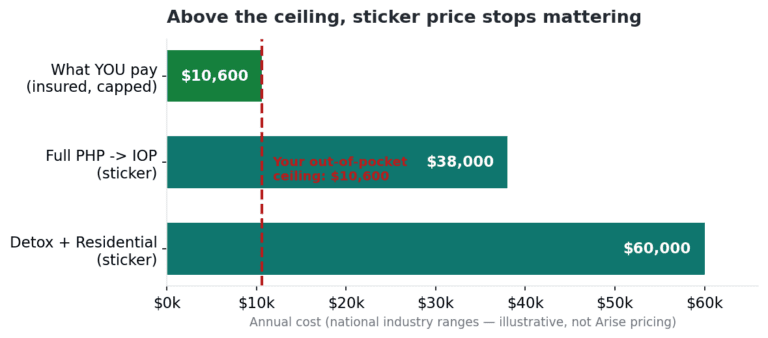
Every ACA-compliant health plan has a hard cap on what you can pay out of pocket in a year. For 2026, the law sets that ceiling at $10,600 for an individual and $21,200 for a family (up about 10% from $9,200 / $18,400 in 2025). Deductibles, copays, and coinsurance all count toward it. Premiums and out-of-network care don’t.
Why does this matter so much for treatment? Because addiction care is one of the few medical events intense enough to blow straight through that ceiling in a matter of weeks. National ranges tell the story:
| Level of care | Typical daily range | What that adds up to |
|---|---|---|
| Medical detox | $250–$800 / day | ~$1,750–$5,600 a week |
| Residential / inpatient | $500–$650 / day | $6,000–$20,000 a month |
| PHP (partial hospitalization) | $350–$450 / day | Several weeks of day treatment |
| IOP (intensive outpatient) | $250–$350 / day | $3,000–$10,000 for a full course |
Stack a detox onto a residential stay, or run a full PHP-to-IOP step-down, and an insured patient frequently hits their out-of-pocket max regardless of the program’s headline price.
That’s the key insight: above the ceiling, a “$40,000 program” and a “$60,000 program” cost the insured patient the exact same thing — the cap. You’re not really shopping on price. You’re shopping on fit, quality, and whether you’ll actually finish.
And the ceiling covers more than the marquee service. The pieces people forget — medication management, drug testing, continuing care, and the PHP → IOP → SOP step-down that protects your gains — all count toward the same annual max once you’ve reached it. The most important parts of recovery are often the cheapest part of the bill. Not sure what your plan includes? See our guide on whether insurance covers rehab, or try our cost calculator to see where your share stops and insurance takes over.
The exception: high deductibles and the self-pay play
There’s one case where price does matter — when you’re unlikely to reach the ceiling at all. If you carry a high-deductible plan, have limited covered services, or are early in the plan year with a fresh deductible, you may pay most costs yourself anyway. In that situation, ask for the self-pay (cash) rate and compare.
Many providers discount self-pay pricing — often around 10% off — because cash up front saves them billing overhead and collection risk. Smart programs pair that discount with downside protection: a written refund policy that returns the unused portion if you don’t complete treatment. That combination — a discount and a refund for the part you don’t use — can beat running everything through a plan that wasn’t going to cover much. (Discount and refund terms vary by provider; always get them in writing.)
Paying up front isn’t just cheaper — it can work better
Here’s the counterintuitive part. Putting your own money down doesn’t only change the price; behavioral research suggests it can change the outcome. Economists call it a commitment device — staking something you’ll lose if you don’t follow through. In study after study outside of addiction, a recent meta-analysis found deposit contracts to be the single most effective financial tool for improving diet, weight control, and physical activity, with similar evidence for smoking cessation.
You’ve seen the everyday version: the person who prepays for a year of personal training shows up more than the one paying month-to-month; the student who funds their own tuition skips fewer classes than the one on a “free” ride; the nutrition client who puts a deposit on the line logs more meals. Skin in the game creates continuity — and continuity, far more than any single therapy, is what predicts recovery.
The number that dwarfs all of these: doing nothing
Now zoom out, because the real comparison isn’t program A versus program B. It’s treatment versus no treatment. Untreated addiction is staggeringly expensive — it just bills you in installments instead of one invoice.
- Lost income and jobs: SUD drives roughly $93 billion a year in lost U.S. productivity — about $3,700 per affected adult annually, before a single job loss.
- Divorce: addiction ranks among the top reasons cited for divorce — and in Texas, a community-property state, that often means losing half of everything you’ve built.
- Health and legal costs: medical spending alone runs ~$15,000 a year higher for an affected person, before legal trouble, accidents, or an overdose.
Set that against the return. The National Institute on Drug Abuse estimates every $1 spent on treatment returns $4–$7 in reduced crime and justice costs — and up to $12 when healthcare savings are included. There are not many investments with a 4-to-12x return and your marriage, job, and life on the other side of it.
Frequently asked questions
How much does rehab cost?
National ranges run roughly $250–$800 a day for medical detox, $500–$650 a day for residential, $350–$450 a day for PHP, and $250–$350 a day for IOP. But for an insured patient, the number that actually matters is your out-of-pocket maximum — capped by law at $10,600 (individual) / $21,200 (family) in 2026 — which puts a hard ceiling on what you pay regardless of the sticker price.
Does insurance cover addiction treatment?
Yes. Under federal parity rules, ACA-compliant plans must cover substance use treatment as an essential health benefit. What varies is your share — your deductible, coinsurance, and whether the provider is in-network. The fastest way to know your real number is to verify your benefits.
Is it cheaper to pay for rehab out of pocket?
Sometimes. If you have a high-deductible plan or limited coverage and won’t reach your out-of-pocket max, the self-pay (cash) rate — often around 10% off — can cost less than running it through insurance. Ask for the self-pay price and a written refund policy for any treatment you don’t complete.
Is rehab worth the cost?
The research says strongly yes. The National Institute on Drug Abuse estimates every $1 spent on treatment returns $4–$7 in reduced crime and justice costs, and up to $12 once healthcare savings are included — before counting the job, marriage, and health you protect by getting well.
The bottom line
If you have solid insurance, stop agonizing over sticker price — your out-of-pocket max already capped it. Focus your energy on the program you’ll actually complete. If you have a high deductible, ask for the self-pay rate and a written refund policy, and use that skin in the game to your advantage. Either way, weigh it against the only number that really matters: what staying sick will cost you.
The other half of the cost picture is what your plan has already paid down. Does rehab count toward your deductible and out-of-pocket max? walks through the three stages — you pay 100%, then about 20%, then nothing at all.
Ready to take the first step?
We’ll tell you what your plan actually covers before you decide anything — free, confidential assessment and insurance check. Call 888-REHAB-TX. You may also find additional resources and help through our mental health partner, Saltwood Mental Health in Dallas.
Arise Recovery Centers runs outpatient programs across Dallas–Fort Worth, Austin, and Houston. Verify your insurance in a couple of minutes or call 1-888-734-2289 (1-888-REHAB-TX).
Related reading: Does insurance cover rehab? · Is outpatient treatment right for you? · Why outpatient rehab location matters more than you think
You can also reach SAMHSA’s free, confidential National Helpline at 1-800-662-HELP (4357), 24/7. This article is educational and not a substitute for professional advice; figures are national ranges, not guarantees. If you’re in immediate danger, call or text 988 or call 911.