
By Danny Andino, CEO, Arise Recovery Centers · Clinically reviewed by Nicholas Overbeck, LPC-S, LCDC
Update, October 2026: The federal ban described below never took effect. On October 9, the DEA withdrew its July notice and started over with a new limit, and the earliest the new ban can take effect is November 13, 2026. Here is what changed and what it means if you use 7-OH.
There’s a product that’s been sitting next to the energy shots at gas stations and smoke shops all over Texas — shiny packets of tablets and gummies with names most parents have never heard of. It acts on the same brain receptors as morphine. And as of this month, the federal government is pulling it off the shelves.
Here’s the part almost nobody is covering: a ban doesn’t un-addict anyone. The day those products disappear from the counter, the people who’ve been taking them every day don’t stop needing them. For a lot of Texas families, the ban won’t be the end of a problem they knew about. It will be the first time they find out the problem exists.
The 30-second answer
- What happened: The DEA is placing concentrated 7-OH (7-hydroxymitragynine) — the “super-kratom” compound sold as tablets, gummies, shots, and strips — into Schedule I. The waiting period ended August 5; the order can take effect any day.
- What it is: A concentrated or synthetic kratom derivative that behaves like an opioid at the doses sold. Federal regulators say it can be more potent than morphine at the same receptors.
- What it is not: This is not a ban on traditional kratom leaf, which remains legal.
- The real risk right now: People dependent on 7-OH losing supply overnight — facing opioid-type withdrawal alone, or replacing it with street opioids, which is far more dangerous.
- If someone you love uses it daily: Get a medical assessment before the supply runs out, not after.
What 7-OH actually is — in one honest paragraph
Kratom is a Southeast Asian plant whose leaves contain trace amounts of a compound called 7-hydroxymitragynine, or 7-OH. In the natural leaf, it’s a rounding error — roughly 0.003% to 0.04% of the material. Over the last few years, manufacturers learned to concentrate and synthesize that compound and press it into tablets, gummies, and drink shots at many times the natural level — and sell them legally at the register, next to the 5-hour Energy. At those concentrations, 7-OH isn’t really “an herbal product” anymore. It’s an opioid-receptor drug in a candy wrapper, and people who take it daily develop the same physical dependence — and the same withdrawal — you’d expect from that sentence.
0.05%
The legal line the DEA drew. Products containing 7-OH above 0.05% become Schedule I — the same category as heroin. Natural kratom leaf runs roughly 0.003–0.04% and is not covered by the ban.
Leaf kratom vs. concentrated 7-OH — they are not the same conversation
| Traditional kratom leaf | Concentrated 7-OH products | |
|---|---|---|
| Form | Ground leaf powder, teas, capsules | Tablets, gummies, shots, strips — often labeled “7” or “7-OH” |
| 7-OH content | Trace — ~0.003–0.04% naturally | Concentrated or synthetic — above the 0.05% line, often far above |
| How it behaves | Stimulant-like at low doses, sedating at higher doses | Opioid-like — FDA warns it acts on mu-opioid receptors and can exceed morphine’s potency |
| Legal status now | Legal federally; Texas regulates labeling | Becoming Schedule I under the DEA’s emergency order |
| Dependence risk | Real, generally slower to develop | High with daily use — opioid-type withdrawal on stopping |
Sources: DEA temporary scheduling order (Federal Register, July 2026); FDA/HHS statements on enhanced 7-OH products. This table describes product categories, not any individual’s risk.
How we got here — and what the next 30 days look like
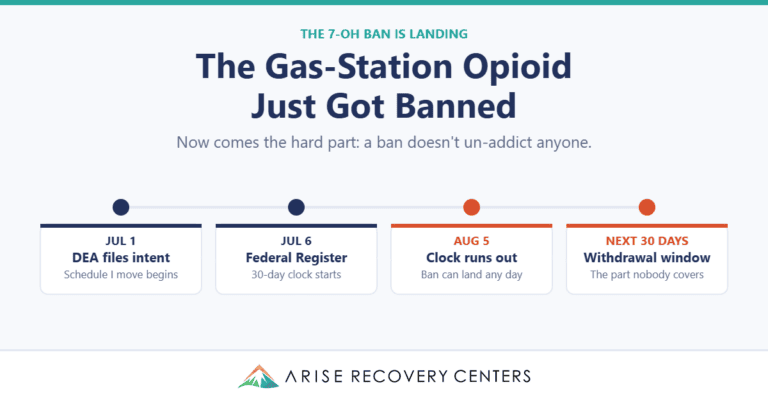
July 1, 2026
DEA announces intent
Notice filed to temporarily schedule concentrated 7-OH plus three related synthetic compounds. HHS and FDA publicly back the move.
July 6, 2026
Federal Register
Formal publication starts the 30-day clock. Florida doesn’t wait — it issues its own emergency ban.
Aug 5, 2026
The clock runs out
Earliest effective date passes. The order can take effect any day. Shops run clearance sales; some users stockpile.
The 30 days after
The part nobody’s covering
Supplies run out. Daily users hit withdrawal — some alone, some switching to street opioids. This is the dangerous window.
Timeline per the DEA’s Federal Register notice and subsequent coverage. Verify current status before making decisions — this is a fast-moving situation.
Why the ban is the start of the visible part
Most people using 7-OH daily fall into two groups, and neither of them is who you’d guess. The first is people who started taking it to get off opioids — it was legal, it was at the gas station, it took the edge off withdrawal, and nobody asked questions. The second is people who never would have touched “drugs” but took a legal gummy for pain, stress, or energy, and are now taking it every four to six hours because they feel sick when they don’t.
Both groups are physically dependent on an opioid-receptor drug. Both are about to lose their supply on a date nobody can predict. And here’s what an insider will tell you happens next, because we’ve seen this movie with every supply disruption: some people white-knuckle withdrawal alone, some buy up clearance stock and postpone the problem a few weeks, and some — the outcome that actually scares us — replace a dosed, labeled product with street opioids or counterfeit pills. In the fentanyl era, that trade is the single most dangerous move a dependent person can make. DEA lab testing has consistently found that a large share of counterfeit pills contain potentially lethal doses of fentanyl.
If you’ve been using 7-OH daily — read this first
Do not replace it with anything from the street. Your tolerance is calibrated to a labeled, dosed product. Counterfeit pills and street opioids have no dose, no label, and frequently contain fentanyl. This is how supply disruptions turn into overdose deaths.
You don’t have to white-knuckle it alone. 7-OH withdrawal behaves like opioid withdrawal — flu-like misery, anxiety, insomnia, cravings. It’s rarely dangerous by itself, but it’s exactly the situation medication (like buprenorphine) was built for, and it’s treatable in an outpatient setting. See the withdrawal timeline and your options · What treatment for this actually involves.
Tell the provider the truth about what you were taking. “A kratom product from the gas station, several times a day” is a sentence clinicians need to hear to help you. Nobody’s calling the police. That’s not how any of this works.
What families might see this month — a red-flag checklist
Signs the ban just made someone’s private problem visible
- Empty packets or tubs with names you don’t recognize — small tablets, gummies, or shots labeled “7,” “7-OH,” or sold near kratom displays.
- Sudden flu that isn’t flu: sweating, chills, muscle aches, diarrhea, yawning, restlessness — starting within a day of “quitting that gas station stuff.”
- Agitation about errands: repeated trips to smoke shops or gas stations, driving farther than usual, visible stress about stores being “out.”
- Stockpiling: clearance-sale purchases, ordering online in bulk before the window closes.
- Money or mood changes that track with the above — irritability in the morning that resolves after a store run.
The rule of thumb: if stopping a “legal supplement” produces flu symptoms and panic, the body is telling you it was an opioid all along. That’s not a moral failing — it’s physiology, and it’s exactly what an assessment is for.
Texas has since done the same thing with delta-8 THC. If you or someone you love was using it daily, here is what the delta-8 ban means for withdrawal and when to get help.
7-OH is one of several drugs in the news this year. The most dangerous of them is medetomidine, a vet sedative now found in most fentanyl it touches, which Narcan cannot reverse.
Overrated vs. underrated: the 7-OH ban edition
↓ Overrated
- “It was legal, so it’s fine.” Legal-at-the-register has never meant safe. Alcohol taught us this; 7-OH is the same lesson in a new wrapper.
- Stockpiling as a plan. Clearance-sale cases postpone the conversation a few weeks. The dependence is still there when the tub is empty.
- The ban as the fix. Scheduling removes the product, not the addiction. Untreated dependence just finds a new supply — often a worse one.
- Waiting to see if it gets bad. The safest exit window is before supply runs out, while withdrawal can be planned for instead of survived.
↑ Underrated
- The assessment. Twenty minutes with a clinician turns “I don’t know what this stuff did to me” into an actual plan.
- Medication. Buprenorphine and similar medications are the evidence-backed bridge off opioid-receptor dependence — including this one.
- Telling your doctor the truth. The dose and frequency you’re embarrassed about is precisely the information that makes treatment safe.
- The next 30 days. Supply disruptions concentrate risk into a short window. Acting inside it is worth more than acting perfectly later.
How this works at Arise — and what we don’t do
We’ll be direct, because it affects your decision: Arise is an outpatient provider. We don’t sell detox beds and we don’t have a financial stake in dramatizing this story. What we do, every week, is assess people who are physically dependent on something — including people whose “something” came from a gas station — and figure out the right next step.
If withdrawal management or medication is needed, we place you with vetted, licensed medical providers in our network, usually within a day. Then you come back to us for the part that decides the outcome: structured outpatient treatment — PHP, IOP, or supportive outpatient, depending on what the assessment shows. Most people navigating a 7-OH problem keep working and living at home the entire time. If what you actually have is a two-week habit and mild rebound symptoms, we’ll tell you that too.
The assessment is free, it takes about 20 minutes, and there’s no obligation attached. See how detox placement works, or check what treatment would actually cost you with our Cost of Treatment calculator.
Using 7-OH daily — or watching someone who is?
Tell us what’s been going on. We’ll tell you straight what it means and what to do next — free, confidential, no obligation. Reach out to us or our mental health partner, Saltwood Mental Health, today, or Call 888-REHAB-TX
Frequently asked questions
Is 7-OH banned now?
The DEA’s emergency move to place concentrated 7-OH products in Schedule I cleared its 30-day waiting period on August 5, 2026, meaning the order can take effect at any time — and by the time you read this it may already be in force. Florida has separately banned these products under an emergency state rule. Check current federal and state status before assuming anything about legality.
Is kratom banned too?
No. The DEA action targets concentrated, enhanced, and synthetic 7-OH products above a 0.05% threshold — tablets, gummies, shots, and strips. Traditional kratom leaf, which contains only trace natural levels of 7-OH, is not covered by the federal order and remains legal in Texas, where it’s subject to labeling regulations.
Is 7-OH an opioid?
Pharmacologically, concentrated 7-OH acts on the same mu-opioid receptors as drugs like morphine, and the FDA has warned it can be more potent than morphine at those receptors. Legally it wasn’t classified as an opioid until this scheduling action. Practically — in terms of dependence, tolerance, and withdrawal — daily users experience it like an opioid, which is why it’s being scheduled.
What does 7-OH withdrawal feel like, and is it dangerous?
Users report opioid-type withdrawal: flu-like symptoms, sweating, chills, muscle aches, diarrhea, anxiety, insomnia, and strong cravings, typically starting within a day of the last dose. Like opioid withdrawal generally, it’s rarely life-threatening on its own — but it’s miserable enough that people relapse to avoid it, and replacing 7-OH with street opioids carries serious fentanyl-related overdose risk. A medical assessment before stopping is the safe play. Here is what 7-OH withdrawal actually looks like day by day — and what makes it manageable.
Can medication help someone get off 7-OH?
Because concentrated 7-OH acts on opioid receptors, clinicians can treat dependence on it the way they treat opioid use disorder — including with medications such as buprenorphine, which relieves withdrawal and reduces cravings. Whether medication fits any individual case is a decision for a licensed prescriber after an evaluation.
My family member has been using these gas-station products daily. What should I do?
Don’t lead with confrontation about “drugs” — many daily 7-OH users genuinely didn’t know they were taking an opioid-receptor compound. Lead with the supply reality: the products are disappearing, withdrawal is coming on someone else’s schedule, and a free assessment now beats an emergency later. If they develop severe symptoms, confusion, or any sign of overdose — especially if they’ve substituted other substances — call 911.
Does insurance cover treatment for this?
Dependence on an opioid-receptor substance is treated as a substance use disorder, which most commercial health plans cover under federal parity rules. Specifics vary by plan. Verify your benefits to see yours.
Sources: Federal Register — Temporary Placement of 7-Hydroxymitragynine Above a Specified Threshold in Schedule I (July 6, 2026); HHS/FDA — HHS, FDA Commend DEA Action Against Dangerous Enhanced 7-OH Products; Congressional Research Service — Temporary Control of 7-OH and Related Substances Under the CSA; FDA statements on 7-OH potency at mu-opioid receptors (July 2025); DEA “One Pill Can Kill” counterfeit-pill lab data; state coverage of Florida’s emergency rule (August 2026). Compiled August 10, 2026 — regulatory status verified at time of writing and subject to change.