
By Danny Andino, CEO, Arise Recovery Centers · Clinically reviewed by Nicholas Overbeck, LPC-S, LCDC · October 2026
If you have been waiting for the 7-OH ban to finally land, it just moved again.
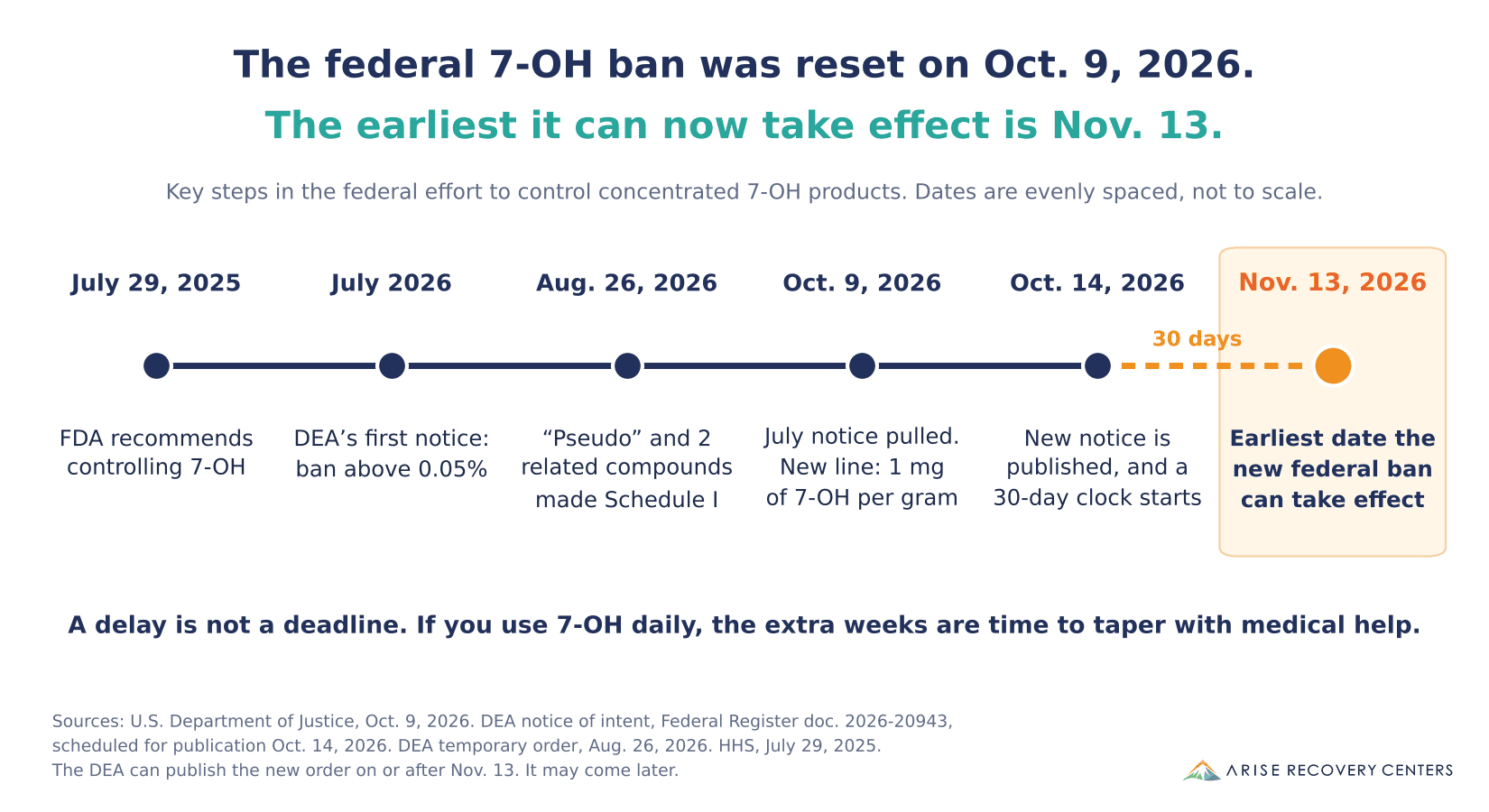
On Friday, October 9, the U.S. Department of Justice announced that the DEA is pulling its July plan and starting over with a new rule. The products are still on the shelf. The earliest the new ban can take effect is November 13.
The short version
- 7-OH is still not a federally controlled drug. The DEA’s July notice never became a final order, and it is being withdrawn.
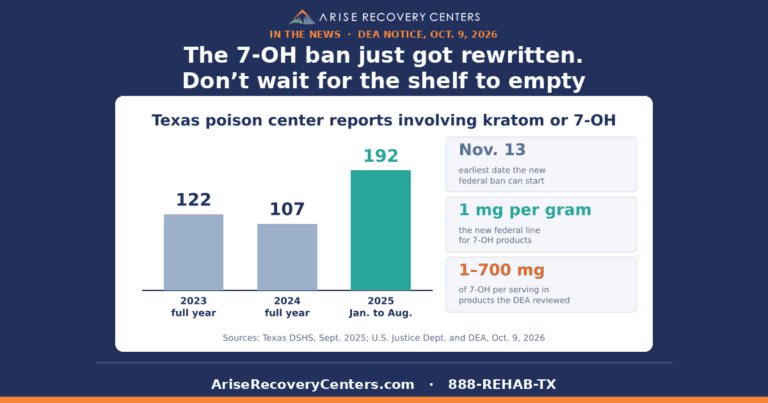
- The new notice draws a new line. 7-OH becomes Schedule I above 1 milligram per gram of product, or 1 milligram per milliliter in liquids.
- It also covers products with more than 1 part 7-OH for every 100 parts mitragynine, the main compound in the kratom leaf.
- The notice is set to publish October 14. The ban can follow 30 days later, so November 13 at the earliest.
- Federal regulators said plainly that products under the line have not been found safe.
- If you use 7-OH every day, the delay is time to plan a taper with medical help. Waiting for the shelf to empty is the hardest way off.
What changed on October 9
In July, the DEA announced it would place concentrated 7-OH in Schedule I, the same category as heroin. The waiting period ended August 5. The final order never came.
On October 8, the U.S. Department of Health and Human Services (HHS) sent the DEA updated science and a new recommended limit. The next day, the Justice Department announced the DEA would withdraw the July notice and issue a new one.
| July 2026 notice | October 2026 notice | |
|---|---|---|
| Status | Being withdrawn. It never took effect. | Publishes October 14, 2026 |
| The line for 7-OH | More than 0.05% of the product (0.5 mg per gram) | More than 1 mg per gram (1 mg per mL in liquids), or more than 1 part 7-OH per 100 parts mitragynine |
| Earliest ban date | Any time after August 5. It was never issued. | On or after November 13, 2026 |
| “Pseudo” (MGPI) | Not included | Schedule I since August 26. Moves to the new line once the new order takes effect. |
Sources: DEA notice of intent, Federal Register document 2026-20943; DEA notice of intent, July 2026; DEA temporary order, August 26, 2026.
The Justice Department did not soften its view of these products.
“Dangerous and addictive opioids do not belong behind convenience store counters.”Attorney General Todd Blanche, October 9, 2026
Why the line moved
Kratom leaf naturally contains a little 7-OH. The DEA says it makes up less than 2% of the leaf’s alkaloids, its active compounds. The products sold as “7-OH” are something else. Makers concentrate it, or make it from the leaf’s main compound in a single chemical step.
The new limit is meant to separate those products from the leaf itself. In the Justice Department’s words, it targets formulations “intentionally enhanced or concentrated.”
How strong are the products people actually buy? A review of 250 products cited by the DEA found anywhere from 1 mg to 700 mg of 7-OH in a single serving. Two packages that look alike can be wildly different.
One sentence in the new notice matters most if you use these products. Neither HHS nor the DEA “has made a finding that these substances are safe to use at below-threshold levels.” Under the line does not mean safe. It only means outside this rule.
What it means in Texas
Texas already has its own rules. State law bars kratom products in which 7-OH makes up more than 2% of the alkaloids, and it bans synthetic 7-OH outright. The federal rule does not override stricter state law.
Even so, Texas health officials warned in September 2025 that concentrated 7-OH was being sold as liquid extracts, powders and gummies. The Texas Poison Center Network logged 192 reports involving kratom or 7-OH from January through late August 2025. That was already more than all of 2024 (107) or 2023 (122).
Of the 2025 reports, 19 involved concentrated 7-OH products. Eleven of those people needed treatment at a health care facility. The Texas Department of State Health Services has urged Texans not to use 7-OH products at all.
A delay is not a deadline. It is a head start.
Planning a taper with medical help now is far easier than going without the day the shelf empties.
If you use 7-OH every day
- Don’t wait for the shelf to empty. Stopping all at once brings opioid-type withdrawal. The FDA lists restlessness, body aches, fatigue, irritability and cold sweats. Here is what 7-OH withdrawal usually looks like, day by day.
- Never fill the gap with pills from someone else. The DEA warns that counterfeit pills often contain fentanyl. That trade is how a rough week turns deadly.
- Say the real number out loud. Standard urine drug screens do not reliably detect 7-OH. A clinician only knows what you tell them, so bring the package or a photo of it.
- Ask about medication. Clinicians treat 7-OH dependence the way they treat opioid dependence, including with buprenorphine. It can take the edge off withdrawal while you taper.
- Expect it to fit around your life. Outpatient care lets you keep working and sleep in your own bed. Here is what 7-OH treatment involves and what it costs.
Overrated vs. underrated
Overrated
- “It’s sold at the gas station, so it’s safe.” Being for sale has never meant being safe. The FDA warns 7-OH products can cause serious harm.
- “I’ll quit when they ban it.” The ban date has already slipped once. Withdrawal is easier to plan for than to be ambushed by.
- “It’s just kratom.” The leaf has trace amounts of 7-OH. The tablets, shots and gummies are concentrated.
Underrated
- A planned taper. Starting while you still have a steady supply means you set the pace.
- Buprenorphine. Clinicians use it for 7-OH dependence, and it can make withdrawal manageable.
- Saying the real dose. “A few tablets a day” and “a 30 mg shot four times a day” lead to different care.
Arise Recovery Centers provides outpatient drug and alcohol treatment at 12 locations in DFW, Houston and Austin: a day program, intensive outpatient and supportive outpatient. This guide to levels of care explains the options. You can schedule a free consultation or verify your insurance online in about two minutes. Both are confidential and do not commit you to anything.
For background on what 7-OH is and how it differs from kratom leaf, see our first article on the 7-OH ban.
Frequently asked questions
Is 7-OH banned now?
Not federally, as of mid-October 2026. The DEA’s July 2026 notice never became a final order and is being withdrawn. A new notice publishes October 14, 2026, and the ban can take effect 30 days later, on or after November 13. Three related compounds, including “pseudo” (MGPI), have been Schedule I since August 26, 2026.
When does the 7-OH ban take effect?
November 13, 2026 is the earliest date. The DEA can publish its temporary order on or after that day, and it could come later. Once it does, 7-OH above the new limit becomes a Schedule I drug for two years, with a possible one-year extension.
What is the new legal limit for 7-OH?
Under the October 2026 notice, a product falls under Schedule I above a set strength: more than 1 milligram of 7-OH per gram in solids, or per milliliter in liquids. MGPI counts toward that total. A product also counts if it has more than 1 part 7-OH for every 100 parts mitragynine. The goal is to target products that were intentionally enhanced or concentrated.
Is kratom being banned?
No. The federal notices target concentrated 7-OH and related compounds, not the kratom leaf. Kratom leaf naturally contains small amounts of 7-OH, and the new limit is designed to leave products close to the natural leaf outside the ban. Texas regulates kratom products under its own state law.
Is 7-OH legal in Texas?
Texas law already bars kratom products in which 7-OH is more than 2% of the alkaloids, and it bans synthetic 7-OH. Kratom products cannot be sold to minors. The Texas Department of State Health Services has urged people not to use any 7-OH products.
What happens if I stop taking 7-OH suddenly?
7-OH acts on the same brain receptors as opioids, so stopping can cause opioid-type withdrawal. Common symptoms include restlessness, body aches, sweats, stomach trouble and poor sleep. It is usually not life-threatening on its own. The bigger risk is reaching for street pills or other drugs to make it stop. A clinician can help you taper and manage symptoms.
Does 7-OH show up on a drug test?
Usually not on a standard one. A 2026 clinical review in Current Addiction Reports noted that routine urine drug screens do not reliably detect 7-OH. Specialized lab tests can. When you get help, tell the clinician exactly what you take and how much.
How do I get off 7-OH safely?
Start with a medical assessment. Clinicians manage 7-OH dependence the way they manage opioid dependence, often with medication such as buprenorphine plus counseling. This can happen in outpatient care while you keep working. At Arise Recovery Centers, intensive outpatient is about 10 hours a week and supportive outpatient about 4, at 12 locations in DFW, Houston and Austin.
This article is education, not medical advice, and it does not replace advice from your own doctor.
Sources: U.S. Department of Justice, “Department of Justice Announces Updates to Emergency Scheduling Actions for 7-OH and Related Opioid Substances,” press release, October 9, 2026. Drug Enforcement Administration, “Schedules of Controlled Substances: Temporary Placement of 7-Hydroxymitragynine and Mitragynine Pseudoindoxyl Above a Specified Threshold in Schedule I,” notice of intent, Docket No. DEA-1570, Federal Register document 2026-20943, scheduled for publication October 14, 2026. DEA, “Temporary Placement of 7-Hydroxymitragynine Above a Specified Threshold in Schedule I,” notice of intent, 91 FR 40917, July 6, 2026. DEA, temporary order placing mitragynine pseudoindoxyl, MGM-15 and MGM-16 in Schedule I, 91 FR 54948, August 26, 2026. U.S. Department of Health and Human Services, press release on FDA’s 7-OH scheduling recommendation, July 29, 2025. Texas Department of State Health Services, “Public Health Officials Warn People Not to Use 7-OH Products,” September 2, 2025. Texas Health and Safety Code, Chapter 444. U.S. Food and Drug Administration, “Products Containing 7-OH Can Cause Serious Harm.” “7-Hydroxymitragynine (7-OH): Clinical Implications of a Potent, Unregulated Opioid Partial Agonist Derived from Kratom,” Current Addiction Reports, May 2026. “Buprenorphine for the Management of 7-Hydroxymitragynine (7-OH) Use: A Retrospective Case Series,” Journal of Addiction Medicine, June 2026. DEA, “One Pill Can Kill.”