
A supportive outpatient program (SOP) is the most flexible level of outpatient addiction treatment — a lighter schedule of individual and group counseling designed to help you sustain your recovery while living your everyday life. At Arise Recovery Centers, our SOP is built for clients who are better suited to a supportive rather than an intensive approach, including those stepping down from a higher level of care.
A supportive outpatient program integrates individual counseling and group counseling in a lighter, more flexible format than IOP or PHP. You attend a few hours of treatment per week, scheduled around work, school, and family, so recovery support fits into your real life. The focus is on maintaining momentum — reinforcing positive behaviors, strengthening coping skills, and catching early warning signs before they become setbacks.
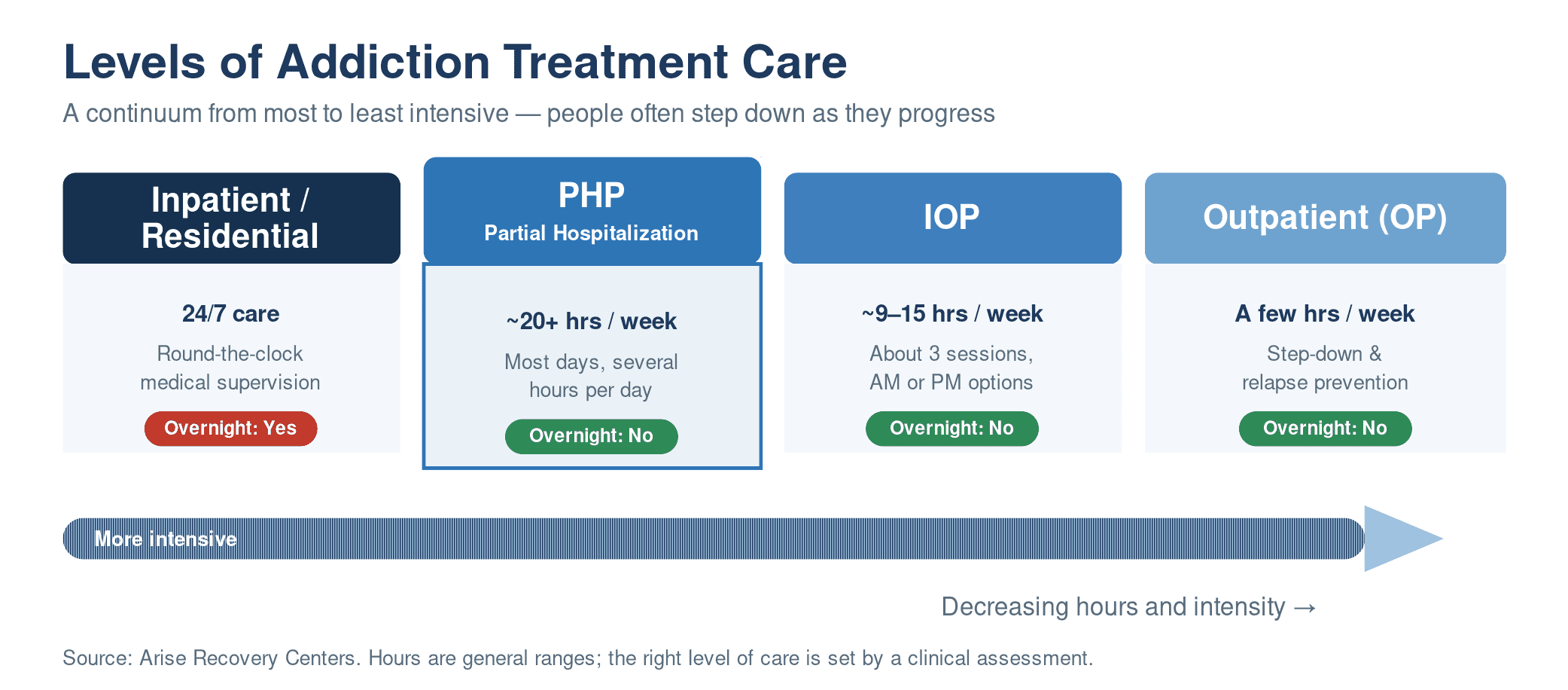
The levels of outpatient care differ mainly in how many hours of structure you get each week. SOP sits at the lightest, most flexible end of the continuum.
| Level of care | Typical hours | Overnight? | Best for |
|---|---|---|---|
| PHP (partial hospitalization) | ~20+ hrs/week, most days | No | Needs intensive daily structure, but home is safe |
| IOP (intensive outpatient) | ~9–15 hrs/week | No | Needs solid support while working or in school |
| SOP (supportive outpatient) | A few hrs/week | No | Sustaining recovery, step-down, relapse prevention |
Most people step down this continuum as they stabilize — for example, from PHP to IOP to a supportive outpatient program. Learn more about the difference between levels in IOP vs. PHP.
A clinical assessment is the best way to confirm whether an SOP is the right fit — or whether a more structured level like IOP would serve you better right now.
Because it's the least time-intensive level of outpatient care, an SOP is typically the most affordable outpatient option. Most major health plans cover supportive outpatient care as part of behavioral health benefits, though coverage, deductible, and copay depend on your plan. Related: Outpatient rehab cost in Texas and Does insurance cover IOP & outpatient rehab?
The first step is a short, confidential phone call and an insurance check, followed by a clinical assessment to match you with the right level of care. Care is also available through our virtual program for Texas residents.
Call 888-REHAB-TX Verify your insurance
An SOP is the most flexible level of outpatient addiction treatment — a few hours of individual and group counseling each week, focused on sustaining recovery while you live at home and keep up with daily responsibilities.
The main difference is intensity. An IOP runs about 9–15 hours a week, while an SOP involves just a few hours a week. Many people step down from IOP to SOP as they stabilize.
An SOP is typically a few hours per week, scheduled flexibly around work, school, and family — though the exact schedule depends on your needs and clinical recommendation.
Often, yes. Many clients move into an SOP after completing PHP or IOP, using it to maintain progress and prevent relapse — but an SOP can also be an appropriate starting point for someone who is stable and well supported.
In most cases, yes. The majority of major health plans cover supportive outpatient care as part of behavioral health benefits, though coverage, deductible, and copay depend on your plan.
The licensee providing these services is licensed by the State of Texas. This page is for informational purposes and is not medical advice. Treatment recommendations are made only after a clinical assessment.