

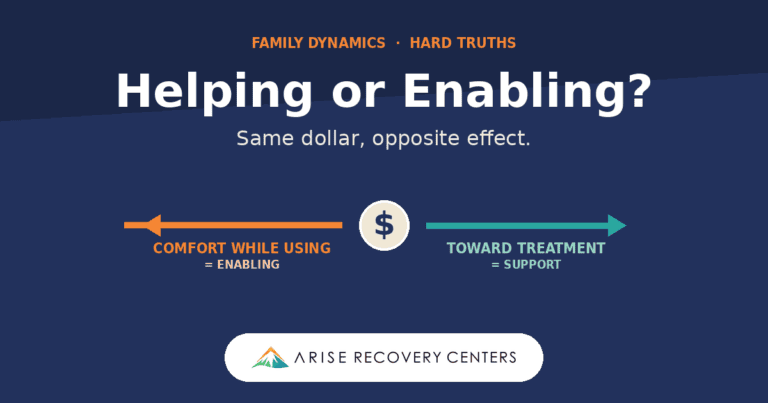
If you love someone in active addiction, you’ve probably paid for something this year — rent, a phone bill, bail, a “loan” that both of you knew wasn’t one. And you’ve probably lain awake wondering which side of the helping vs. enabling line you landed on. Here’s the confusing part nobody tells families: the exact same act — money, housing, a ride — can be support or fuel, depending entirely on which direction it points.
Last reviewed and updated July 2026.
This article is general education, not medical or clinical advice. Every family situation is different — especially where safety is a concern — and the right moves are best worked out with a licensed professional.
Why loving families get this wrong
Addiction is a family illness with terrible math: one person uses, and three, four, five people reorganize their lives around it. Nearly half of U.S. adults — 46% — say they have a family member or close friend who is or has been addicted to drugs (Pew Research Center). So if you’re in this, you’re not rare and you’re not to blame.
Here’s the plain-English version of why this is so hard: your brain is wired to protect the people you love from pain right now, and addiction exploits exactly that wiring. Every rescue — the bail, the covered shift, the “last” $200 — feels urgent, loving, and small in the moment. But addiction runs on avoided consequences the way a fire runs on oxygen. And the alternative most families imagine — keep rescuing or cut them off completely — is a false choice that leaves everyone feeling like a failure at both.
Helping vs. enabling: the one-sentence rule
Strip away the guilt and the jargon, and the helping vs. enabling question comes down to one sentence you can apply in the moment, before the money leaves your hand:
A second test when you’re not sure: “Am I absorbing a consequence that belongs to them?” Consequences aren’t cruelty — they’re information. A missed shift or a bounced payment is the real-world feedback that tells a person’s brain this is costing me something. Quietly absorb the consequence and you delete the information — the addiction keeps running on a clean screen, and you’ve been recruited as its shock absorber.
One caveat before the matrix: boundaries are about money, cover stories, and comfort — never about safety. If there’s risk of overdose, violence, or suicide, that’s a crisis, not a teaching moment — call or text 988 or 911.
The side-by-side: same situation, opposite move
Five situations almost every family faces. Left column makes using more comfortable; right column points the same love toward treatment.
| Enabling looks like… | Support looks like… |
|---|---|
| MoneyCash, “loans,” covering the credit card — money that frees up their money for using. | MoneyPaying the treatment bill, the assessment, or the pharmacy directly. Never cash — pay the thing itself. |
| HousingFree room, no conditions, while active use continues under your roof. | Housing“You always have a home here the day you’re in treatment” — housing tied to help, not to using. |
| Cover storiesCalling in sick for them, lying to family, smoothing it over with the landlord. | HonestyLetting the real story stand — and offering to sit with them while they make the hard call themselves. |
| Crisis responseInstant rescue: bail, tow fees, replacing the totaled car, no conversation. | Crisis responseShowing up at the crisis with a treatment option in hand — crises are when people say yes. |
| Your energyMonitoring, searching rooms, counting drinks — managing their addiction full-time. | Your energyGoing to your own support (Al-Anon, family therapy, a CRAFT-trained counselor) whether they get help or not. |
The pattern: enabling shortens the distance between your loved one and their next use. Support shortens the distance between your loved one and treatment. Every dollar, bed, and favor points one direction or the other.
The “Am I enabling?” self-check
Answer honestly — nobody’s grading this but you. Score each line 1 (never) to 5 (regularly), then add it up.
| # | In the last 90 days, have I… | 1 = never · 5 = often |
|---|---|---|
| 1 | Given money (or paid a bill) knowing it might free up money for using? | 1 2 3 4 5 |
| 2 | Lied or covered for them — with an employer, family member, or landlord? | 1 2 3 4 5 |
| 3 | Absorbed a consequence that was theirs — bail, fees, cleanup, apologies? | 1 2 3 4 5 |
| 4 | Threatened a boundary (“this is the last time”) and not followed through? | 1 2 3 4 5 |
| 5 | Rearranged my life — sleep, work, money, health — around their using? | 1 2 3 4 5 |
| 6 | Avoided mentioning treatment because I didn’t want the fight? | 1 2 3 4 5 |
Heuristic self-check, not a clinical assessment. A high score doesn’t mean you caused anything — it means the strategy needs to change, and that’s changeable.
Three scripts for the hard conversations
Boundaries fail when we improvise them mid-argument. Decide the words in advance. Steal these:
Notice what all three do: no shame, no ultimatum theater, and every “no” is attached to a “yes” — a concrete, same-week path to help. That combination isn’t just kinder; it’s the approach the research says actually works.
The research: families have more power than they think
The most hopeful numbers in this topic come from CRAFT — Community Reinforcement and Family Training. It teaches families to do, systematically, what the scripts above do: reward sober behavior, stop cushioning use, take care of themselves, and make treatment easy to say yes to. In randomized research on families of treatment-refusing loved ones, CRAFT got 64% into treatment — versus about 30% for a classic confrontational intervention and 13% for a support-group-only approach (Miller, Meyers & Tonigan, 1999). Later trials ran as high as 74%.
Read that again, because it flips the script most families carry: “you can’t help someone who doesn’t want it” is mostly false. Roughly two out of three people entered treatment because someone who loved them changed their own behavior first — no rock bottom, no TV-style confrontation. Families who get their own support and education change outcomes whether or not the loved one is ready today (SAMHSA, Resources for Families).
And when they do say yes — even a reluctant, one-foot-in yes — speed matters, because willingness has a shelf life. Outpatient treatment that starts fast and fits around work and school is often the easiest yes to get. To have an option ready before the next conversation, it takes two minutes to verify insurance or find the nearest of our Texas locations — no commitment, and they never have to know you checked.
Outpatient programs across Dallas–Fort Worth, Houston & Austin — family involvement welcomed. Families can call even if your loved one isn’t ready yet. Free and confidential.
Frequently asked questions
Direction. Help that moves a loved one toward treatment — the assessment, the ride, housing tied to being in care — is support. Help that makes continued use more comfortable — cash, cover stories, absorbing their consequences — is enabling, even when it comes from love. Before you act, ask: does this point toward treatment, or toward comfort while using?
Usually not. The best-studied family approach, CRAFT, is neither rescue nor cutoff — it pairs firm boundaries with warmth and a ready path to treatment, and it engaged about 64% of treatment-refusing loved ones into care, versus 30% for confrontational intervention. Boundaries never mean ignoring danger: overdose risk, violence, or suicidal talk is a crisis — call or text 988.
A useful rule: pay the thing, never the person. Cash — and bills paid that free up their cash — tends to subsidize use. If you want to spend money on them, point it at recovery: the assessment, the treatment bill, the pharmacy, the ride. Say yes to those instantly, so help is always the easiest thing to reach for.
Yes, more than most families believe. In CRAFT studies, roughly two-thirds of treatment-refusing people entered care after their family changed its own behavior — rewarding sober time, ending rescues, keeping a concrete treatment offer on the table. Start with your own support now, and call a treatment program yourself so a plan is ready the moment they say yes.
Also for families: sending your kid to college when addiction runs in the family — the red zone, the genetics, and the 3-sentence script.