

Last week, Tony Romo — Cowboys legend, beloved broadcaster, the guy half of Texas grew up cheering for — was arrested in Milwaukee on suspicion of driving while intoxicated after a golf tournament. First arrest. Court date in September. And within hours, the internet split into its two usual camps: “leave him alone, it was one mistake” and “he obviously has a problem.” Here’s the uncomfortable truth from people who work inside addiction treatment: both camps are wrong — and the way they’re wrong is exactly why so many people get help years later than they should.
Last reviewed and updated July 2026.
To be clear at the top: this article is not a claim that Tony Romo has a drinking problem. One arrest proves nothing about any individual — he’s entitled to due process and privacy, and we know nothing about his health. What his headline gives the rest of us is a rare moment when everyone is thinking about the same question at the same time. This is about that question.
“Is he an alcoholic?” is the wrong question
The all-or-nothing frame — you’re either an alcoholic or totally fine — is the single most damaging idea in this field. It hands every drinker an easy out: I’m not sleeping under a bridge, so I’m fine. Clinicians threw that binary away years ago. The actual diagnosis, alcohol use disorder, runs on a spectrum — mild, moderate, and severe — scored across 11 criteria, and meeting just 2 of them counts as mild (NIAAA). Nobody asks whether your blood pressure makes you “a hypertensive.” They ask how high it is, and whether it’s trending the wrong way.
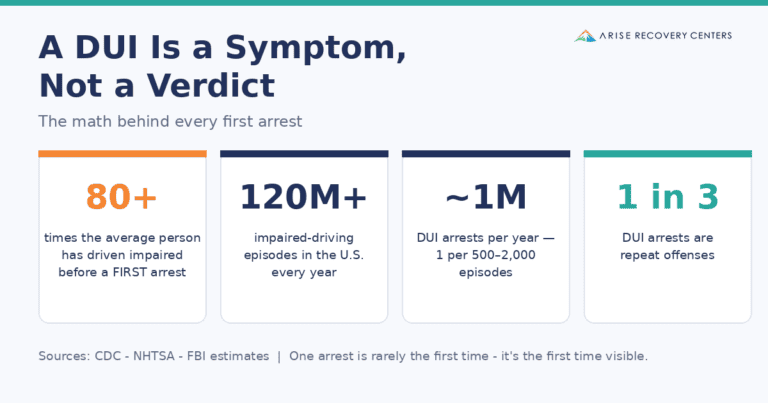
The math behind every DUI
Here’s why “one bad night” is statistically naive — not about Romo, about everyone. Drunk driving is astonishingly common, and getting caught is astonishingly rare:
Read that middle number again. By the time the lights flash for the first time, the average driver has already rolled those dice more than 80 times. That’s the real meaning of a first DUI: it’s almost never the first time — it’s the first time visible. Which is exactly why shrugging it off as “one mistake” misreads the data, and why calling someone “an alcoholic” over it misreads the person. The honest read is in the middle: a pattern just surfaced. Look at it.
A DUI is chest pain, not a diagnosis
Think about how medicine handles an ambiguous warning sign. A 45-year-old gets chest pain at dinner. Nobody at the table says “ignore it — you’re not a cardiac patient.” And nobody says “you’re dying.” They say: get it checked. Maybe it’s nothing. Maybe it’s reflux. Maybe it’s the early warning that saves your life precisely because you didn’t wait for the heart attack to be sure.
A DUI is chest pain. So is drinking that’s crept from two to four, a spouse’s raised eyebrow, a hangover that costs a Monday. None of them are a diagnosis. All of them are the body of your life throwing a signal — and the only wrong response is the one most people choose: waiting for certainty. In medicine, waiting until you’re sure it’s a heart attack is how people die in ambulances. In drinking, waiting until you’re sure you’re “an alcoholic” is how people lose ten years. An earlier piece of ours put numbers on where that waiting leads — alcohol quietly kills more Texans than every illicit drug combined.
The crossroads: why embarrassment can be a gift
Here’s something counterintuitive that everyone inside treatment knows: the mortifying public moment is often the most valuable thing that ever happens to a person’s drinking. Not because shame heals — it doesn’t. But because a crisis briefly does what nothing else can: it makes the cost of the status quo undeniable, to the drinker and everyone around them, all at once. Researchers politely call events like a DUI a “teachable moment.” We’d put it more plainly: it’s a crossroads with a clock on it.
The window is real but it closes fast. The court date gets handled, the story fades, the discomfort dulls — and with it, the motivation. People who use the window — who walk into an assessment while the sting is fresh — routinely look back on the arrest as the best worst thing that ever happened to them. People who only “get through” the legal process, learning nothing but to be more careful, are heavily represented in the roughly one-third of DUI arrests that are repeat offenses (NHTSA).
If that’s where Romo is — and we genuinely don’t know — then what looks like the worst week of his public life could be the most useful. That’s true for him, and it’s true for the reader whose DUI didn’t make ESPN: the embarrassment is not the punishment. It’s the wake-up call, already paid for. The only question is whether it gets used.
The morning-after protocol
For anyone — you, your spouse, your brother — in the days after a DUI. Five moves, in order:
What the BAC number is really telling you
Here’s the part of a DUI almost nobody examines, and it’s the most biologically revealing: the number on the breathalyzer. The average BAC at a DUI arrest is roughly 0.16 — twice the legal limit. Now the uncomfortable biology: at 0.16, an occasional drinker isn’t debating whether they’re okay to drive. They’re slurring, stumbling, possibly vomiting — their body is sounding every alarm it has. The only way a person gets to 0.16 and still feels capable of driving is tolerance: the nervous system has been exposed to alcohol often enough, and heavily enough, that it has physically adapted to it.
This is the most important idea in the whole article, so here it is plainly: tolerance is not a talent. It’s an adaptation — and adaptations take repetition to build. Nobody develops the ability to function at twice the legal limit on their third drink ever. The brain gets there the same way a callus does: repeated exposure. So when someone says “I’m fine, I can handle it” — that sentence, said honestly, is itself the finding. Being able to handle a lot of alcohol is not evidence that alcohol isn’t a problem. It’s evidence of how much alcohol there’s been.
Doctors read this exactly the way they read a resting heart rate or an A1C: not as a character judgment, but as a number that quietly records months of behavior. And like those numbers, it moves. Tolerance built over years starts coming down within weeks of a change — which is why the biology here is hopeful, not damning.
What actually happens in an assessment
Most people never get evaluated because they’ve invented a version of it in their head: a stranger deciding they’re an alcoholic, a lecture, a bed in a facility, everyone finding out. That’s not what it is. Here’s the real thing, so the unknown stops being the obstacle:
The reason we push this so hard: an assessment is the only thing in this entire article that can tell you the answer is “you’re fine.” Wondering can’t. The internet can’t. Your brother-in-law with an opinion definitely can’t. People assume evaluation is how you get labeled — in practice, it’s how the majority of people finally stop carrying the question around.
A good assessment also covers medication, which is where most people’s picture of alcohol treatment is a decade out of date. Three FDA-approved medications exist and almost nobody is offered them — only about 1.6% of adults with alcohol use disorder receive one. There is also a newer conversation about GLP-1 drugs: here is where the Ozempic research actually stands before you ask a doctor about it.
Confidential alcohol assessments and outpatient treatment across Dallas–Fort Worth, Houston & Austin — built around work, family, and (when needed) court requirements. Free and confidential. You may also find additional resources and help through our mental health partner, Saltwood Mental Health in Dallas.
Frequently asked questions
Not automatically — and that’s the wrong frame. Alcohol problems run on a clinical spectrum (mild, moderate, severe alcohol use disorder), not an alcoholic/not-alcoholic binary. What a DUI reliably is: a symptom worth evaluating. FBI estimates suggest the average person has driven impaired 80+ times before a first arrest, so a DUI usually means a pattern became visible — not that one bad night happened. A professional assessment answers what the label debate can’t.
FBI estimates put it at more than 80 times before a first arrest. Nationally, the CDC counts well over 100 million self-reported impaired-driving episodes a year against roughly 1 million arrests — about one arrest per 500–2,000 episodes. That’s why treating a first DUI as “bad luck” misses what the numbers actually say.
Usually not residential rehab. Most people start with a professional alcohol assessment — often court-required anyway — which determines whether treatment is warranted and at what level. When it is, it’s typically outpatient: structured therapy several hours a week, in the evenings, while you keep working. Done voluntarily and early, it can satisfy court requirements and actually address the reason the DUI happened.
Two tracks at once: a lawyer for the legal problem, and a voluntary alcohol assessment for the health question — they are not the same problem, and winning the first answers nothing about the second. Then: look honestly at how often this almost happened before, tell one person the full truth, and if the assessment recommends help, act while the motivation is fresh. The window after a DUI closes faster than people expect.