

Clinically reviewed by Nicholas Overbeck, LPC-S, LCDC
Somebody in your life has probably mentioned it by now. A friend started Ozempic for weight and stopped wanting wine. A cousin lost interest in beer without trying. Those stories have been circulating for a couple of years, and the research has now caught up with them.
Two randomized trials have tested semaglutide — the drug sold as Ozempic and Wegovy — in people with alcohol use disorder. The second, published in The Lancet in May 2026, is the larger and more encouraging of the two. It is also being described online in a way its own authors would not recognize.
Here is what the trials found, what they did not test, and the part of this story that has nothing to do with Ozempic at all.
The short version
• In the big trial, people taking semaglutide went from about 17 heavy drinking days a month to roughly 5.
• But everyone in that trial was also in therapy, including the placebo group — and the placebo group got from 17 down to about 9 on therapy alone.
• So roughly two thirds of the improvement came from treatment. The drug added the rest.
• Everyone in the trial also had obesity, and nobody knows yet what happens after you stop.
• Meanwhile, three medications for alcohol use disorder have been approved for decades — and 1.6% of people who could use them are prescribed one.
First, one term you need
Both trials measure heavy drinking days. In the Lancet study that meant roughly 60 grams of alcohol in a day for men and 48 for women — about four to five standard drinks for a man, three to four for a woman. Participants averaged about 17 such days a month when they enrolled, out of 30.
The first trial: 48 people who weren’t trying to quit
In 2025, researchers published a phase 2 trial in JAMA Psychiatry. Forty-eight adults with alcohol use disorder received either low-dose semaglutide or a placebo for nine weeks. These were non-treatment-seeking participants — people who met criteria for the disorder but were not trying to cut back. Lower severity, less motivation, no program attached.
The results were real but narrow. Semaglutide reduced how much people drank in a supervised laboratory session, reduced how much they drank on the days they did drink, and reduced weekly craving. Among participants who smoked, it reduced cigarettes per day.
It did not reduce their average daily drinking, and it did not reduce how many days they drank at all. The authors were careful about what they claimed: the findings, they wrote, provide “initial prospective evidence” and justify “larger clinical trials.” That is a researcher’s way of saying keep studying this — don’t start prescribing it.
The second trial: bigger, longer, and much stronger
The Lancet trial ran at the Mental Health Center Copenhagen from June 2023 to February 2025. It differed from the first one in nearly every way that matters:
| 2025 — JAMA Psychiatry | 2026 — The Lancet | |
|---|---|---|
| Participants | 48, not seeking treatment | 108, actively seeking treatment |
| Severity | Lower | 85% met criteria for severe AUD |
| Dose | Up to 1.0 mg weekly | 2.4 mg weekly (the Wegovy dose) |
| Length | 9 weeks | 26 weeks |
| Therapy included | No | Yes — up to ten CBT sessions, both groups |
The headline finding: participants on semaglutide cut their share of heavy drinking days by 41.1 percentage points. In plain terms, they went from roughly 17 heavy drinking days a month to about 5.
Craving fell. Total alcohol intake fell by roughly 33 standard drinks a month more than in the placebo group. Liver enzymes improved. So did phosphatidyl ethanol — a blood marker of alcohol intake that does not care what you tell your doctor. Participants also lost about 25 pounds on average.
Those are good numbers, and they come with one detail almost nobody is repeating.
How much of that was the drug?
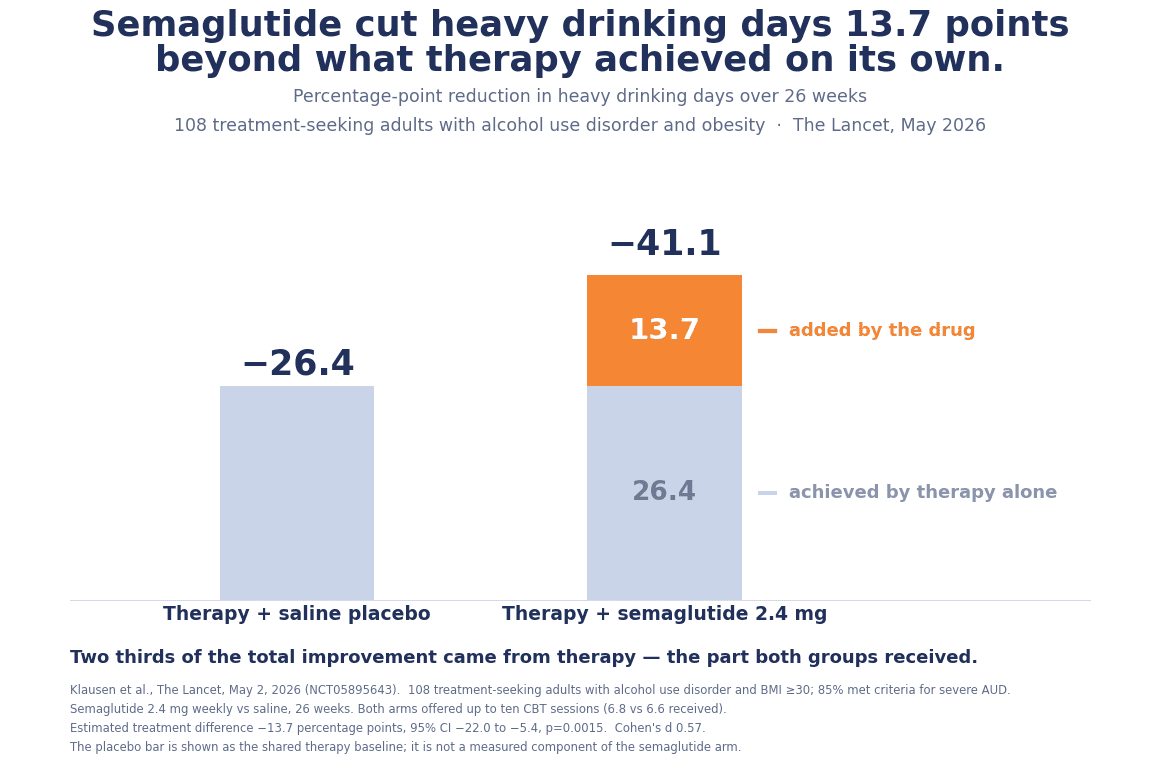
The comparison was therapy plus semaglutide versus therapy plus saline — never drug versus nothing. The grey block shows the shared therapy baseline; it is not a separately measured component of the semaglutide group.
The placebo group did not get nothing. They got saline injections and cognitive behavioral therapy — and they cut their heavy drinking days by 26.4 points, from about 17 a month down to about 9. In people who were 85% severe alcohol use disorder. In six months.
Semaglutide added 13.7 points on top of that. Both groups received almost identical amounts of therapy: 6.8 sessions on average in the semaglutide group, 6.6 in the placebo group. And this design was deliberate — the authors note that current standards call for investigational drugs to be tested “alongside effective interventions such as psychotherapy,” not instead of them.
So when you see a headline saying a weekly shot cut drinking by 41%, the accurate version is this: a weekly shot, added to six months of therapy, in people who were already showing up for treatment, cut heavy drinking days by 41 points — and therapy plus a saline injection got two thirds of the way there on its own.
No trial has tested this drug for alcohol use disorder without treatment attached. Not one.
How it compares to the medications we already have
Thirteen-point-seven points is a real effect, and it is fair to ask how that stacks up against the drugs already approved for this. The Lancet authors asked exactly that.
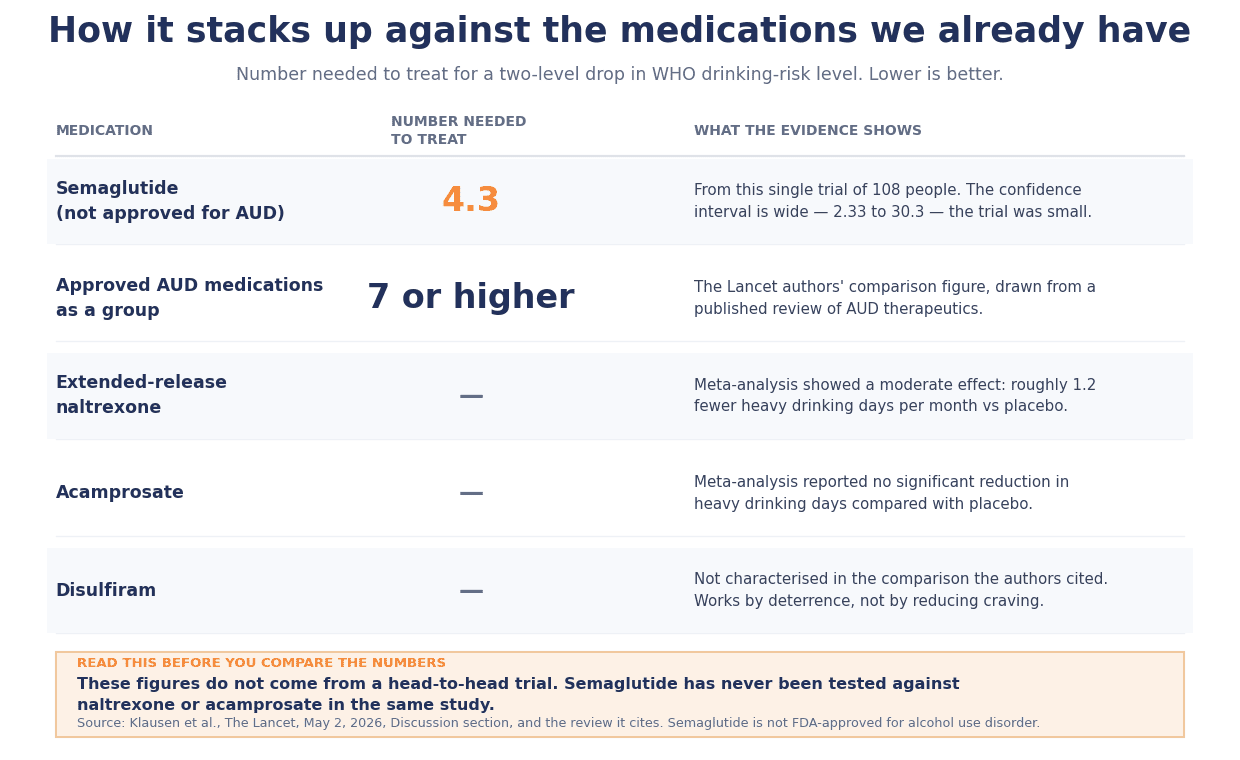
Number needed to treat — how many people you would have to treat for one additional person to improve. Lower is better.
By that measure semaglutide came out at 4.3, against 7 or higher for the approved medications as a group. In the authors’ words, semaglutide “could be more efficacious than approved medications for alcohol use disorder.”
The detail behind that group figure is not flattering to the current options. For acamprosate, a meta-analysis found no significant reduction in heavy drinking days at all compared with placebo. For extended-release naltrexone, a meta-analysis found a moderate effect — about 1.2 fewer heavy drinking days per month. Disulfiram was not in that comparison; it works by making you sick if you drink, rather than by reducing the wanting, which makes it a different kind of tool for a different kind of person.
But read that chart carefully, because it is not a race anyone actually ran. Semaglutide’s 4.3 comes from one trial of 108 people, and its margin of error runs from 2.33 all the way to 30.3 — which is another way of saying the true figure could be considerably worse than 7. The comparison numbers come from separate reviews of separate studies in different populations. Nobody has tested semaglutide head-to-head against naltrexone or acamprosate. Until someone does, “better than what we have” is a promising hypothesis, not a finding.
Five things the trial does not tell you
1. Whether it works if your BMI is under 30. Every participant had obesity — it was an entry requirement. The authors state directly that this “limits the generalisability of the findings to the entire population of patients with alcohol use disorder,” and call for larger trials in people without obesity.
2. Whether the drinking effect is really a weight effect. In the semaglutide group, weight loss and reduced drinking moved together, significantly so. In the placebo group they did not. The researchers did not measure calorie intake, and they say plainly they cannot rule out that the drinking reduction runs through the weight loss rather than through the brain’s reward system.
3. What happens when you stop. The trial collected no drinking data after week 26. In their words, future studies “should include longer-term follow-up.”
4. Whether you drink less often. Heavy drinking days dropped. But the number of days with no alcohol at all did not improve by a statistically significant margin. People drank less on the days they drank — they did not necessarily drink on fewer days. If your goal is abstinence rather than cutting back, that distinction matters.
5. What it actually feels like. Nausea affected 57% of the semaglutide group versus 7% on placebo. Constipation 35%. Reflux 28%. Food aversion 24%. Vomiting 15%. Most of it was mild to moderate and passed with time — but five participants left the trial because of side effects.
The authors’ own closing sentence is worth quoting exactly: “key limitations and safety uncertainties do persist, and additional research is needed before off-label use can be endorsed.”
Semaglutide is not FDA-approved for alcohol use disorder. Any prescription for that purpose today is off-label.
The part of this story nobody is writing about
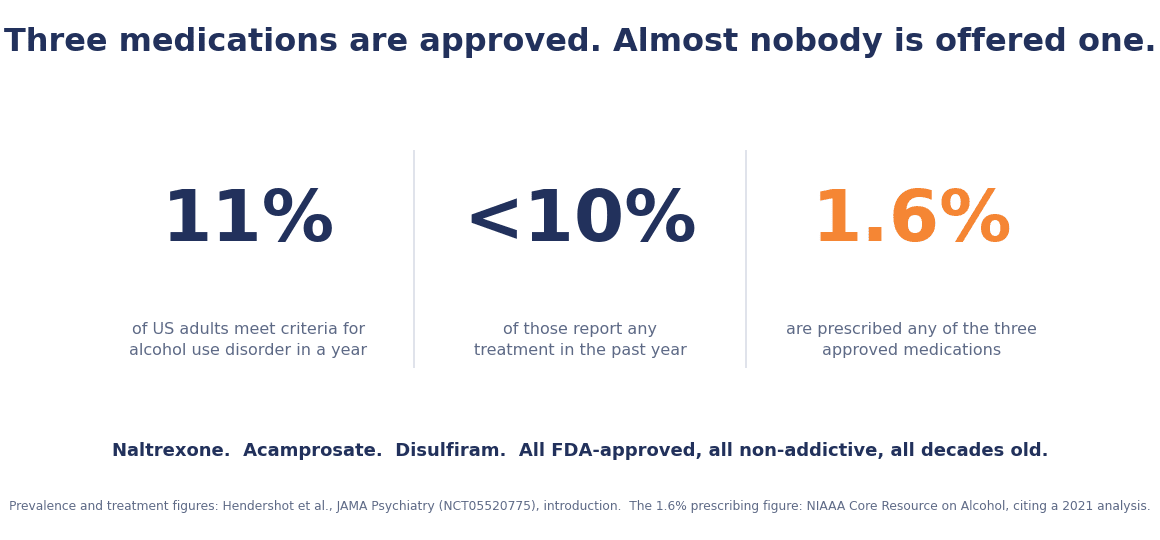
Three medications have been approved for alcohol use disorder for decades. Almost no one with the disorder is ever offered one.
While everyone argues about Ozempic, three medications are already approved for alcohol use disorder: naltrexone, acamprosate and disulfiram. They are not new, not experimental, not addictive, and not difficult to prescribe.
Roughly 11% of American adults meet criteria for alcohol use disorder in a given year. Fewer than 10% of them report any treatment at all. And by NIAAA’s own accounting, 1.6% are prescribed any of the three approved medications. The researchers behind the JAMA trial called it “one of the largest known health care treatment gaps.”
That is not a research problem. Those drugs exist. They are sitting on the shelf.
Semaglutide may well turn out to be better than all of them. But “better than a medication almost nobody receives” is a low bar, and clearing it does not help anyone who is never offered either one.
One more number to keep in view: the federal study on how much alcohol is safe, shelved and then published in June 2026, found no level with a net health benefit and put the line at one drink a day. Here is what it found.
What to do with all this
If you are drinking more than you want to be, ask about medication now. Not eventually, and not only about the one in the headlines. Naltrexone and acamprosate are available today and covered by most insurance. If a provider has never raised them with you, raise them yourself.
If you are already on a GLP-1 for weight or diabetes and have noticed you want to drink less — that is consistent with what the research shows, and worth telling whoever manages your care. It is also not, on its own, treatment.
If someone offers you a shot instead of a program, understand what you are being sold. Every participant in the only trial that showed a large effect spent six months in cognitive behavioral therapy. The drug has never been tested alone. A prescription without a plan is not what the research studied.
And if the drinking has a hold on you, treat the drinking. The most striking number in the Lancet trial is not 41.1 or 13.7. It is 26.4 — what people got from showing up, twice a month, for six months, with no active medication at all.
Talk to someone at Arise
Arise Recovery Centers runs licensed outpatient and intensive outpatient programs across Texas — in the Dallas–Fort Worth area, Houston, and Austin. We provide medication management alongside treatment, and we are glad to talk through what the current evidence does and does not support for your situation.
Call 888-REHAB-TX or reach out through our contact page. You can also reach out to our mental healthcare partner, Saltwood Mental Health. If a different level of care is the right answer for you, we will tell you that too.
Sources
- Klausen MK, et al. Once-weekly semaglutide versus placebo in patients with alcohol use disorder and comorbid obesity: a randomised, double-blind, placebo-controlled trial. The Lancet 2026;407(10540):1687–1698. NCT05895643.
- Hendershot CS, et al. Once-Weekly Semaglutide in Adults With Alcohol Use Disorder: A Randomized Clinical Trial. JAMA Psychiatry. NCT05520775.
- National Institutes of Health, Adding weekly GLP-1 to cognitive behavioral therapy further reduces heavy drinking, April 30, 2026.
- NIAAA, Core Resource on Alcohol: Recommend Evidence-Based Treatment — Know the Options.
Related reading: alcohol deaths among young women are up 255% since 1999 — and most of what is driving it is not how much anyone is drinking.