

By Danny Andino, CEO, Arise Recovery Centers · Clinically reviewed by Nicholas Overbeck, LPC-S, LCDC · October 2026 · Overrated or Underrated
If you are a few days into Sober October, you are probably grading it on one thing: will you make it to November 1?
That is the wrong scorecard. A month off does real, measurable things for your body. But the most useful thing it gives you is information about your drinking, and most people never read it.
The short version
- A Brown University review of 16 studies (Alcohol and Alcoholism, 2025) found that people who finish a month off report better well-being and keep drinking less for months afterward.
- In a 2018 BMJ Open study, 94 moderate-to-heavy drinkers who quit for a month saw their blood pressure, insulin resistance and a key liver enzyme all fall. A group that kept drinking saw no real change.
- You do not have to be perfect. People who slipped during the month still drank less six months later.
- Heavier drinkers are less likely to finish. If the month is harder than you expected, that is useful information, not failure.
- If you drink heavily every day, talk to a doctor before you stop. Alcohol withdrawal can be dangerous, and it can be treated safely.
What a month off actually does
The best body data comes from a 2018 study by researchers at University College London, published in BMJ Open. It followed 94 healthy moderate-to-heavy drinkers who gave up alcohol for one month. Before the month, they averaged about 18 standard drinks a week. A comparison group of 47 people kept drinking.
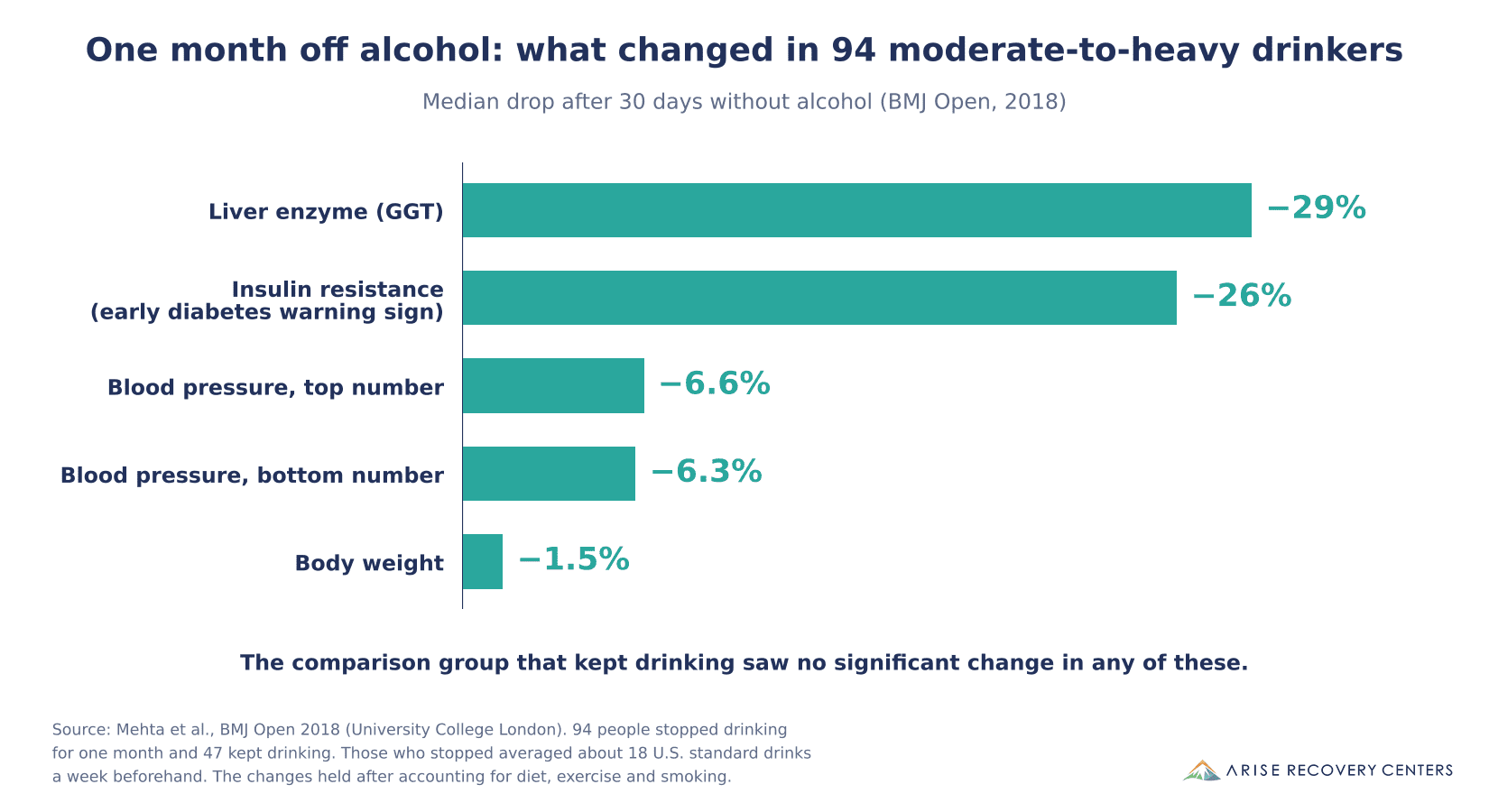
After 30 days, the group that stopped drinking saw insulin resistance, an early warning sign for type 2 diabetes, fall about 26%. A liver enzyme called GGT fell about 29%. The top blood pressure number fell 6.6%, and weight dropped about 1.5%. Two blood proteins linked to cancer growth also fell sharply.
None of it came from eating better or exercising more. The changes held after the researchers accounted for diet, exercise and smoking.
Brown University’s Center for Alcohol and Addiction Studies looked at the bigger picture. Its 2025 review covered 16 studies of Dry January, the same challenge in a different month. People who completed it reported better well-being, healthier lab results and more confidence turning down a drink. Most kept drinking less for months afterward.
Why Sober October is really a test
The same research found something people in treatment see every year. A month off is easiest for light and moderate drinkers. In the Brown review, they were more likely to finish than heavier drinkers.
A University of Sussex study of 857 Dry January participants found the same thing. The best predictor of making it through was how often someone had been drunk in the month before.
In other words, a hard month is not a character flaw. It is a signal.
How hard the month feels tells you more than whether you finished.
In SAMHSA’s 2025 national survey, 82.5% of adults who felt they needed help with alcohol or drugs, but did not get it, gave the same reason. They thought they should be able to handle it on their own. A month off is the honest test of that belief.
The 30-day scorecard
Check yourself at three points. The “worth a call” column is adapted from the screening questions the National Institute on Alcohol Abuse and Alcoholism (NIAAA) publishes for alcohol use disorder.
| Checkpoint | Normal: keep going | Worth a call |
|---|---|---|
| Days 1–3 | Cravings at the time you would usually pour a drink. Feeling bored or out of routine. | Shaky hands, sweating, a racing heart, nausea or trouble sleeping as the alcohol wears off. These can be withdrawal symptoms. Call a doctor today instead of pushing through alone. |
| Around day 10 | Urges still show up, but they pass. Saying no is getting easier. | You have already changed the rules more than once (“just weekends,” “just wine”). Or you want a drink so badly it crowds out everything else. |
| Day 30 | Better sleep, mood or energy, and a plan to keep some of it going. | You have been counting down to November 1. Or the first night back turns into more than you planned. |
Adapted from NIAAA, “Understanding Alcohol Use Disorder” (updated January 2025). A guide, not a diagnosis.
Getting through the month on THC seltzers instead? Most of them stop counting as legal hemp under federal law on December 11, 2026. Here is what the THC drinks ban changes and how to plan for it.
Overrated vs. underrated
Overrated
- Pass or fail. People who slipped still drank less months later. A drink on day 12 is not a reason to quit the month.
- November 1 as the finish line. Thirty days does not undo years of heavy drinking. What you do in November matters as much as October.
- Going cold turkey if you drink every day. If you drink heavily every day, stopping suddenly without medical help can be dangerous.
Underrated
- Your lab work. Blood pressure, insulin resistance and liver enzymes can move in 30 days.
- Signing up and telling people. Brown’s researchers found that people who registered and used a challenge’s tools, like an app or coaching emails, were more likely to finish. They also kept drinking less afterward.
- Saying no gets easier. Across the studies, people came out of the month more confident turning down a drink.
What to actually do
Getting the most out of the month
- Tell one person and track your days. An app or a calendar works.
- Plan for your usual drinking time. The 5 p.m. drink, Friday night, the game. Have something else ready. For some people non-alcoholic beer helps. For others it is a trigger.
- Score yourself at day 3, day 10 and day 30 with the table above.
- If you drink heavily every day, talk to a doctor before you start. Withdrawal can be managed safely. Here is how to know if you need detox first.
- If anything in “worth a call” fit, get a free consultation. It tells you whether you need intensive outpatient (about 10 hours a week at Arise), a lighter supportive program, or just a plan.
Arise Recovery Centers provides outpatient alcohol and drug treatment at 12 locations in DFW, Houston and Austin: a day program, intensive outpatient and supportive outpatient. Our mental health partner, Saltwood Mental Health, may also be a valuable resource in your sober journey. This guide to levels of care explains the options. You can schedule a free consultation or verify your insurance online in about two minutes. Both are confidential and do not commit you to anything.
Frequently asked questions
Is Sober October worth it?
For most drinkers, yes. In a 2018 BMJ Open study, moderate-to-heavy drinkers who quit for one month saw lower blood pressure, lower insulin resistance and better liver enzyme levels. A 2025 Brown University review of 16 studies found people who completed a month off reported better well-being and kept drinking less for months afterward.
What happens to your body when you stop drinking for a month?
In the BMJ Open study, 94 moderate-to-heavy drinkers stopped for a month. Insulin resistance fell about 26%, the liver enzyme GGT about 29%, systolic blood pressure 6.6% and weight about 1.5%. The changes held after accounting for diet, exercise and smoking. A group that kept drinking saw no significant change.
Does it still count if I slip during Sober October?
Yes. In a University of Sussex study of 857 Dry January participants, people drank less six months later whether or not they completed the month. The drop was more likely for people who finished. If you slip, start again the next day.
Will I drink more after Sober October ends?
Probably not. The Sussex study found very few people drank more after a month off. The Brown University review found most participants kept drinking less in the months that followed.
Is it dangerous to stop drinking for a month?
For most people, no. But if you drink heavily every day, stopping suddenly can cause alcohol withdrawal, which NIAAA calls potentially life-threatening. Talk to a doctor before you stop. Withdrawal can be treated so it is safer and less miserable.
What does it mean if I can’t make it through Sober October?
It is information, not failure. Heavier drinkers are less likely to finish a month off. If you wanted to stop but couldn’t, or the urge crowded out everything else, those are two of the screening questions NIAAA lists for alcohol use disorder. A free consultation can tell you what it means.
How do I know if my drinking is a problem?
NIAAA lists 11 questions doctors use to screen for alcohol use disorder. Two examples: drinking more or longer than you intended, and trying to cut back but not being able to. Two or three yes answers point to a mild alcohol use disorder. Here are the signs to look for.
Can I get help for drinking without leaving my job?
Yes. Outpatient treatment is scheduled around work and family. At Arise Recovery Centers, intensive outpatient is about 10 hours a week and supportive outpatient is about 4, at 12 locations in DFW, Houston and Austin. Verifying your insurance online takes about two minutes and does not commit you to anything.
This article is education, not medical advice, and it does not replace advice from your own doctor.
Sources: Strowger M, Meisel MK, Uriarte S, Colby SM. “A scoping review of Dry January: evidence and future directions.” Alcohol and Alcoholism, 2025;60(5):agaf057, and Brown University School of Public Health news release, December 3, 2025. Mehta G, et al. “Short-term abstinence from alcohol and changes in cardiovascular risk factors, liver function tests and cancer-related growth factors.” BMJ Open, 2018;8:e020673. de Visser RO, Robinson E, Bond R. “Voluntary temporary abstinence from alcohol during ‘Dry January’ and subsequent alcohol use.” Health Psychology, 2016;35(3):281–289. SAMHSA, 2025 National Survey on Drug Use and Health, July 2026 (Table A.61B). NIAAA, “Understanding Alcohol Use Disorder,” updated January 2025.