
By Danny Andino, CEO, Arise Recovery Centers · Clinically reviewed by Nicholas Overbeck, LPC-S, LCDC · October 2026
Most people think a hangover is the whole price of a big night. A new study suggests the brain pays a second bill, and it starts within an hour.
Researchers at Cleveland Clinic watched what heavy alcohol does inside the brains of living mice. The brain’s own immune cells turned on it. Here is what they found, what counts as a binge, and why the brain can recover when the drinking stops.
The short version
- A Cleveland Clinic study in the journal Immunity, published October 8, 2026, looked at what heavy alcohol does to the brain. It makes the brain’s own immune cells break down the scaffolding that holds brain cells together.
- In mice, the damage started within about an hour. One binge was enough to cut connections between brain cells. Repeated binges killed brain cells in the frontal cortex, which handles judgment and self-control.
- Donated brain tissue from people who had alcohol use disorder showed the same breakdown.
- A binge means 4 or more drinks for a woman, or 5 or more for a man, in about two hours. About 56 million U.S. adults binged in the past month, according to the 2025 national survey.
- The hopeful part: brain changes from heavy drinking can improve with months without alcohol. That is according to the National Institute on Alcohol Abuse and Alcoholism (NIAAA).
- Outpatient treatment can help you cut back or stop, and you can keep working while you do it.
What the researchers saw
The brain has its own immune cells, called microglia. Normally they patrol with long, branching arms. They clean up debris and watch for injury.
The Cleveland Clinic team, led by neuroscientist Dimitrios Davalos, used a special microscope to follow the same cells in living mice over time. Within about an hour of a heavy dose of alcohol, the microglia pulled their arms in. Then they started breaking down the extracellular matrix. That is the mesh of proteins that holds brain cells in place and helps them talk to each other.
All of this began before the alcohol’s sedation peaked. As the scaffolding broke down, brain cells went quieter. The researchers link that to effects every drinker knows: drowsiness, poor coordination and passing out.
| When | What happened in the mice |
|---|---|
| Within about 1 hour | The brain’s immune cells pulled in their arms and began stripping the scaffolding around brain cells, before sedation peaked. |
| After one binge | The scaffolding was damaged, and connections between brain cells were lost. |
| After repeated binges | Brain cells died in the frontal cortex, the area behind the forehead that handles judgment and self-control. |
| With one switch turned off | Mice without a protein called MyD88 in these immune cells were protected. Less damage, less sedation, same blood alcohol. |
Sources: Paouri E, et al., Immunity, October 8, 2026; Cleveland Clinic news release, October 13, 2026.
The switch that protected the brain
The team found a protein called MyD88 that works like an on switch for this immune response. In mice whose microglia lacked it, alcohol did far less harm. The scaffolding stayed intact.
Those mice were also less sedated and less clumsy, even with the same blood alcohol level as the other mice. That suggests the immune cells, not just the alcohol itself, drive part of the damage. The researchers call MyD88 a key target for future treatment. There is no medicine that does this for people yet.
Does this happen in people?
The main experiments were in mice, so they do not prove the same timeline in humans. But the team also studied a small set of donated brains from people who had alcohol use disorder. Their frontal cortex showed the same breakdown of the scaffolding. Cleveland Clinic calls it the first direct evidence of this process in the human brain.
The study looked at heavy drinking, not a glass of wine with dinner. The mice got doses large enough to sedate them, modeling binge and high-intensity drinking. NIAAA defines high-intensity drinking as twice the binge level or more: 8 or more drinks for a woman, or 10 or more for a man.
What counts as a binge, and how common it is
NIAAA defines binge drinking as drinking that brings blood alcohol to 0.08%, the legal limit for driving. For a typical adult, that means 4 or more drinks for a woman, or 5 or more for a man, in about two hours.
One standard drink is 12 ounces of regular beer, 5 ounces of wine or 1.5 ounces of liquor. A big pour of wine or a strong cocktail can count as two.
Binge drinking is common, and it is not just a college habit. In the 2025 National Survey on Drug Use and Health, about 56 million U.S. adults said they binged in the past month. That is about 1 in 5 adults.
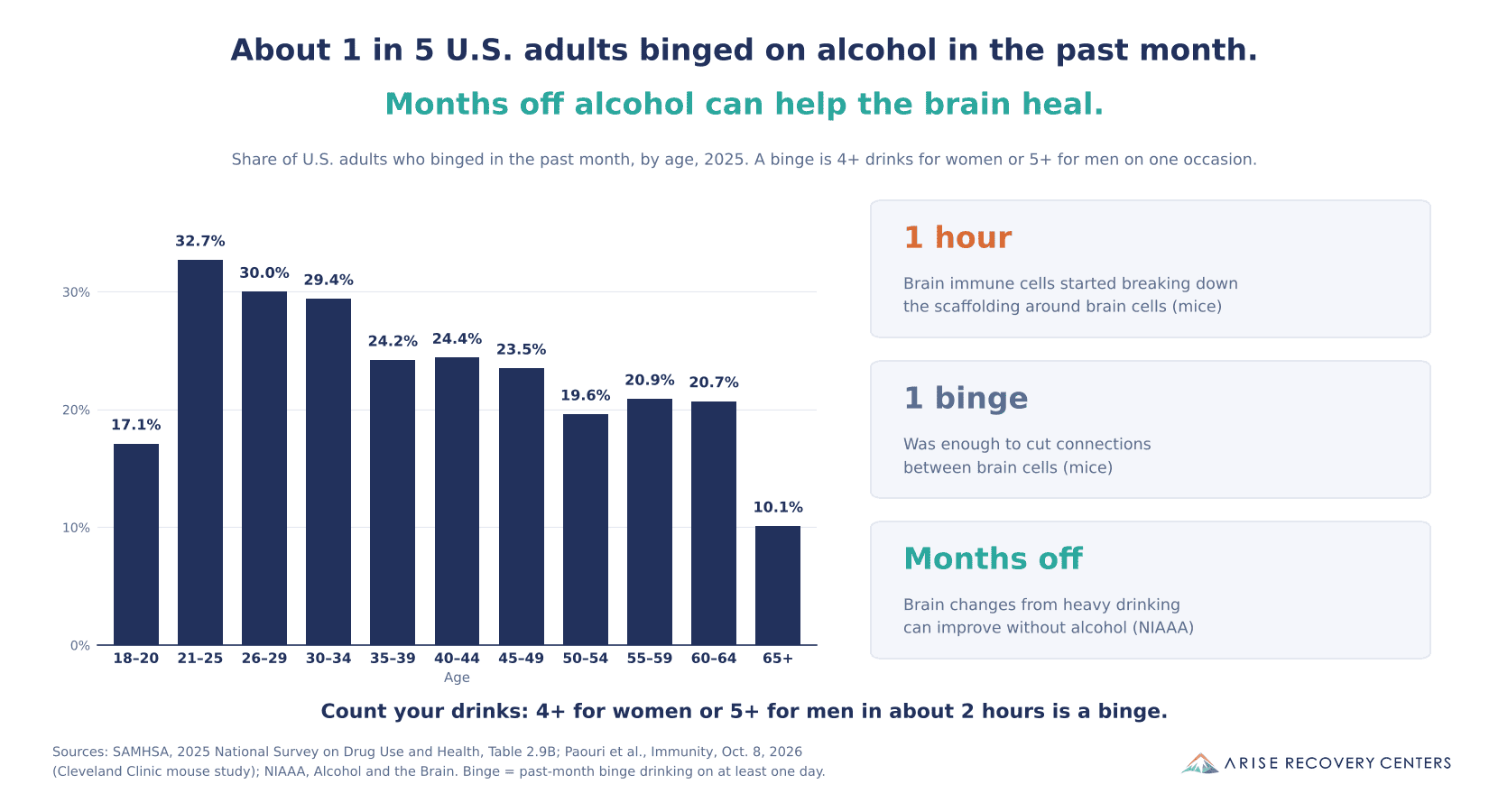
The rates stay high long after college. About 3 in 10 people in their late 20s and early 30s binged in the past month. So did about 1 in 4 in their late 30s and 40s, and about 1 in 5 from 50 to 64. Among adults who work full time, the rate was 26.6%.
That last number matters. Binge drinking is common among people with jobs, kids and full calendars. From the outside, it rarely looks like a crisis.
The good news: the brain can recover
NIAAA says a growing number of studies point the same way. At least some brain changes from alcohol use disorder can improve, and possibly reverse, with months without drinking. That includes changes in thinking, mood and behavior.
The mouse study adds a reason to act early. The damage built up with each round of heavy drinking. Cutting back sooner means less of it has a chance to add up.
The brain can heal. Some changes from heavy drinking improve with months off alcohol.
That is NIAAA’s read of the research. Support makes those months easier, and outpatient care fits around work.
One safety note. If you have been drinking heavily every day for a long time, do not quit cold turkey on your own. NIAAA warns that sudden withdrawal can be painful and even life-threatening, and a doctor can make it safer. Here is how to tell if you need detox first.
Overrated vs. underrated
Overrated
- “It’s only on weekends.” In the mice, a single binge was enough to damage the brain’s scaffolding.
- “I can hold my liquor.” Needing more to feel it is tolerance, one of the signs of alcohol use disorder.
- “Binging is a college thing.” About 3 in 10 adults ages 26 to 34 binged in the past month.
Underrated
- Counting drinks. Four for women, five for men, in two hours. Most people never count.
- Time off. A month without alcohol is a start. NIAAA says brain changes can keep improving over months.
- Outpatient care. You keep your job and your routine while you change your drinking.
When it is more than a rough weekend
Binge drinking is not the same thing as alcohol use disorder. But NIAAA says drinking this way, over time, raises the risk of developing it. Signs include drinking more than you meant to, trying to cut back and not managing it, and needing more to feel the same effect. Here are the signs of alcohol use disorder in plain language.
The risk is shifting toward older adults, too. We wrote recently about why heavy drinking at 50 to 64 is up 36%, and why alcohol deaths among young women have climbed so fast.
Arise Recovery Centers provides outpatient drug and alcohol treatment at 12 locations in DFW, Houston and Austin: a day program, intensive outpatient and supportive outpatient. Many people keep working while they attend. This guide to levels of care explains the options. You can schedule a free consultation or verify your insurance online in about two minutes. Both are confidential and do not commit you to anything.
Frequently asked questions
Does binge drinking cause brain damage?
Heavy drinking can harm the brain. In an October 2026 Cleveland Clinic study, a single binge in mice made the brain’s immune cells break down the scaffolding around brain cells. It also cut connections between them. Repeated binges killed brain cells in the frontal cortex. Brain tissue from people with alcohol use disorder showed the same scaffolding damage.
What did the Cleveland Clinic alcohol study find?
Researchers found that microglia, the brain’s immune cells, drive part of alcohol’s damage. In mice, they began breaking down the extracellular matrix within about an hour of heavy alcohol. Turning off a protein called MyD88 in these cells protected the brain and reduced sedation. The study was published October 8, 2026, in the journal Immunity.
What are microglia?
Microglia are the brain’s resident immune cells. They patrol the brain, clear debris and respond to injury. The new study found that heavy alcohol exposure turns them against the brain’s own scaffolding, the extracellular matrix that holds brain cells in place.
How many drinks is binge drinking?
NIAAA defines binge drinking as a pattern that brings blood alcohol to 0.08% or higher. For a typical adult, that is 4 or more drinks for a woman, or 5 or more for a man, in about two hours. One standard drink is 12 ounces of beer, 5 ounces of wine or 1.5 ounces of liquor.
How common is binge drinking in the U.S.?
In the 2025 National Survey on Drug Use and Health, about 56 million U.S. adults, or about 1 in 5, said they binged in the past month. Rates were about 3 in 10 among adults in their late 20s and early 30s, and 26.6% among adults who work full time.
Can the brain recover from heavy drinking?
At least partly, yes. NIAAA says a growing number of studies show that some brain changes from alcohol use disorder can improve, and possibly reverse, with months without alcohol. That includes changes in thinking and mood.
Is it safe to stop drinking suddenly?
It depends on how much and how long you have been drinking. If you have been drinking heavily for a long time, stopping suddenly can cause withdrawal that is painful and even life-threatening, according to NIAAA. Talk to a doctor before you stop. Medication can make withdrawal safer.
Where can I get help for binge drinking in Texas?
Binge drinking and alcohol use disorder can be treated in outpatient care while you keep working. Arise Recovery Centers offers a day program, intensive outpatient and supportive outpatient at 12 locations in DFW, Houston and Austin. A free consultation is confidential and does not commit you to anything.
This article is education, not medical advice, and it does not replace advice from your own doctor.
Sources: Paouri E, Stanko S, Gasmi N, et al., “Microglia-Mediated Extracellular Matrix Disruption Drives Neuronal Dysfunction, Motor Impairments, and Sedation Following Alcohol Abuse,” Immunity, published online October 8, 2026, doi:10.1016/j.immuni.2026.09.011. Cleveland Clinic, “Alcohol and the Brain Interact Through Immune Cells, New Research Shows,” news release via EurekAlert!, October 13, 2026. ScienceAlert, “Alcohol Triggers Immune Cells to Destroy the Brain’s Structural Matrix, Study in Mice Shows,” October 2026. Substance Abuse and Mental Health Services Administration, Results from the 2025 National Survey on Drug Use and Health: Detailed Tables, Tables 2.9A, 2.9B and 2.28B. National Institute on Alcohol Abuse and Alcoholism, “Understanding Binge Drinking”; “Drinking Levels and Patterns Defined”; “Alcohol and the Brain: An Overview”; “Understanding Alcohol Use Disorder”; Rethinking Drinking, “Should You Cut Down or Quit?”