
By Danny Andino, CEO, Arise Recovery Centers · Clinically reviewed by Nicholas Overbeck, LPC-S, LCDC · November 2026
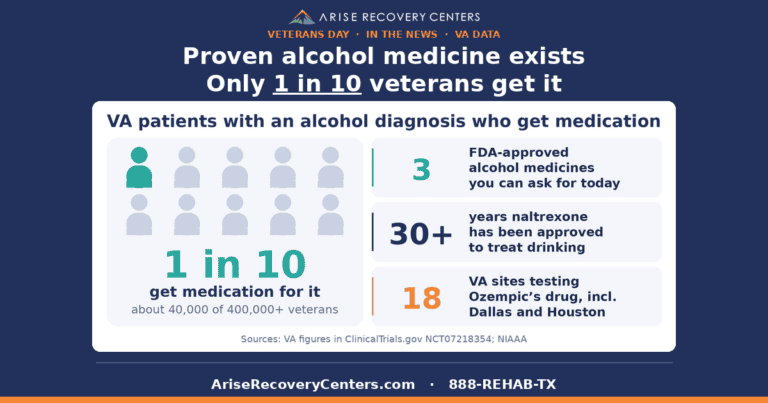
This Veterans Day, start with a number the VA keeps about its own patients. More than 400,000 veterans in VA health care have a diagnosis of alcohol use disorder. Only about 40,000 of them are getting medication for it.
The VA just launched a national trial to see whether the drug in Ozempic can help. Two of the sites are in Dallas and Houston. But medicines that already work have been around for decades. Here is what they are, and how to get started without waiting.
The short version
- The VA counts more than 400,000 veterans in its care with an alcohol use disorder diagnosis. About 40,000 of them, roughly 1 in 10, get medication for it.
- Outside the VA, the number is lower. In 2025, fewer than 3 in 100 Americans with alcohol use disorder got medication for it.
- Three medicines are FDA-approved for alcohol use disorder. The newest was approved in 2004. A 2023 review of 118 clinical trials called two of them, naltrexone and acamprosate, first-line treatments.
- The VA’s new trial is testing semaglutide, the drug in Ozempic and Wegovy, in about 622 veterans. The Dallas VA and Houston’s Michael E. DeBakey VA are both enrolling.
- Main results are expected in 2029. The VA says not to start these drugs on your own to treat drinking.
- Medicine works best alongside counseling. Outpatient treatment gives you both while you keep working and live at home.
What the VA is testing
The trial is called CRAVE. It began enrolling on July 28, 2026, at 18 VA medical centers. It plans to enroll about 622 veterans ages 18 to 80 who have moderate or severe alcohol use disorder and want to cut back.
Half will get a weekly shot of semaglutide for 24 weeks. The other half will get placebo shots. Researchers will track how much each group drinks.
Semaglutide is approved for diabetes and weight loss, not for alcohol use disorder. Early studies are promising, and we walked through them in what the trials found on Ozempic and drinking. But the VA is clear on one point. Do not start a GLP-1 drug on your own to treat drinking. Proven treatments are already available.
Veterans in North Texas and the Houston area can ask about the trial at the Dallas VA Medical Center or the Michael E. DeBakey VA Medical Center. Both are listed as recruiting on ClinicalTrials.gov, the federal trial registry.
The bigger story: medicine that works, barely used
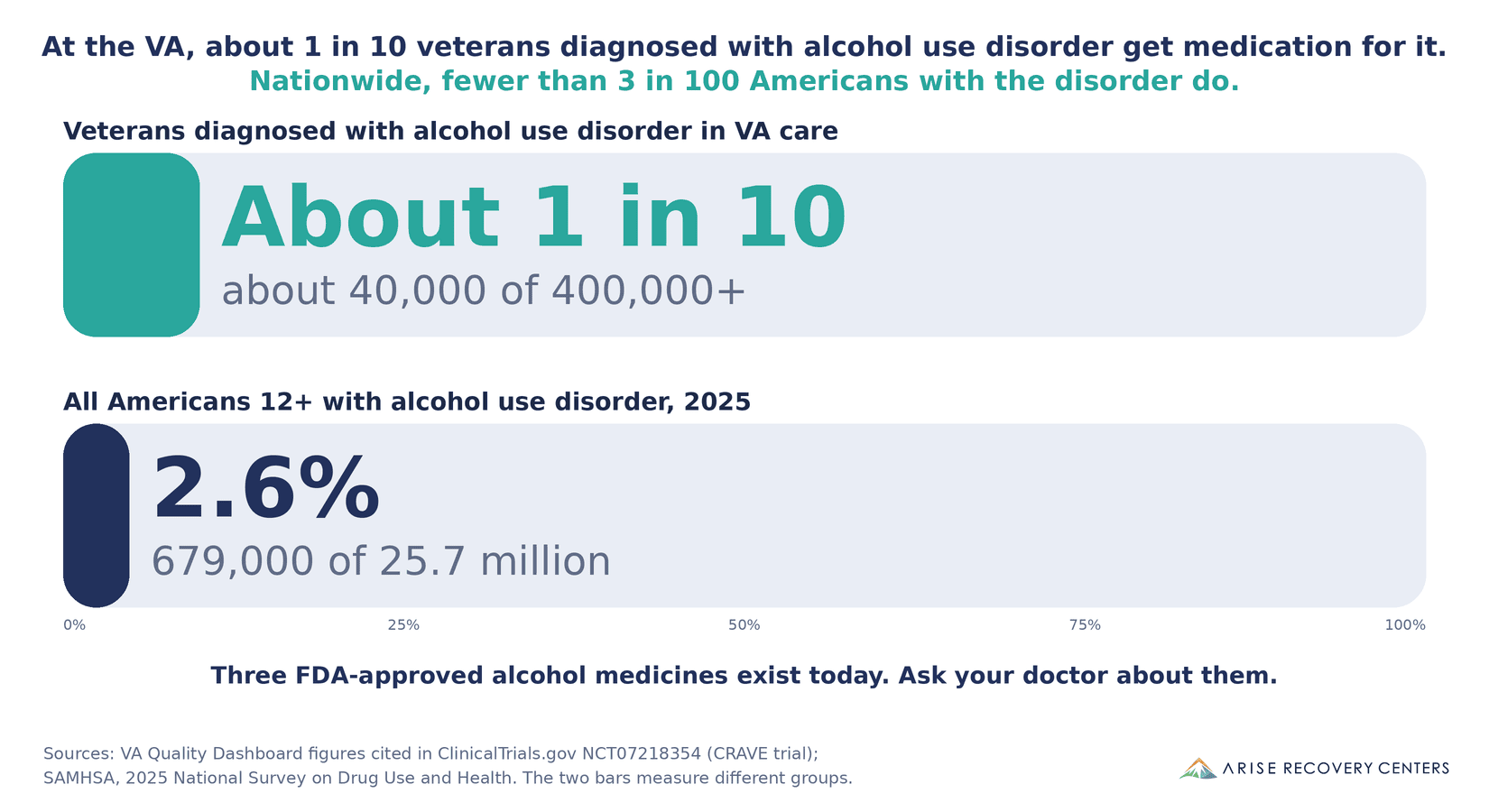
The trial’s federal listing includes a striking line. More than 400,000 veterans in VA care have an alcohol use disorder diagnosis. Only about 40,000 are being treated with medication. The figure comes from the VA’s own quality dashboard.
The VA still does better than most. Nationwide, 25.7 million Americans had alcohol use disorder in 2025, according to SAMHSA’s national survey. Just 2.6% of them got medication for it.
The gap is not because the medicines are new or unproven. The newest one was approved more than 20 years ago. The VA and Defense Department treatment guideline recommends naltrexone or topiramate as first-line medicine for moderate to severe alcohol use disorder.
The medicines, in plain English
| Medicine | What it does | How you take it | Approved for alcohol |
|---|---|---|---|
| Naltrexone | Blunts cravings and makes drinking feel less rewarding | A daily pill or a monthly shot | 1994 (pill), 2006 (shot) |
| Acamprosate | Helps you stay stopped once you have quit | Pills, three times a day | 2004 |
| Disulfiram (Antabuse) | Makes you feel sick if you drink | A daily pill | 1949 |
| Topiramate | Reduces heavy drinking; the VA guideline lists it as first-line | A daily pill | Prescribed off-label |
Sources: National Institute on Alcohol Abuse and Alcoholism; VA/DoD Clinical Practice Guideline for the Management of Substance Use Disorders (2021). Naltrexone cannot be taken with opioid pain medicine, so your doctor will check what fits you.
A 2023 review in JAMA pooled 118 clinical trials with nearly 21,000 people. It found that naltrexone and acamprosate both reduce drinking, and it called them first-line treatments. Most of those trials paired the medicine with counseling. That is how these medicines are meant to be used.
Proven alcohol medicines exist today.
You can ask about naltrexone or acamprosate at your next appointment, at the VA or with any doctor. You do not have to wait for a trial to finish.
Why so few veterans get it
From where we sit, the reasons are rarely medical. They usually sound like one of these:
- “Nobody ever offered it.” Many people with a drinking problem never hear that medicine for it exists. Their doctor never brings it up, so they never ask.
- “I should handle this myself.” Military culture prizes toughness. Asking for help with drinking can feel like weakness. It is not. It is using every tool you have.
- “Treatment means leaving for 30 days.” For many people, it does not. Outpatient care fits around a job and a family.
- “The VA is my only option.” The VA is one door. If you have insurance through work or a spouse, civilian programs are another.
Overrated vs. underrated
Overrated
- Waiting for the Ozempic trial. Results are years away, and the VA says not to start it on your own for drinking.
- Toughing it out. Willpower alone is the hardest way to quit.
- “30 days away or nothing.” Residential care helps some people. It is not the only way to start.
Underrated
- The medicines that already exist. Three are FDA-approved, and they have been used for decades.
- Medicine plus counseling. Most of the trials tested them together.
- Outpatient care near home. You keep your job, your bed and your people.
If you love a veteran who drinks too much
Lead with what you have seen, not a label. “You’ve been drinking more lately, and I’m worried about you” lands better than “You’re an alcoholic.”
Ask what they would like to change. Then offer one concrete next step, like sitting in on the first phone call. Here are more ways to support a loved one through outpatient rehab. If you are not sure the drinking has crossed a line, these are the signs of alcohol use disorder to look for.
Where outpatient care fits in
Medicine handles part of the problem. Counseling handles the rest: the triggers, the stress, the habits and the people. Outpatient treatment gives you both without stepping away from your life.
Arise Recovery Centers provides outpatient drug and alcohol treatment at 12 locations in DFW, Houston and Austin: a day program, intensive outpatient and supportive outpatient. We work alongside your prescriber if you take naltrexone or another alcohol medication, or help you find one. If an assessment points to a higher level of care, we say so and help you find it.
This guide to levels of care explains the options. You can schedule a free consultation or verify your insurance online in about two minutes. Both are confidential and do not commit you to anything.
Safety note: If you drink heavily every day, do not stop suddenly on your own. Alcohol withdrawal can be dangerous, so talk to a doctor first, or read whether you need detox before rehab. If you or a veteran you love is in crisis, call 988 and press 1 for the Veterans Crisis Line, or text 838255.
Frequently asked questions
How many veterans have alcohol use disorder?
The VA reports that more than 400,000 veterans in its health care system have a diagnosis of alcohol use disorder. VA figures cited in the CRAVE trial’s federal registry listing show only about 40,000 of them are being treated with medication, roughly 1 in 10.
What medications treat alcohol use disorder?
Three medicines are FDA-approved: naltrexone, which comes as a daily pill or a monthly shot, acamprosate and disulfiram. The VA and Defense Department guideline also recommends topiramate, which is prescribed off-label. A 2023 JAMA review of 118 trials found that naltrexone and acamprosate both reduce drinking.
Is the VA testing Ozempic for alcohol use disorder?
Yes. The CRAVE trial began July 28, 2026. It is testing weekly semaglutide, the drug in Ozempic and Wegovy, against placebo for 24 weeks in about 622 veterans at 18 VA medical centers. Semaglutide is not approved for alcohol use disorder, and the VA advises against using it on your own to treat drinking.
Is the VA alcohol trial enrolling in Texas?
Yes. ClinicalTrials.gov lists the Dallas VA Medical Center and the Michael E. DeBakey VA Medical Center in Houston as recruiting sites. The trial is for veterans ages 18 to 80 with moderate or severe alcohol use disorder who want to cut back. Ask your VA care team, or search for the CRAVE trial on ClinicalTrials.gov.
Is naltrexone addictive?
No. Naltrexone is not a controlled substance and does not produce a high. It blocks opioid receptors, so it cannot be taken with opioid pain medicine. Your doctor will check for that before prescribing it.
Do veterans have to get alcohol treatment through the VA?
No. The VA is one option. Veterans with insurance through work, a spouse or another plan can also use civilian doctors and treatment programs.
Can I keep working during outpatient alcohol treatment?
Many people do. Supportive and intensive outpatient programs meet for set hours each week, so most people keep their jobs. A day program takes more time each week and is used when someone needs more support.
Where can veterans find outpatient alcohol treatment in Texas?
Arise Recovery Centers offers a day program, intensive outpatient and supportive outpatient at 12 locations in DFW, Houston and Austin. We work alongside your prescriber on medication, or help you find one. A free consultation is confidential and does not commit you to anything.
This article is education, not medical advice.
Sources: U.S. Department of Veterans Affairs, “Philadelphia VA Healthcare System Named One of 18 VA Sites to Test Efficacy of GLP-1 as Treatment for Alcohol Use Disorder,” press release, July 30, 2026. ClinicalTrials.gov, NCT07218354, “Cessation or Reduction of Alcohol Consumption in Veterans: A Randomized Controlled Trial for Alcohol Use Disorder (CRAVE),” VA Office of Research and Development, CSP #2041, record updated September 2026 (VA Quality Dashboard figures accessed January 31, 2025). Substance Abuse and Mental Health Services Administration, “SAMHSA Releases Annual National Survey on Drug Use and Health,” July 27, 2026. National Institute on Alcohol Abuse and Alcoholism, “Medications Development Program.” McPheeters M, et al., “Pharmacotherapy for Alcohol Use Disorder: A Systematic Review and Meta-Analysis,” JAMA, 2023;330(17):1653–1665. U.S. Department of Veterans Affairs and Department of Defense, VA/DoD Clinical Practice Guideline for the Management of Substance Use Disorders, 2021. Veterans Crisis Line.