
By Danny Andino, CEO, Arise Recovery Centers · Clinically reviewed by Nicholas Overbeck, LPC-S, LCDC · October 2026
Federal prosecutors call it the largest addiction treatment fraud case the Justice Department has ever brought. Two of the people charged with recruiting patients live in Greenville, Texas, about 50 miles northeast of Dallas.
The pitch they allegedly used still works on families in a crisis. Here is what happened, the red flags to know by heart, and a five-minute check that tells a real program from a fake one.
The short version
- On October 22, 2026, federal prosecutors in Los Angeles charged a father and son who allegedly ran dozens of Southern California treatment companies. Prosecutors say they billed private insurers more than $1.6 billion for sham treatment.
- Two alleged recruiters in the case are from Greenville, Texas. Prosecutors say recruiters lured people from around the country with cash, apartments, gift cards, drugs and free flights.
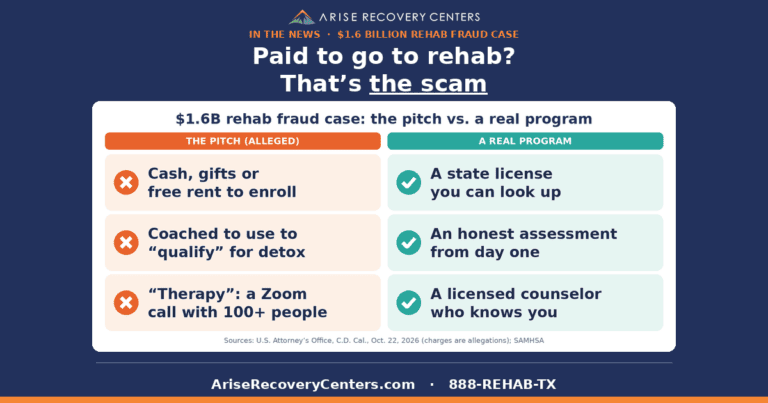
- Patients were allegedly coached to use drugs or fake symptoms so they would qualify for detox. The “therapy” that followed was a Zoom call with more than 100 people.
- A real program never pays you to sign up. Paying or taking money for patient referrals has been a federal crime since 2018.
- Every licensed treatment program in Texas can be looked up on the state’s website in about a minute. Checking accreditation takes another minute.
- Outpatient care close to home means you sleep in your own bed, keep your phone, and keep your family in the loop.
What prosecutors say happened
The U.S. Attorney’s Office in Los Angeles announced the case on October 22. It charges four people: a father and son from Los Angeles who allegedly controlled the treatment companies, and two alleged recruiters from Greenville, Texas.
Prosecutors say the recruiters, known in the industry as “body brokers,” targeted people who were homeless, short on money, or attending support-group meetings. They looked for people whose insurance paid the most. Sometimes, prosecutors say, they enrolled people in insurance plans they did not qualify for.
The bait, according to the charges, was money, apartments, hotel stays, cars, gift cards, cigarettes, drugs and free flights. Once patients arrived, staff allegedly coached them to fake symptoms, or to drink or use, so they would qualify for detox.
After detox, the “therapy” was allegedly a Zoom call with more than 100 people. Patients only had to turn their cameras on. Some were cut off from family, had their belongings withheld, and were physically blocked from leaving. Prosecutors say some who tried to leave were drugged to keep them there. Court documents reviewed by Behavioral Health Business describe one patient who never attended a therapy session in 13 months.
These are charges, not convictions. Everyone charged is presumed innocent unless proven guilty in court.
Why this lands in Texas
This is not just a California story. Prosecutors say patients were brought in “from around the country.” When a family is up at 2 a.m. searching for help, a stranger offering cash, free housing and a bed by tomorrow can sound like an answered prayer.
That is a sales pitch. A 2018 federal law, the Eliminating Kickbacks in Recovery Act, makes it a crime to pay or take money for patient referrals. It covers treatment programs, recovery homes and labs, even when private insurance pays. Each violation can bring up to 10 years in prison.
The red flags
Every item below comes from what prosecutors describe in this case. Any one of them is a reason to walk away.
Walk away if you hear this
- Cash, gift cards, free rent or other perks to get you to enroll.
- A recruiter who finds you at a meeting, a shelter or online and promises a bed today.
- An offer to sign you up for new insurance before you start.
- Being told to use, or to describe worse symptoms, so you “qualify.”
- Your phone or belongings taken, or calls with family discouraged.
- “Therapy” that is a big video call with no counselor checking on you.
Help getting to care is not a red flag by itself. Many programs help patients get to appointments, and some help arrange travel to a higher level of care. The red flag is perks offered to get you to sign up, especially from a recruiter who also wants your insurance details.
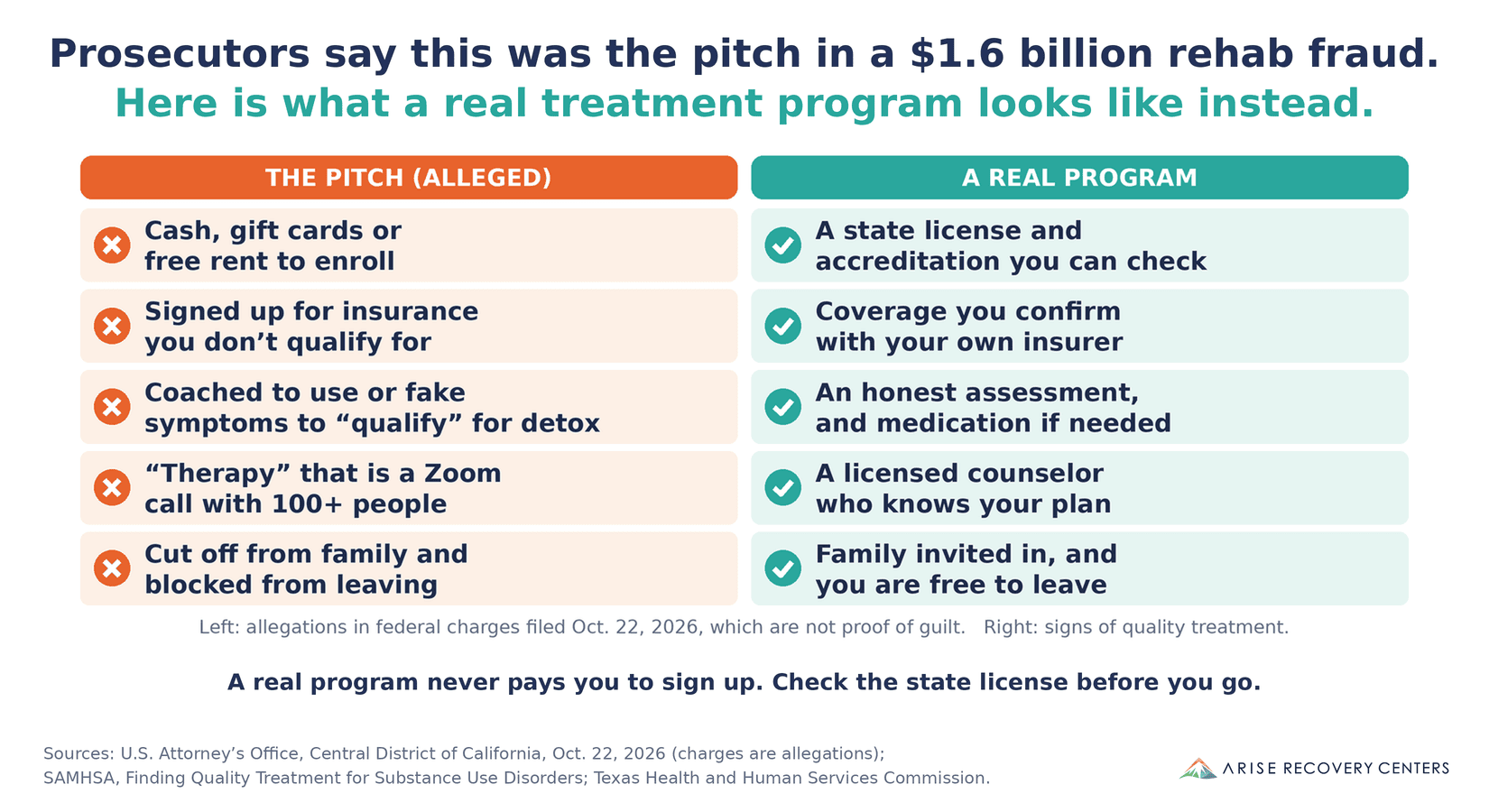
A real program never pays you to sign up.
If someone offers money, gifts or free housing to get you into a program, walk away. Then call your insurance company yourself.
The five-minute check
Run these five checks on any program before you or someone you love walks in the door. The first two take about a minute each.
- Look up the state license. Texas Health and Human Services licenses addiction treatment facilities. Anyone can verify a license on its website.
- Check accreditation. Search the program’s name on The Joint Commission’s lookup. CARF is the other major accreditor of treatment programs.
- Call your insurance yourself. Use the number on the back of your card and ask if the program is in network. Do not let a recruiter “handle” your coverage.
- Ask about medication. Federal health officials list FDA-approved medication for alcohol and opioid use disorders as a sign of quality care.
- Ask how family is involved. A real program invites family in. It does not cut them off.
Checks 4 and 5 come from SAMHSA’s five signs of quality treatment: accreditation, medication, proven therapies, family involvement and ongoing support.
Overrated vs. underrated
Overrated
- “All expenses paid.” Free rent and spending money to enroll is the pitch, not a perk.
- Star ratings. Online reviews are easy to fake. A state license is not.
- “We have a bed tonight.” Fast help is good. Fast help with no license check is how people get trapped.
Underrated
- The license lookup. It is free, public and takes about a minute.
- Calling your own insurer. Your plan can tell you who is in network and what you will owe.
- Care close to home. You keep your bed, your phone, your job and your people.
Why close to home is a safer place to start
For many people, outpatient treatment near home is the right place to start. You go to sessions and sleep in your own bed. Nobody can take your phone or lock a door. Your family can see what treatment looks like and be part of it.
Distance itself is not the danger. Isolation is. If an assessment shows you need more, like medical detox or residential care, a good program says so and helps you find a licensed one. Here is how to tell whether you need detox first, and why location matters more than people think. If you are helping someone else, these are ways to support a loved one through outpatient rehab.
Arise Recovery Centers provides outpatient drug and alcohol treatment at 12 locations in DFW, Houston and Austin: a day program, intensive outpatient and supportive outpatient. Our programs are licensed by Texas Health and Human Services and accredited by The Joint Commission. You can check both with the links above.
This guide to levels of care explains the options. You can schedule a free consultation or verify your insurance online in about two minutes. Both are confidential and do not commit you to anything.
Frequently asked questions
What is the $1.6 billion rehab fraud case?
On October 22, 2026, the U.S. Attorney’s Office in Los Angeles charged four people in what it calls the largest case of its type the Justice Department has ever prosecuted. Prosecutors say a father and son ran dozens of Southern California treatment companies that billed private insurers more than $1.6 billion for sham addiction treatment. The charges are allegations, not convictions.
Were Texans involved in the rehab fraud case?
Yes. Two of the four people charged are alleged recruiters from Greenville, Texas, about 50 miles northeast of Dallas. Prosecutors say recruiters brought patients to Southern California from around the country.
What is a body broker in addiction treatment?
A body broker is someone paid to steer people into a treatment program or recovery home, often by offering them cash, gifts or free housing. Since 2018, the federal Eliminating Kickbacks in Recovery Act has made paying or taking money for those referrals a crime, including when private insurance pays.
Is it a red flag if a rehab offers to help with travel?
Not by itself. Many legitimate programs help patients get to care, such as rides to appointments or travel to a higher level of care arranged by a treatment team. The red flag is perks offered to get you to enroll: cash, gift cards, free rent or spending money, especially from a recruiter who also wants your insurance information.
How do I check if a rehab is licensed in Texas?
Texas Health and Human Services licenses chemical dependency treatment facilities, the state’s term for addiction treatment programs. Its website has a “Find or Verify a License” section with an online license search and a downloadable list of licensed facilities. It takes about a minute.
How can I tell if an addiction treatment program is legitimate?
Check for a state license and accreditation from The Joint Commission or CARF. Call your insurance company yourself to confirm the program is in network. Then ask whether the program offers medication for alcohol or opioid use disorder and how it involves family. Those are among the signs of quality treatment that SAMHSA lists.
What should I do if I think a rehab is a scam?
Do not enroll, and do not hand over your insurance information. You can file a complaint with Texas Health and Human Services, which licenses and inspects treatment facilities. Call the fraud line for your insurance company too. If someone is in danger, call 911.
Where can I find legitimate outpatient rehab in Texas?
Start by checking any program’s state license and accreditation. Arise Recovery Centers offers a day program, intensive outpatient and supportive outpatient at 12 locations in DFW, Houston and Austin. Our programs are licensed by Texas Health and Human Services and accredited by The Joint Commission. A free consultation is confidential and does not commit you to anything.
This article is education, not medical advice.
Sources: U.S. Attorney’s Office, Central District of California, “L.A. Health Care Fraud Takedown Results in 15 Defendants Charged, Including Six Medical Professionals,” October 22, 2026 (updated October 26, 2026). Behavioral Health Business, “DOJ Charges Sham SUD Network in $1.6B Fraud Scheme,” October 23, 2026. Shatterproof, “Shatterproof Statement on DOJ Addiction Treatment Fraud Charges,” October 29, 2026. Eliminating Kickbacks in Recovery Act of 2018, 18 U.S.C. § 220. Substance Abuse and Mental Health Services Administration, Finding Quality Treatment for Substance Use Disorders (PEP18-TREATMENT-LOC). Texas Health and Human Services Commission, “Chemical Dependency Treatment Facilities”; Texas Health and Safety Code, Chapter 464. The Joint Commission, “Find Accredited Organizations.”