
By Danny Andino, CEO, Arise Recovery Centers · Clinically reviewed by Nicholas Overbeck, LPC-S, LCDC · October 2026
A lot of people didn’t quit drinking. They swapped. The six-pack became a four-pack of THC seltzers, and the hangovers went away.
That swap is about to get harder. A federal law signed last November rewrites what counts as legal hemp. On December 11, 2026, nearly every THC drink sold today falls outside the new line.
The short version
- A federal law signed November 12, 2025, caps hemp products at 0.4 milligrams of total THC per container. Anything above that is no longer legal hemp.
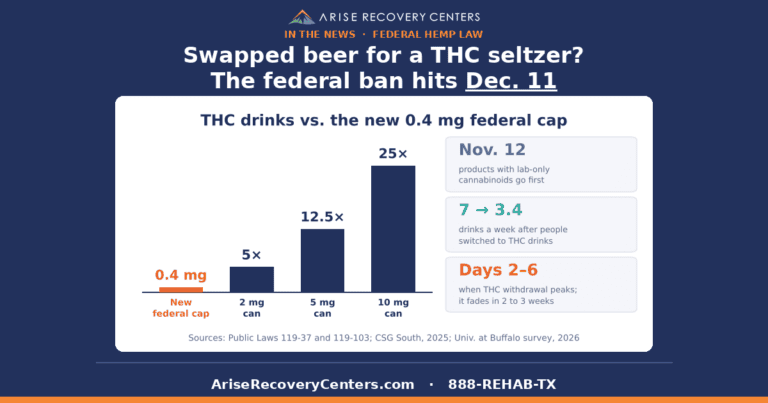
- Most THC drinks have 2 to 10 milligrams per can. That is 5 to 25 times the new line.
- Products with cannabinoids the plant can’t make on its own lose hemp status November 12, 2026. The 0.4 mg cap and the rest of the change start December 11, 2026, unless Congress delays it again.
- In Texas, THC drinks are legal today for adults 21 and older. The federal change applies on top of Texas rules.
- If THC drinks helped you drink less, the goal is to keep the drinking down when the cans disappear.
- If you use THC every day, stopping can bring a few rough weeks of poor sleep and irritability. It usually peaks in days 2 to 6 and fades in 2 to 3 weeks.
What changes, and when
For years, federal law treated hemp as legal if it had no more than 0.3% delta-9 THC by dry weight. That loophole created the THC drink aisle. Last November, Congress rewrote the definition in a funding bill, effective one year later. In September, a second funding bill pushed most of it back one month.
| Date | What happens |
|---|---|
| November 12, 2025 | Congress rewrites “hemp” in Public Law 119-37. The new rules start one year later. |
| January 20, 2026 | The Texas Alcoholic Beverage Commission finalizes its rules: THC drinks sold only to adults 21 and older, with ID checks. |
| September 2, 2026 | A new funding law delays most of the change to December 11, 2026. |
| November 12, 2026 | Products with cannabinoids the plant cannot make on its own lose federal hemp status. |
| December 11, 2026 | Everything else starts, including the 0.4 mg per container cap on total THC. |
Sources: Public Law 119-37, Division B, Section 781; Public Law 119-103 (H.R. 6500), Section 2019; Texas Tribune reporting on TABC rules, January 2026.

The limit is per container, not per serving. A 12-pack does not get twelve times the room. In practice, nearly every THC seltzer sold today is over the line.
Why so many drinkers switched
The swap was real. A 2026 University at Buffalo survey asked 438 adults who use cannabis about their drinking. People who started THC drinks said they went from about 7 drinks a week to about 3.4. About 6 in 10 said they cut back or stopped.
It was a small, self-reported survey, so it cannot prove the drinks caused the change. But it matches what a lot of people describe: same ritual, same can in hand, no hangover.
The bigger picture has shifted too. In 2022, for the first time, more Americans used cannabis daily or near-daily than drank that often: 17.7 million versus 14.7 million, according to a study in the journal Addiction.
The drinking you cut doesn’t have to come back.
If you went from 7 drinks a week to 3, you already proved the pattern can change. The ban takes away a product. It does not take away what you learned.
What happens when the cans disappear
There are two risks, and they point in opposite directions.
The first is the drinking coming back. If THC drinks were how you wound down, the evening still needs something. For a lot of people, the easiest thing within reach will be a beer.
The second is THC itself. Cannabis use disorder is real. The National Institute on Drug Abuse estimates 22% to 30% of people who use cannabis have it, and using daily is the strongest predictor. If you have been drinking THC every night, stopping can bring withdrawal: poor sleep, irritability, anxiety, low appetite.
It is uncomfortable, not dangerous. It usually peaks in days 2 to 6 and fades in 2 to 3 weeks. Here is the full day-by-day withdrawal timeline from our article on the Texas delta-8 ban.
Overrated vs. underrated
Overrated
- “Stock up before December 11.” A closet full of cans is not a plan. It is a supply with an expiration date.
- “When they’re gone, I’ll just go back to beer.” That hands back the progress you made.
- “It’s just a seltzer.” Every night for months is a habit, whatever is in the can.
Underrated
- Picking your own date. Stopping on your schedule is easier than stopping when the shelf empties.
- Fixing sleep first. Bad sleep is what sends most people back to the can or the bottle.
- A new ritual. Something cold in a can still works. Non-alcoholic beer helps some people and not others.
A plan for the next 8 weeks
- Count honestly this week. How many THC drinks and how many alcoholic drinks, per week. Write both numbers down.
- Pick your date before December 11. Start tapering now, so the last can is your choice, not the store’s.
- Plan the evening, not the product. Decide what happens at 7 p.m. when you used to open a can: a walk, a call, a different drink, an early night.
- Protect your sleep for three weeks. Same bedtime, no screens in bed, less caffeine after noon. Insomnia is the hardest part of THC withdrawal.
- Watch the alcohol number. If it climbs back toward where it was, that is not failure. It is information, and it is a good time to talk to someone.
Arise Recovery Centers treats alcohol and cannabis use disorders in outpatient care at 12 locations in DFW, Houston and Austin. Supportive outpatient is about 4 hours a week, intensive outpatient about 10 and the day program about 25. You keep your job and sleep in your own bed. This guide to levels of care explains the options. You can schedule a free consultation or verify your insurance online in about two minutes. Both are confidential and do not commit you to anything.
Frequently asked questions
Are THC drinks being banned?
Most of them, under federal law. A law signed November 12, 2025, limits hemp products to 0.4 milligrams of total THC per container. Most THC drinks have 2 to 10 milligrams per can, so they will no longer count as legal hemp once the rule takes effect.
When does the THC drink ban start?
Products made with cannabinoids the plant cannot produce on its own lose federal hemp status November 12, 2026. The rest, including the 0.4 mg cap, starts December 11, 2026. Congress already delayed it once, in September 2026, and could change the date again.
What is the 0.4 mg THC limit?
It is the most total THC a finished hemp product can contain per container. “Total THC” includes THCA, which turns into THC when heated. The limit applies to the whole can, bottle or package, not to each serving.
Are THC drinks legal in Texas?
Yes, for now. Texas allows hemp-derived THC drinks for adults 21 and older, and stores licensed by the Texas Alcoholic Beverage Commission must check ID. The federal change applies on top of Texas rules, so products over the new line will no longer be legal hemp once it takes effect.
Do THC drinks help you drink less alcohol?
Some people say yes. In a 2026 University at Buffalo survey of 438 cannabis users, people who started THC drinks reported going from about 7 drinks a week to 3.4. The survey was small and self-reported, so it cannot prove cause and effect.
Can you get addicted to THC drinks?
Yes. The National Institute on Drug Abuse estimates 22% to 30% of people who use cannabis have cannabis use disorder. Frequent use is the strongest risk factor. The form does not change that. A daily drink is daily use.
What happens if I stop drinking THC seltzers?
If you used them often, you may have withdrawal: trouble sleeping, irritability, anxiety and low appetite. A 2020 review found withdrawal in about 47% of regular users. Symptoms usually peak in days 2 to 6 and fade in 2 to 3 weeks. It is uncomfortable but not medically dangerous.
How do I keep from drinking more when THC drinks go away?
Plan the evening, not the product. Pick a stop date, protect your sleep and track your alcohol each week. If drinking starts climbing back, outpatient care can help while you keep working. At Arise Recovery Centers, intensive outpatient is about 10 hours a week, at 12 locations in DFW, Houston and Austin.
This article is education, not medical or legal advice, and it does not replace advice from your own doctor.
Sources: Public Law 119-37, Division B, Section 781, amending Section 297A of the Agricultural Marketing Act of 1946 (signed November 12, 2025). Continuing Appropriations and Extensions Act, 2027 (H.R. 6500, Public Law 119-103), Section 2019, “Section 781 Extension” (signed September 2, 2026). Texas Tribune, “TABC finalizes rules for consumable hemp industry in Texas,” January 20, 2026. Council of State Governments South, “Hemp Beverages: High Risk or High Reward?” December 2025. Kruger JS, Felicione N, Kruger DJ, “The Exploration of Cannabis Beverage Substitution for Alcohol: A Novel Harm Reduction Strategy,” Journal of Psychoactive Drugs, 2026. Caulkins JP, “Changes in Self-Reported Cannabis Use in the United States from 1979 to 2022,” Addiction 119, no. 9 (2024): 1648–1652. National Institute on Drug Abuse, “Cannabis (Marijuana).” Bahji A, et al., “Prevalence of Cannabis Withdrawal Symptoms Among People With Regular or Dependent Use of Cannabinoids,” JAMA Network Open 3, no. 4 (2020). Bonnet U, Preuss UW, “The Cannabis Withdrawal Syndrome: Current Insights,” Substance Abuse and Rehabilitation 8 (2017): 9–37.