
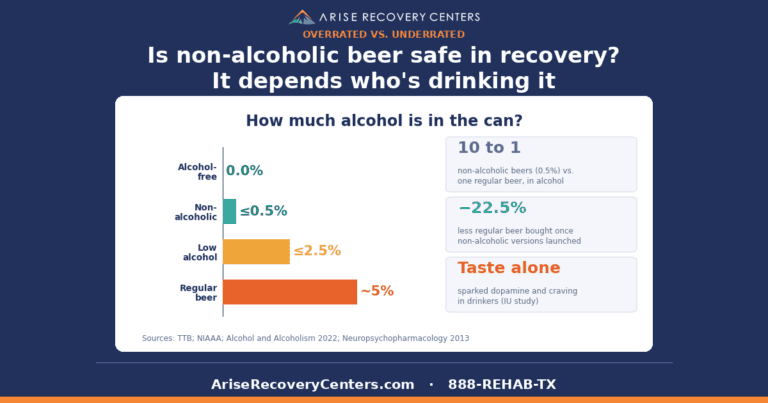
By Danny Andino, CEO, Arise Recovery Centers · Clinically reviewed by Nicholas Overbeck, LPC-S, LCDC · September 2026 · Overrated vs. Underrated
Non-alcoholic beer is having a moment. Gallup’s August 2026 poll found 17% of U.S. adults have swapped in non-alcoholic drinks for alcohol, and more than a third of them are drinking more of those alternatives than before.
So is non-alcoholic beer a smart tool or a sneaky trap? The honest answer is that it depends on who is drinking it.
The short version
- “Non-alcoholic” on a U.S. beer label can mean up to 0.5% alcohol. Only “alcohol-free” means zero.
- For people cutting back, non-alcoholic beer looks like a real help. When brands launched non-alcoholic versions in the UK, households that bought them bought about 22.5% less of the regular beer.
- For people in recovery from alcohol use disorder, it is riskier. In one study, the taste of beer alone, with no alcohol effect, triggered dopamine release and cravings.
- Early recovery, a family history of alcoholism, or taking disulfiram (Antabuse) are all reasons to skip it.
- If you are in treatment, talk it through with your counselor before you try one.
What “non-alcoholic” actually means
The words on the can matter. Federal labeling rules from the Alcohol and Tobacco Tax and Trade Bureau (TTB) set three different lines.
| Label says | Alcohol allowed | What that means for you |
|---|---|---|
| Alcohol-free | 0.0% | No alcohol at all |
| Non-alcoholic | Under 0.5% | A trace amount. The can must say “contains less than 0.5% alcohol by volume.” |
| Low or reduced alcohol | Under 2.5% | This is real alcohol. It is not a recovery drink. |
| Regular beer | About 5% | One 12-ounce can is one standard drink |
Source: TTB malt beverage labeling rules. Regular beer and standard drink: NIAAA.
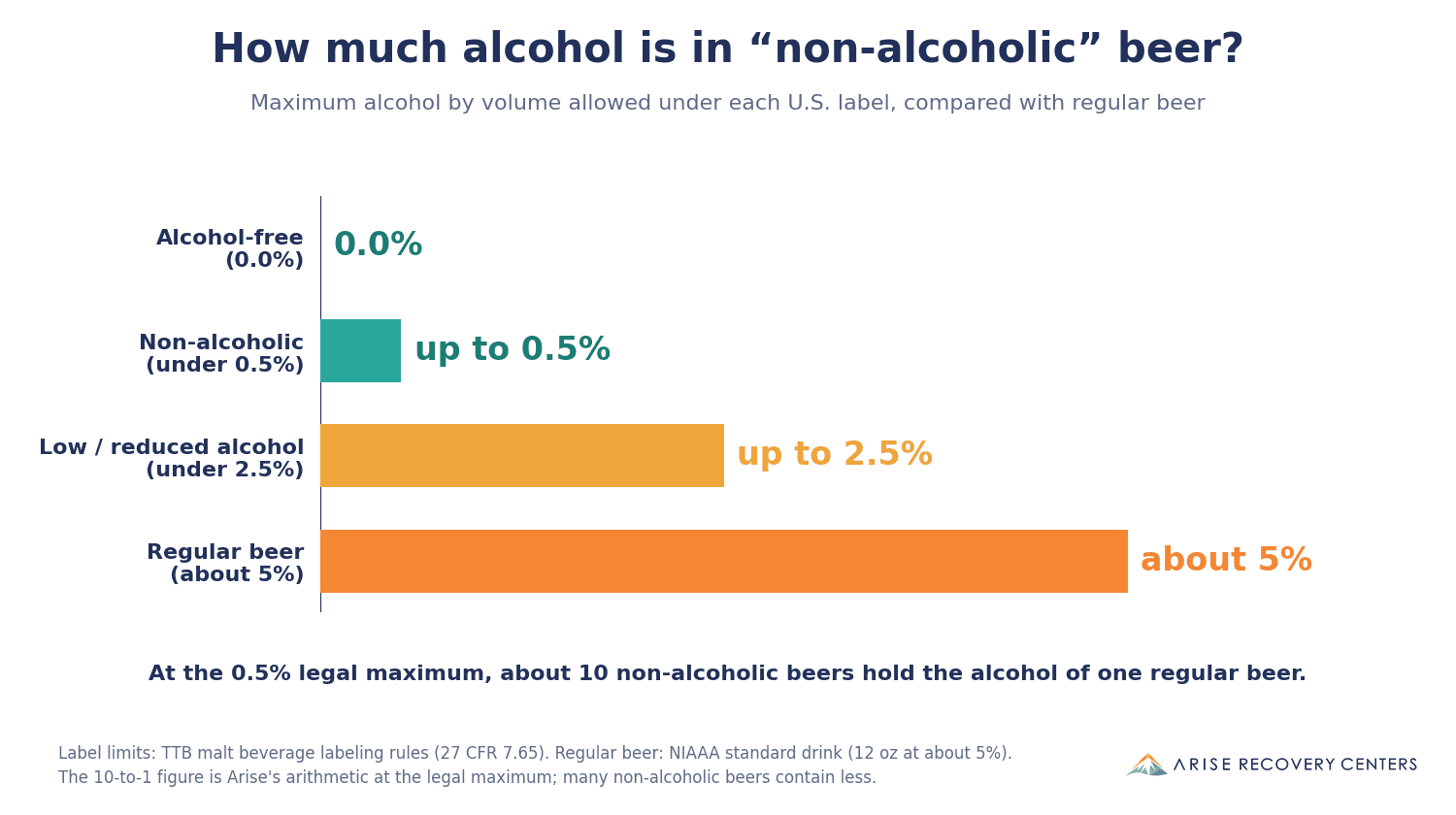
Here is the math on that 0.5%. A regular beer is about 5% alcohol, so a can of non-alcoholic beer at the legal maximum has about one-tenth the alcohol. Roughly ten of them add up to one regular beer. (That is our arithmetic, and most non-alcoholic beers come in lower.)
Nobody gets drunk on non-alcoholic beer. For most people in recovery, the alcohol is not the real issue. The taste is.
The case for non-alcoholic beer: underrated for people cutting back
The best evidence comes from real shopping data. Researchers tracked the beer purchases of 64,280 British households from 2015 to 2018, as brands launched no- and low-alcohol versions of their beers (Alcohol and Alcoholism, 2022).
- Households that bought the regular beer bought about 22.5% less of it after the non-alcoholic version came out.
- The non-alcoholic version was not a gateway. New buyers of the non-alcoholic beer were less than one-third as likely to go on to buy the regular one.
For someone who drinks more than they want to and does not have an alcohol use disorder, that is a meaningful tool. It keeps the ritual, the cold can after work, and drops most of the alcohol.
The same logic is why a lot of people swapped beer for THC seltzers. Most of those cans lose federal legal status on December 11, 2026. If that is you, here is what the THC drinks ban means and how to keep the drinking down.
The case against: risky in early recovery
Addiction is not only about the chemical. The brain also learns the cues around it: the smell, the taste, the sound of a can opening.
A study at Indiana University put that to the test (Neuropsychopharmacology, 2013). Researchers gave 49 men about half an ounce of their favorite beer over 15 minutes. That is far too little to feel. They compared it with a sports drink.
- The taste of beer alone triggered a dopamine release in the brain’s reward system. The sports drink did not.
- The men reported more craving for beer afterward.
- The effect was strongest in men with a family history of alcoholism.
That is the concern in recovery. Non-alcoholic beer can hand your brain the exact cue it spent years linking to drinking, without the part you are trying to avoid. For some people, that turns into craving. For others, it turns into “one real beer won’t hurt.” That thought is a classic part of the mental stage of relapse.
The question is not “is there alcohol in it?” The question is “what does it do to my cravings?”
Some people in long-term recovery drink non-alcoholic beer with no problem. Others find it pulls them right back to the bar. Your honest answer to that question matters more than the label.
A simple way to decide
Green light
Cutting back, no alcohol use disorder
non-alcoholic beer is a reasonable swap. The shopping data suggests it replaces drinks rather than adding to them.
Talk it through first
Stable recovery, a year or more
Some people handle it fine. Raise it with your counselor or sponsor, and notice honestly whether it sparks cravings.
Skip it
Early recovery, family history, or Antabuse
The first months are when cues hit hardest. On disulfiram (Antabuse), Mayo Clinic says to avoid alcohol-containing products, down to sauces and mouthwash.
Trying a month off instead? Here is what Sober October actually does, and how to read your results.
Overrated vs. underrated
Overrated
- “It’s basically soda.” It is built to taste, look and feel like beer. That is the point, and that is the risk.
- “Non-alcoholic” means zero. It can mean up to 0.5%. Look for “alcohol-free” or “0.0%.”
- Using it to prove you’re fine. If you are testing yourself, you already have your answer.
Underrated
- Non-alcoholic beer for people cutting back. Real data shows it replaces regular beer rather than leading to it.
- Drinks that don’t taste like beer. Sparkling water, craft sodas or a new after-work ritual skip the taste cue entirely.
- Asking your counselor. It is a normal question in treatment, not a confession.
What to actually do
Before you reach for one
- Read the label. “Alcohol-free” or “0.0%” is different from “non-alcoholic.”
- Be honest about why. Replacing a habit is different from getting as close to drinking as possible.
- Watch the next 24 hours. More cravings, more thoughts about drinking or bargaining with yourself are your signal to stop.
- If you take disulfiram (Antabuse), skip it. Ask your prescriber before any product that contains alcohol.
- If cutting back is not working, that is useful information too. Heavy drinking is rising in some age groups, and an assessment can tell you whether outpatient treatment makes sense.
Arise Recovery Centers provides outpatient alcohol and drug treatment at 12 locations in DFW, Houston and Austin: a day program, intensive outpatient and supportive outpatient. This guide to levels of care explains the options, and you can verify your insurance online in about two minutes. It is confidential and does not commit you to anything. You may also find additional resources and help through our mental health partner, Saltwood Mental Health in Dallas.
Frequently asked questions
Does non-alcoholic beer have alcohol in it?
It can. Under federal TTB labeling rules, a malt beverage labeled “non-alcoholic” can contain up to 0.5% alcohol by volume and must say so on the label. Only products labeled “alcohol-free” must contain zero alcohol.
Can you get drunk on non-alcoholic beer?
Practically, no. At the 0.5% legal maximum, a can of non-alcoholic beer has about one-tenth the alcohol of a regular 5% beer, so roughly ten would equal one regular beer. Many non-alcoholic beers contain less than that.
Is non-alcoholic beer okay in recovery?
It depends on the person and the stage of recovery. The alcohol content is rarely the problem. The taste and ritual can trigger cravings. A 2013 study in Neuropsychopharmacology found the taste of beer alone triggered dopamine release and craving, most strongly in men with a family history of alcoholism. Many clinicians advise avoiding it in early recovery.
Does drinking non-alcoholic beer count as a relapse?
That is a personal and program-specific question, and recovery communities disagree. A more useful question is what it does to your cravings and your thinking about drinking. If it pulls you toward alcohol, treat that as a warning sign and talk to your counselor.
Does non-alcoholic beer help people drink less?
For people cutting back, the evidence is encouraging. A study of 64,280 British households in Alcohol and Alcoholism (2022) found that when brands launched no- and low-alcohol versions, households bought about 22.5% less of the regular beer, and the non-alcoholic versions did not act as a gateway to stronger beer.
Can I drink non-alcoholic beer on Antabuse (disulfiram)?
No. Mayo Clinic advises people taking disulfiram to avoid alcohol-containing products, including sauces, vinegars, cough syrups and mouthwash, and to keep avoiding them for 14 days after the last dose. Beer labeled non-alcoholic can still contain alcohol. Ask your prescriber before using any such product.
What is the difference between “non-alcoholic” and “alcohol-free”?
“Alcohol-free” means 0.0% alcohol. “Non-alcoholic” means less than 0.5%. “Low” or “reduced” alcohol means under 2.5%, which is real alcohol and not a recovery drink.
What if I can’t cut back on my own?
That is common, and it is not a failure. Outpatient treatment lets you get care while you keep working and living at home. Arise Recovery Centers offers day programs, intensive outpatient and supportive outpatient at 12 Texas locations, and you can verify your insurance online confidentially.
This article is for education, not diagnosis, and it does not replace advice from your own doctor or treatment team.
Sources: Gallup, “Americans’ Drinking Remains at Record Low,” August 20, 2026. TTB, “Malt Beverage Labeling: Alcohol Content” (27 CFR 7.65). Anderson P. et al., “Are Lower-Strength Beers Gateways to Higher-Strength Beers?” Alcohol and Alcoholism, 2022. Oberlin B.G. et al., “Beer Flavor Provokes Striatal Dopamine Release in Male Drinkers,” Neuropsychopharmacology, 2013. Mayo Clinic, “Disulfiram (oral route).” NIAAA, “What is a standard drink?”