
By Danny Andino, CEO, Arise Recovery Centers · Clinically reviewed by Nicholas Overbeck, LPC-S, LCDC · October 2026
Picture someone being treated for opioid addiction. Most people don’t picture a 45-year-old with a job, a mortgage and a health plan through work. The newest numbers say they should.
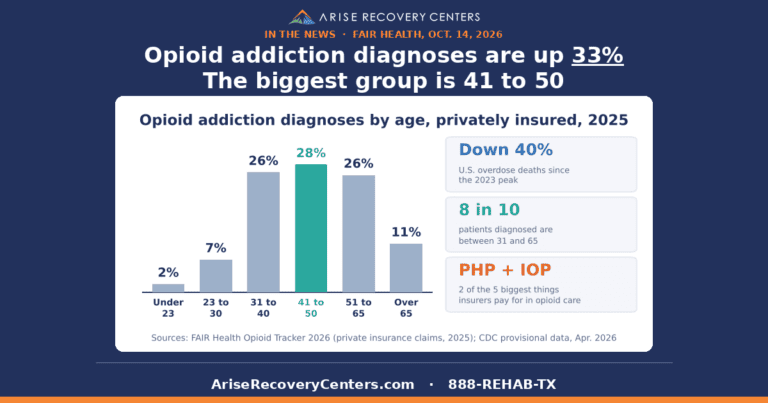
On October 14, FAIR Health released its yearly Opioid Tracker. FAIR Health is a nonprofit with the country’s largest database of private insurance claims. Among privately insured patients, opioid addiction diagnoses rose 33% from 2022 to 2025. The biggest group was 41 to 50.
The short version
- Among people with private insurance, opioid use disorder diagnoses rose 32.7% from 2022 to 2025. That is 449 patients per 100,000 in 2022 and 596 in 2025.
- Ages 41 to 50 were the largest group, at 28%. About 8 in 10 patients were between 31 and 65.
- Texas has a lower rate, 357 per 100,000, but it rose every year. The largest Texas group is 51 to 65.
- Overdose deaths are still falling. More diagnoses can mean more people getting into care, because a diagnosis is usually where treatment starts.
- Private insurance already pays for outpatient opioid care. Day programs and intensive outpatient are two of the five biggest things it pays for in opioid treatment.
- Opioid addiction can be treated while you keep working. Medication paired with counseling is the standard approach.
What the new numbers show
FAIR Health’s tracker covers claims from more than 75 insurers and claims administrators. That means people with private insurance, mostly the kind that comes with a job. Job-based coverage is the most common health insurance in the country. It covered 53.5% of Americans in 2025, according to the U.S. Census Bureau.
| United States | Texas | |
|---|---|---|
| Diagnosed, per 100,000 patients (2025) | 596 | 357 |
| Change since 2022 | Up 32.7%, from 449 | Rose every year, 2022 to 2025 |
| Largest age group | 41 to 50 (28.1%) | 51 to 65 (29.7%) |
| Share ages 31 to 65 | 80% | 81% |
| Men / women | 56% / 44% | 51% / 49% |
Source: FAIR Health Opioid Tracker 2026, national and Texas infographics. Privately insured patients, 2025 data.
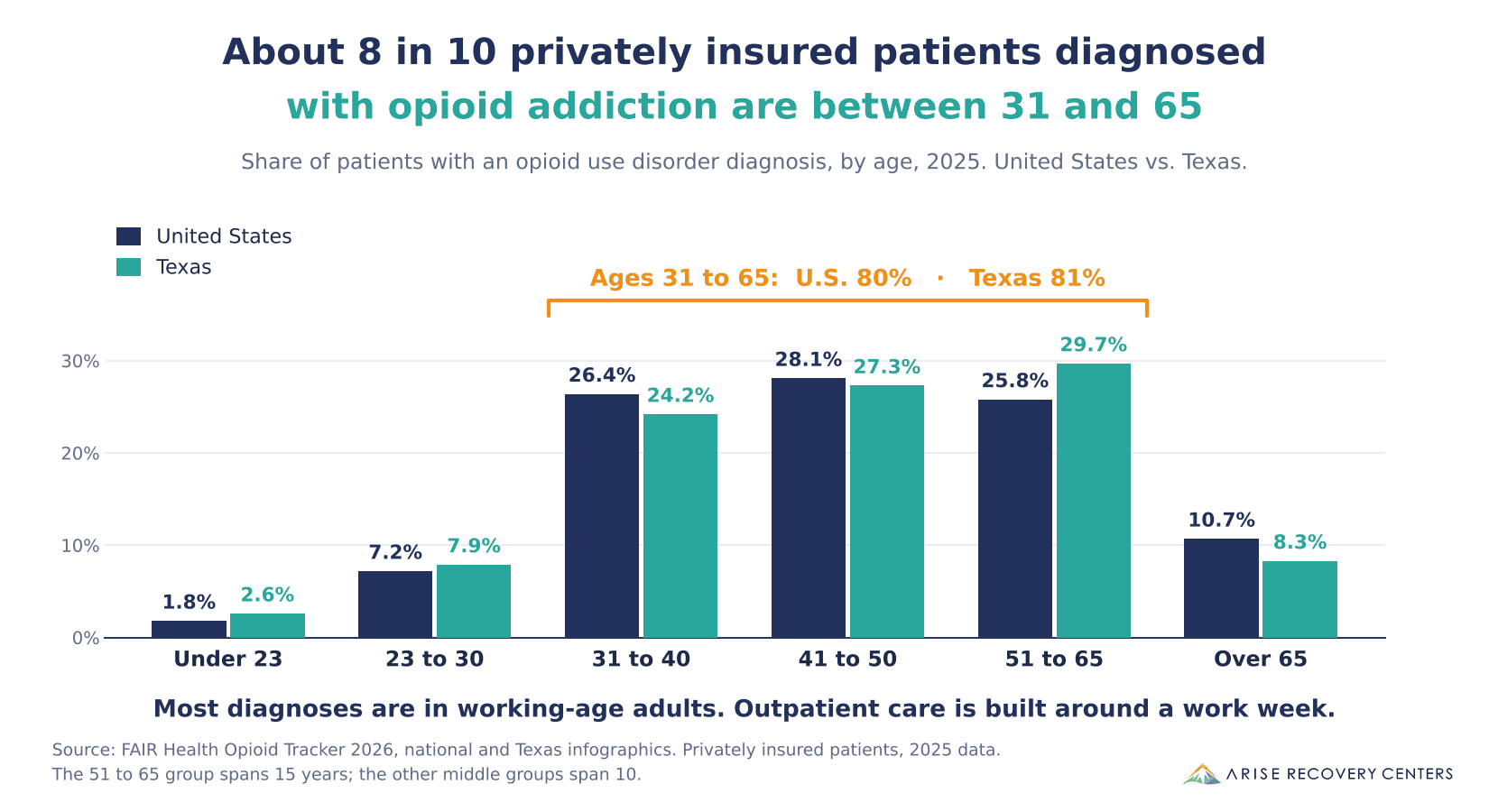
Look at the youngest groups. People under 31 made up less than 1 in 10 diagnoses nationally. Among people with private insurance, opioid addiction is mostly an issue for working-age adults in the middle of their careers.
Fewer deaths, more diagnoses
Overdose deaths are still falling. About 67,000 Americans died of a drug overdose in the 12 months ending April 2026, according to provisional CDC data. That is down about 40% from the 2023 peak. Texas lost about 4,490 people in the same period, roughly 12 a day.
Falling deaths and rising diagnoses can both be true. A diagnosis is usually where treatment starts. A clinician has to name the problem before a health plan will pay to treat it.
The data also shows more front doors. From 2022 to 2025, nurse practitioners’ share of opioid treatment claims grew 67%. Psychiatric nurses’ share grew 47%, and emergency medicine’s grew 44%. Telehealth went from 5.8% of claims to 8.6%. And since 2023, clinicians no longer need a special federal waiver to prescribe buprenorphine, one of the main medications for opioid addiction.
Private insurance already pays for outpatient opioid care.
Day programs and intensive outpatient are two of the five biggest things private insurance pays for in opioid treatment nationally (FAIR Health, 2025 data).
“I can’t take a month off work”
For a lot of people at this age, the first question is about the job, not the drug. Most opioid treatment does not require a month away. Outpatient care runs on a schedule built around your week, and you sleep at home.
At Arise Recovery Centers, supportive outpatient is about 4 hours a week and intensive outpatient about 10. The day program is about 25.
The law gives you more cover than most people know. The Family and Medical Leave Act can protect time off for treatment from a health care provider, if you and your employer qualify. Under the Americans with Disabilities Act, opioid use disorder can count as a disability. The federal Equal Employment Opportunity Commission says people in treatment or recovery may qualify for reasonable accommodations. That protection does not cover current illegal drug use.
Medication is the part most people skip. In 2022, only about 1 in 4 adults who needed opioid addiction treatment got medication for it, according to the CDC. Yet in a study of more than 17,000 overdose survivors, methadone was linked to 59% fewer opioid overdose deaths over the next year. Buprenorphine was linked to 38% fewer. Here is how medication and outpatient counseling work together.
Overrated vs. underrated
Overrated
- “Addiction looks a certain way.” Among the privately insured, the biggest group is 41 to 50, and 8 in 10 are 31 to 65.
- “I’d have to quit my job.” Outpatient care is built around a work week.
- “I’ll taper myself off quietly.” Withdrawal is hard to finish alone. And after a break, your tolerance drops, so a slip is when overdose risk is highest.
Underrated
- Medication. Methadone and buprenorphine are linked to far fewer overdose deaths.
- Telling one clinician the whole truth. A diagnosis is how treatment, and coverage, starts.
- The protections you already have. FMLA and the ADA cover more than most people assume.
If this is you
- Tell one clinician the real story. Your doctor, a nurse practitioner or an addiction program. Name the drug, the amount and how long.
- Ask about medication on day one. Buprenorphine can often be started in an office visit and taken at home.
- Check your coverage instead of guessing. You can verify your insurance online in about two minutes.
- Know your job protections. Ask HR about FMLA, or start with your Employee Assistance Program if you have one. EAPs are generally confidential.
- Keep naloxone at home. Naloxone (Narcan) reverses opioid overdoses and is sold over the counter. Any pill that did not come from a pharmacy can contain fentanyl. If someone has already overdosed, here is what to do in the days after.
Arise Recovery Centers provides outpatient drug and alcohol treatment at 12 locations in DFW, Houston and Austin: a day program, intensive outpatient and supportive outpatient. We work alongside your prescriber if you take buprenorphine or naltrexone, or help you find one. This guide to levels of care explains the options. You can schedule a free consultation or verify your insurance. Both are confidential and do not commit you to anything.
Frequently asked questions
Is opioid addiction increasing?
Diagnoses are. Among people with private insurance, opioid use disorder diagnoses rose 32.7% from 2022 to 2025, according to FAIR Health’s October 2026 Opioid Tracker. Overdose deaths are falling at the same time, down about 40% from the 2023 peak. More diagnoses can mean more people are being identified and treated.
What age group has the most opioid addiction?
Among privately insured patients in 2025, ages 41 to 50 had the largest share of opioid use disorder diagnoses, at 28.1%. Ages 31 to 40 were close behind at 26.4%, and 51 to 65 at 25.8%. In Texas, the largest group was 51 to 65, at 29.7%.
Can you be addicted to opioids and still work?
Yes. The FAIR Health numbers show it: they come from private insurance, and most private coverage comes through a job. Holding a job does not mean the problem is under control. It usually means you have more to protect by getting help early.
Does insurance cover opioid addiction treatment?
Most private health plans do. Federal parity law requires plans that cover addiction treatment to cover it on terms comparable to other medical care. In FAIR Health’s 2025 data, day programs and intensive outpatient were two of the five biggest things private insurance paid for in opioid treatment. Arise works with most commercial health plans, and you can verify your coverage online.
Can I get opioid addiction treatment without missing work?
Often, yes. Outpatient care lets you live at home and keep your schedule. At Arise Recovery Centers, supportive outpatient is about 4 hours a week, intensive outpatient about 10 and the day program about 25. A clinical assessment helps match the level to what you need.
Can I lose my job for going to rehab?
Federal law offers real protection, with limits. The Family and Medical Leave Act can protect time off for treatment if you and your employer qualify. Under the Americans with Disabilities Act, people in treatment or recovery who are not currently using drugs illegally may be entitled to reasonable accommodations. HR or an Employee Assistance Program can explain your options.
What medications treat opioid addiction?
The FDA has approved three: buprenorphine, methadone and naltrexone. Buprenorphine and methadone reduce cravings and withdrawal. In a study of more than 17,000 overdose survivors, they were linked to 38% and 59% fewer opioid overdose deaths over the next year. Medication works best alongside counseling.
Where can I get outpatient opioid addiction treatment in Texas?
Arise Recovery Centers offers outpatient treatment at 12 locations in DFW, Houston and Austin, including a day program, intensive outpatient and supportive outpatient. We coordinate with your prescriber if you take medication, or help you find one. A free consultation is confidential and does not commit you to anything.
This article is education, not medical advice, and it does not replace advice from your own doctor.
Sources: FAIR Health, “FAIR Health Releases Annual Update of Opioid Tracker, an Interactive Tool Tracking Opioid Use Disorder Nationally and State by State,” press release, October 14, 2026. FAIR Health, “The FAIR Health Opioid Tracker 2026: A User’s Guide,” October 2026, and Opioid Tracker national and Texas infographics (2025 data). Centers for Disease Control and Prevention, National Center for Health Statistics, “Provisional Drug Overdose Death Counts,” 12 months ending April 2026, accessed October 14, 2026. Dowell D, et al., “Treatment for Opioid Use Disorder: Population Estimates, United States, 2022,” Morbidity and Mortality Weekly Report 73, no. 25 (June 27, 2024): 567–574. Larochelle MR, et al., “Medication for Opioid Use Disorder After Nonfatal Opioid Overdose and Association With Mortality,” Annals of Internal Medicine 169, no. 3 (2018): 137–145. Substance Abuse and Mental Health Services Administration, “Waiver Elimination (MAT Act).” SAMHSA, Opioid Overdose Prevention Toolkit. U.S. Census Bureau, “Health Insurance Coverage in the United States: 2025,” P60-291, September 15, 2026. 29 CFR 825.119, “Leave for Treatment of Substance Abuse” (Family and Medical Leave Act). U.S. Equal Employment Opportunity Commission, “Use of Codeine, Oxycodone, and Other Opioids: Information for Employees,” August 5, 2020. U.S. Food and Drug Administration, “Information about Medications for Opioid Use Disorder (MOUD),” and approval of over-the-counter naloxone nasal spray, March 29, 2023. U.S. Department of Labor, “Mental Health and Substance Use Disorder Parity.”