
Clinically reviewed by Nicholas Overbeck, LPC-S, LCDC
Written by Danny Andino, Chief Executive Officer, Arise Recovery Centers · Medically reviewed by Nicholas Overbeck, LPC-S, LCDC — Licensed Professional Counselor Supervisor & Licensed Chemical Dependency Counselor, Arise Recovery Centers · Published August 20, 2026
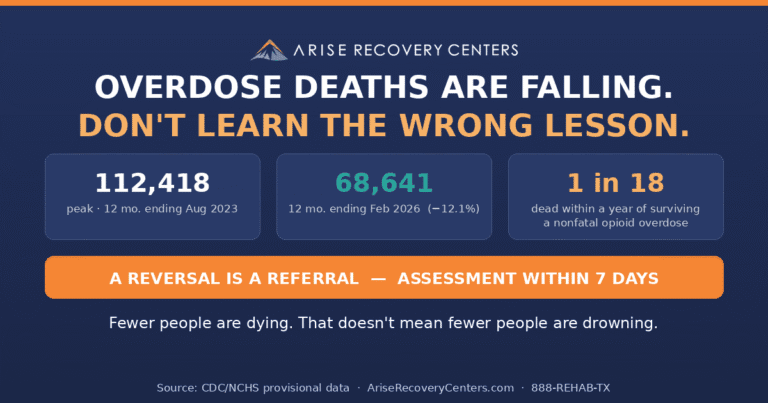
For the first time since fentanyl arrived, the overdose numbers are moving the right direction — and they’re moving fast. Federal data now shows about 68,641 overdose deaths in the twelve months ending February 2026, down 12.1% from the year before and down nearly 40% from the peak in 2023. That is tens of thousands of people who are alive who would not have been.
It is real good news. It is also the most dangerous headline a family can misread.
Because here is what those numbers do not say: they do not say fewer people are addicted. They say fewer people are dying of being addicted. Those are completely different sentences, and the gap between them is where a lot of families are about to lose someone.
The 30-second answer
- What’s true: Overdose deaths have dropped three years running — about 68,641 nationally in the 12 months ending February 2026, per CDC provisional data.
- Why they’re dropping: Mostly naloxone everywhere, more people on treatment medications, and shifts in the drug supply — not a drop in how many people have a substance problem.
- The trap: “He’s still alive” is being heard as “he’s okay.” Surviving an overdose is the single loudest warning signal a person will ever give you.
- The hard number: In one large study, 5.5% of people were dead within a year of being treated in an ER for a nonfatal opioid overdose — 1 in 18. A fifth of those deaths happened in the first month.
- The rule: A reversal is a referral. Every overdose survived should trigger a professional assessment inside seven days — not a conversation “when things calm down.”
What the numbers actually mean
Rolling twelve-month counts are the honest way to read this, because they smooth out seasonal noise. Here is the shape of it:
Peak · 12 mo. ending Aug 2023
112,418
The top of the curve. Roughly 308 people a day, every day, for a year.
12 mo. ending Feb 2025
78,046
The turn. Naloxone distribution and treatment medications scale up nationally.
12 mo. ending Feb 2026
68,641
Down 12.1% year over year, nearly 40% off the peak — and still about 188 people a day.
CDC provisional counts (predicted values, which account for reporting lag). Provisional data is revised as investigations close.
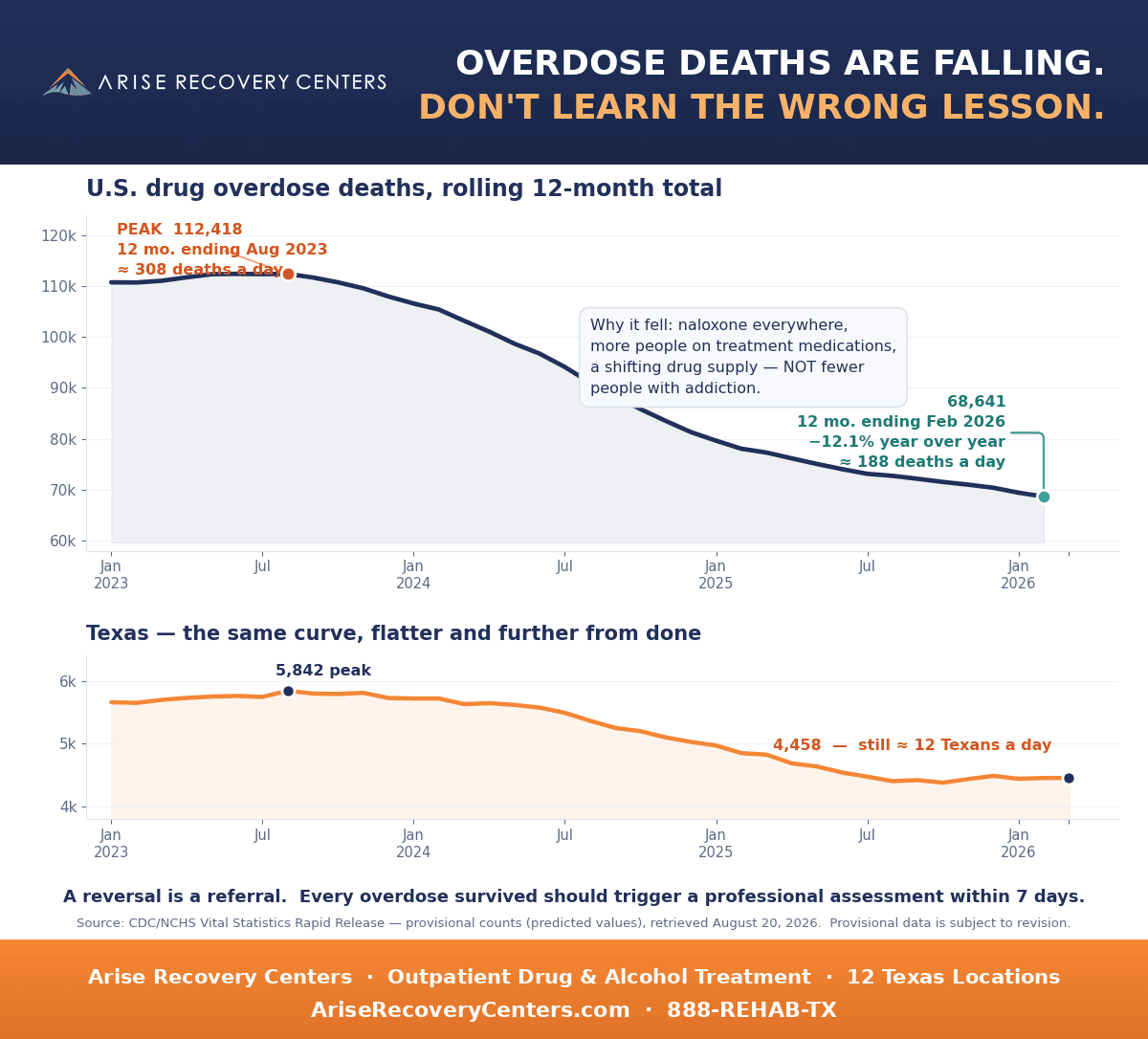
In Texas the same curve is a little flatter and a lot less finished. The state peaked around 5,842 deaths in the twelve months ending August 2023 and sits at roughly 4,458 for the twelve months ending March 2026 — a real 24% improvement from the peak, but only about 7.7% better than a year ago. Translated out of statistics: Texas is still burying roughly twelve people a day. “Better” and “fine” are not the same word.
| What the headline says | What it actually means |
|---|---|
| “Overdose deaths fell 12%” | Fewer overdoses ended in a death certificate. The number of overdoses did not fall 12%. |
| “The opioid crisis is turning around” | The mortality curve is turning around. Addiction prevalence is a separate, slower-moving number. |
| “Naloxone is working” | True — and naloxone’s entire job is to buy time. It reverses an overdose. It does not treat the disorder that caused it. |
| “He survived, so it wasn’t that bad” | Backwards. He survived because someone was in the room with the right drug. Next time is a coin flip on logistics. |
| “Things are safer now” | The supply is not safer. The response is faster. Those are opposite kinds of luck. |
This is the whole article in one table. If you take nothing else, take this.
Survival is a warning, not an all-clear
This is the part we see from the inside that never makes the news. A family gets the worst phone call of their life, the person comes home from the ER, everybody exhales — and then nothing happens. No assessment, no treatment, no plan. The overdose becomes a story the family doesn’t tell.
The research on what happens next is brutal and specific. In a study of 11,557 people treated in Massachusetts emergency departments for a nonfatal opioid overdose, 5.5% were dead within one year. About 1.1% were dead within a single month. That is not a scare statistic; that is a follow-up appointment nobody scheduled.
1 in 18
Dead within a year of an emergency-department-treated nonfatal opioid overdose. Roughly one in five of those deaths came in the first 30 days — which is exactly the window families spend recovering from the shock instead of acting.
And the medicine that changes those odds is sitting right there, unused. In a study of 17,568 Massachusetts adults who survived an opioid overdose, fewer than one in three received any medication for opioid use disorder in the year that followed. Among those who did, methadone was associated with a 59% lower rate of opioid-overdose death and buprenorphine with a 38% lower rate over twelve months. We have a treatment with that kind of association and two-thirds of survivors never touch it.
The rule: a reversal is a referral
If you remember one heuristic from this article, make it this one. It is the same logic as a cardiac event — nobody survives a heart attack and goes home without a cardiologist.
The 7-day rule
Every overdose reversal — naloxone at home, an ambulance, an ER visit, or a “he just needed to sleep it off” night — gets a professional assessment scheduled within seven days.
Not “when he’s ready.” Not “after the holidays.” Within a week, while the fear is still in the room and while the person is still frightened enough to say yes. That window closes fast, and in our experience it is the single highest-leverage seven days a family will ever get.
An assessment is not enrollment. It is a licensed clinician spending an hour figuring out what’s actually going on and what level of care matches it. Sometimes the answer is outpatient counseling. Sometimes it’s medication. Sometimes it’s a higher level of care first. You cannot make that call from the kitchen table, and you shouldn’t have to.
What to actually do this week
- Get naloxone in the house — even if things seem fine. It’s available over the counter at Texas pharmacies and free through many community programs. Nobody has ever regretted owning it.
- Make sure someone else knows how to use it. Naloxone in a drawer that only the person using drugs knows about is decoration. Roommates, siblings, spouses.
- After any reversal, call 911 anyway. Naloxone wears off faster than many opioids do, and people can re-overdose after waking up.
- Book the assessment inside seven days. Write the date on the calendar in front of the person. Specific beats sincere.
- Ask directly about medication. If opioids are involved, ask any program you talk to whether they prescribe or coordinate buprenorphine or methadone. A program that waves that off is telling you something.
Rule of thumb: the strength of a family’s reaction should match what almost happened, not what did happen. Judge the near-miss, not the outcome.
A return to use after time away rarely comes out of nowhere; most people are two stages into it before anyone notices. Here are the three stages of relapse and the move that stops each one.
One more reason a reversal is not an all-clear: a veterinary sedative called medetomidine is now being cut into fentanyl, and naloxone does not touch it. If someone was reversed but stayed unconscious for hours, or crashed into a brutal withdrawal a day later, read what medetomidine does and why it changes the plan.
Overrated vs. underrated: reading the good news correctly
↓ Overrated
- “The crisis is ending.” Deaths falling is a mortality story. Nothing in this data says fewer people are using or fewer people are addicted.
- Survival as evidence of control. “He handled it” is the most expensive sentence in this whole subject. He was rescued.
- Waiting for rock bottom. In the fentanyl era, rock bottom and death are frequently the same event. There is no educational overdose.
- Willpower and a scared straight talk. The near-death experience already delivered that talk. It didn’t work. That’s the point.
↑ Underrated
- Naloxone in a house where “nothing is going on.” Cheap, over-the-counter, zero downside. Treat it like a smoke detector.
- The 7-day post-overdose window. Willingness has a half-life. Week one is when people say yes to things they’ll refuse in week three.
- Medication for opioid use disorder. Two-thirds of survivors never get it, and the association with lower mortality is one of the strongest findings in the field.
- Outpatient care as the follow-through. The reversal is the ER’s job. Staying alive for the next five years is outpatient’s job.
- Counting near-misses out loud. Families track the ER visits. They don’t track the nights someone “slept weird.” Both are data.
Where treatment fits — plainly
Naloxone is the airbag. Treatment is learning to drive. Both matter; only one of them changes what happens next month.
For most people leaving an overdose, the practical path is outpatient — because it is the level of care people will actually accept while keeping a job, a lease, and custody of their kids. At Arise that runs from a Partial Hospitalization Program, through intensive outpatient (IOP, generally 9–12 hours a week across three to five days, with morning and evening tracks), down to a Supportive Outpatient Program as things stabilize. If someone needs medical detox first, that gets sorted at the assessment rather than guessed at. If you’re not sure which of those fits, we wrote a plain-English breakdown of what level of care a person actually needs, and a separate one on the line between helping and enabling — which is the exact question families ask in the week after an overdose.
The falling death count is not a reason to relax. It is the reason to move. It means more people are getting a second chance than at any point in this crisis — and a second chance is only worth something if somebody uses it.
If you have questions about overdoses or the risk of an overdose for you or a loved one, reach out to us or our mental health partner, Saltwood Mental Health, today.
Did someone in your life survive an overdose?
Call us. We’ll tell you straight what we’re hearing and whether an assessment makes sense — free, confidential, no obligation, and nobody gets enrolled in anything for asking a question.
Call 888-REHAB-TX
Verify your insurance
Frequently asked questions
Are overdose deaths really going down?
Yes. CDC provisional data shows about 68,641 U.S. overdose deaths in the twelve months ending February 2026, a 12.1% decline from the prior year and the third consecutive annual drop. Calendar year 2025 came in around 69,973 deaths versus 81,313 in 2024. These are provisional figures and get revised as death investigations close, but the direction has been consistent for three years.
Why are overdose deaths falling?
Researchers generally point to several forces at once: far wider naloxone distribution (including over-the-counter availability), more people receiving medications for opioid use disorder, changes in the illicit drug supply, and — grimly — the fact that a large share of the highest-risk population has already died. Notably, none of those mechanisms means fewer people are developing substance use disorders.
What should I do after someone survives an overdose?
Three things, in order. Call 911 at the time even if naloxone worked, because naloxone can wear off before the opioid does. Get naloxone into the home and make sure a second person knows how to use it. Then schedule a professional assessment within seven days — not weeks later. A nonfatal overdose is one of the strongest predictors of a fatal one, and willingness to accept help drops sharply as the memory fades.
How risky is it really to survive an overdose?
In a study of 11,557 patients treated in emergency departments for nonfatal opioid overdose, 5.5% died within one year and 1.1% within a month. Individual risk varies enormously with substance, health, and whether treatment follows — but as a population signal, surviving an overdose puts someone in a very high-risk group for the following year.
Does naloxone encourage riskier drug use?
The concern is common and the evidence does not support it. Naloxone’s function is narrow: it reverses opioid overdose so the person is alive to make a different decision. Public-health bodies recommend it be available to anyone who uses opioids and to the people around them. It has no effect on non-opioid overdoses and no potential for misuse.
Can outpatient treatment work after an overdose, or does it require inpatient?
It depends on the assessment — that’s the entire reason the assessment exists. Some people need medical detox or a higher level of care first, particularly with alcohol or benzodiazepines involved. Many people step directly into a partial hospitalization or intensive outpatient program and do well, especially when medication for opioid use disorder is part of the plan. Outpatient’s practical advantage is that people accept it, because it doesn’t require disappearing from their life for a month.
What are overdose deaths doing in Texas specifically?
Texas is improving more slowly than the country overall. CDC provisional counts show roughly 4,458 overdose deaths in the twelve months ending March 2026, down about 7.7% from the prior year and about 24% from the state’s peak of roughly 5,842 in the twelve months ending August 2023. That still works out to about twelve Texans a day.
Sources: CDC/NCHS Vital Statistics Rapid Release — Provisional Drug Overdose Death Counts (68,641 predicted deaths for the 12 months ending February 2026; 12.1% decline; national and Texas 12-month rolling counts, retrieved via CDC’s VSRR dataset); CDC/NCHS — U.S. Overdose Deaths Decrease for Third Consecutive Year in 2025 (69,973 deaths in 2025 vs. 81,313 in 2024; opioid-involved deaths 44,564 vs. 55,296); Weiner SG, Baker O, Bernson D, Schuur JD, One-Year Mortality of Patients After Emergency Department Treatment for Nonfatal Opioid Overdose, Annals of Emergency Medicine 2020;75(1):13–17 (11,557 patients; 5.5% one-year mortality; 1.1% at one month); Larochelle MR et al., Medication for Opioid Use Disorder After Nonfatal Opioid Overdose and Association With Mortality, Annals of Internal Medicine 2018;169(3):137–145 (17,568 survivors; fewer than one third received medication; methadone 59% and buprenorphine 38% lower opioid-overdose mortality at 12 months). Statistics compiled August 20, 2026.
Related reading: why alcohol deaths among young women are rising faster than any other group.