
By Danny Andino, CEO, Arise Recovery Centers · Clinically reviewed by Nicholas Overbeck, LPC-S, LCDC · Updated August 2026
Update, October 2026: The federal 7-OH ban was reset on October 9, and the earliest it can now take effect is November 13, 2026. If you use 7-OH every day, that is time to plan a taper with medical help. Here is what the new rule changes.
Two weeks ago the packets were still on the counter. Now the shelf is empty, the clerk shrugs, and you’re sitting in your car at 6 a.m. sweating through a shirt, wondering why quitting a legal supplement feels like the worst flu of your life.
Here’s the honest answer: because it wasn’t a supplement. Concentrated 7-OH (7-hydroxymitragynine, often typed “7OH”) works on the same receptors as morphine. When you stop, your body does exactly what it would do coming off any opioid. That’s not weakness and it’s not in your head — it’s physiology, and it’s the single most treatable part of this whole situation.
The 30-second answer
- Why it feels like this: 7-OH acts at mu-opioid receptors. Stopping produces opioid-type withdrawal — the FDA specifically lists restlessness, body aches, fatigue, irritability, and cold sweats.
- How long: Most people report symptoms starting within about a day of the last dose, peaking in the first few days, and easing over roughly a week — with sleep, mood, and cravings lagging behind for weeks.
- Is it dangerous? Opioid-type withdrawal is rarely life-threatening on its own. The danger is what people do to make it stop.
- The #1 rule: Do not replace it with street pills. Counterfeit pills frequently contain fentanyl. That trade is how a bad week becomes a fatal one.
- What actually helps: Medication. Clinicians treat 7-OH dependence the way they treat opioid dependence — including buprenorphine — and it’s routinely handled in an outpatient setting while you keep working.
What the timeline usually looks like
Nobody can hand you an exact schedule — how much you took, how long, how often, and what else is in the picture all move these windows. But daily users describe a recognizable arc, and it’s the same arc clinicians see with short-acting opioids.
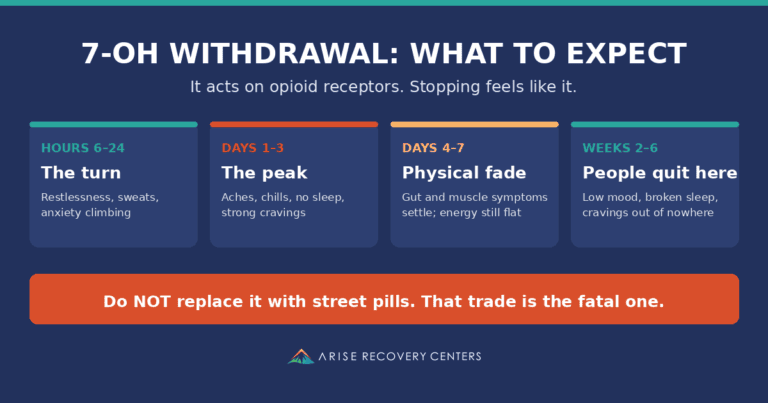
Hours 6–24
The turn
Restlessness, yawning, runny nose, watery eyes, goosebumps, anxiety climbing. The first “I need to go find some” thought lands here.
Days 1–3
The peak
Body aches, sweats and chills, stomach cramps, nausea or diarrhea, no sleep, irritability. This is the window most people relapse in.
Days 4–7
The physical fade
Gut and muscle symptoms settle. Appetite starts returning. Energy is still flat and sleep is still broken.
Weeks 2–6
The part people quit on
Low mood, poor sleep, and cravings that arrive out of nowhere. Physically you look fine — which is exactly why this stretch catches people off guard.
Composite of commonly reported patterns and the opioid-withdrawal course clinicians manage; individual experience varies substantially. This is not a diagnostic tool — it’s what to expect so you can plan for it instead of being blindsided.
Go get medical help now — don’t wait it out
Withdrawal misery is one thing. These are different, and they warrant a call or an ER visit:
- Seizures or confusion. The FDA lists seizures among reported harms of 7-OH products.
- Signs of liver trouble — yellowing eyes or skin, dark urine, pain under the right ribs. Heavy long-term kratom-family use has been linked to serious liver problems.
- Vomiting or diarrhea you can’t keep ahead of. Dehydration is the complication that actually puts people in the hospital.
- Pregnancy. Withdrawal in pregnancy is managed differently and needs a physician immediately — do not stop on your own.
- You’ve been mixing 7-OH with alcohol, benzos, or other opioids. That changes everything about how this should be handled.
Unresponsive or barely breathing? Call 911 and use naloxone (Narcan) if you have it — 7-OH acts on opioid receptors, so naloxone is worth trying. Poison Help: 1-800-222-1222.
Three ways off — and what each one actually costs you
People treat this as a willpower question. It’s closer to a logistics question. Here’s the honest comparison.
| Cold turkey, alone | Self-taper | Medical + outpatient treatment | |
|---|---|---|---|
| How rough | Brutal Full-force symptoms, days 1–3 | Moderate Stretched out, blunted | Manageable Medication targets the symptoms directly |
| Relapse risk | Highest — the fix is one purchase away | High — tapering your own supply rarely holds | Lowest of the three, especially past week two |
| Danger | Substitution risk: street pills, alcohol, benzos | Dose creep; no one watching for red flags | Complications get caught early |
| Cost | $0 upfront — plus the cost of the attempt that fails | You keep buying product | Usually insurance-covered as a substance use disorder |
| Time | A week of being useless | Weeks, often indefinitely | Assessment in about 20 minutes; outpatient fits around a job |
| Honestly best for | Short, light use — days, not months | Almost nobody, without supervision | Daily use, months of it, or any prior opioid history |
General comparison for education, not a recommendation for any individual. Cost and coverage vary by plan. Some people do stop on their own — the point isn’t that it’s impossible, it’s that the odds and the risk are worth knowing before you pick.
There is no FDA-approved medication specifically for 7-OH.
What there is: published case reports and reviews describing clinicians managing kratom-family withdrawal the same way they manage opioid withdrawal — including buprenorphine — with maintenance to prevent relapse. Whether it fits you is a prescriber’s call after an evaluation.
Overrated vs. underrated: getting off 7-OH
↓ Overrated
- “Just push through it.” Willpower isn’t the bottleneck. Access to the product is. Most relapses are a decision made at hour 40 with no sleep.
- Tapering your own stash. You are the addict and the pharmacist in the same body. It almost never holds.
- Waiting until you “hit bottom.” A supply cutoff already handed you the moment. Waiting just adds a fentanyl-era substitution risk.
- Detox as the finish line. Getting through week one is the easy half. Weeks two through six decide the outcome.
↑ Underrated
- Saying the real number out loud. “Eight tablets a day for a year” is the sentence that makes treatment safe. Nobody’s calling the police.
- Medication. The single biggest difference between a miserable week and a manageable one.
- Sleep and hydration. Unglamorous, and they carry more of days 3–7 than anything else you’ll do.
- One person who knows. A spouse, a sibling, a coworker. Doing this in secret is what makes week three dangerous.
One more thing worth knowing. 7-OH acts on the same receptors as other opioids, so an overdose is possible — and if one has already happened, it changes the timeline. Overdose deaths nationally are falling, but surviving one is the loudest warning signal a person ever gives: here is what to do in the seven days after.
What to say when you call
You don’t need the right words. You need three facts.
“I’ve been taking a 7-OH product from a smoke shop. About ___ a day, for about ___ months. I stopped ___ days ago and I feel like I have the flu.”
- What you took — brand name is fine, “the gas station tablets” is fine.
- How much and how long — round numbers. Nobody’s grading you.
- Anything else in the mix — alcohol, benzos, other opioids, prescriptions. This is the part that changes the plan, so don’t leave it out.
Rule of thumb: if stopping produced flu symptoms and panic, you were physically dependent on an opioid-receptor drug — and that’s a medical situation with a standard playbook, not a character problem.
How this works at Arise
We’re an outpatient provider in Texas, and we’ll be straight with you about what that means. If you need medically supervised withdrawal management first, we place you with vetted licensed providers in our network — usually within a day. Then you come back for the part that decides whether this sticks: structured outpatient treatment — high-intensity outpatient, IOP, or supportive outpatient, depending on what the assessment shows. Most people keep working and sleeping at home the entire time.
If what you actually have is a two-week habit and mild rebound symptoms, we’ll tell you that too and send you on your way. The assessment is free, takes about 20 minutes, and carries no obligation. If you’re catching up on why these products disappeared, start with our breakdown of the 7-OH ban, see how detox placement works, or run the numbers with our Cost of Treatment calculator.
Coming off 7-OH — or watching someone try?
Tell us what’s been going on. We’ll tell you straight what it means and what to do next. Free, confidential, no obligation. If you or someone you love is struggling with 7-OH, reach out to us or our mental health partner, Saltwood Mental Health, today. You can also Call 888-REHAB-TX
Frequently asked questions
How long does 7-OH withdrawal last?
Daily users commonly report symptoms beginning within about a day of the last dose, peaking over the first two to three days, and physical symptoms easing across roughly a week. Sleep problems, low mood, and cravings often persist for several weeks after the physical part passes. Duration varies with dose, how long you used, and whether other substances are involved — these are patterns, not a schedule.
What are 7-OH withdrawal symptoms?
The FDA lists withdrawal symptoms including restlessness, body aches, fatigue, irritability, and cold sweats, alongside other reported harms of 7-OH products such as anxiety, depression, gastrointestinal distress, insomnia, and seizures. In practice people describe it as a severe flu stacked on top of anxiety: chills and sweating, muscle and joint pain, stomach upset, no sleep, and strong cravings.
Is 7-OH withdrawal dangerous?
Opioid-type withdrawal is generally not life-threatening by itself, but that’s a low bar and it isn’t the whole picture. Dehydration from vomiting or diarrhea, seizures, and pre-existing medical conditions can all make it dangerous. The bigger risk is behavioral: people trying to stop the symptoms with street opioids or counterfeit pills, which in the fentanyl era carries real overdose risk. If you use multiple substances, are pregnant, or have other health conditions, talk to a physician before stopping.
Can you take buprenorphine (Suboxone) for 7-OH withdrawal?
Because concentrated 7-OH acts on mu-opioid receptors, clinicians can treat dependence on it the way they treat opioid use disorder. Published case reports and reviews describe using buprenorphine/naloxone for kratom-family withdrawal and dependence, with maintenance to prevent relapse. There is no FDA-approved medication specifically indicated for 7-OH, and whether medication fits your situation is a decision for a licensed prescriber after an evaluation — including timing, since starting buprenorphine too early can trigger precipitated withdrawal.
Can I just taper down instead of stopping?
Tapering is a legitimate clinical strategy — but it works best when someone other than the person in withdrawal controls the schedule and the supply. Self-tapering from your own stash tends to stall, and with concentrated 7-OH the product you were tapering is now being pulled from the market, which removes the option mid-plan. Talk to a clinician about a supervised taper or a medication bridge instead — here is how each of those actually works, side by side.
Does insurance cover treatment for 7-OH dependence?
Dependence on an opioid-receptor substance is treated as a substance use disorder, which most commercial health plans cover under federal parity rules. Specifics vary by plan and level of care. Verify your benefits to see exactly what yours covers.
My spouse says it’s “just kratom.” Are they right?
Partly, and the distinction matters. Traditional kratom leaf contains only trace natural 7-OH and is a different product from the concentrated tablets, gummies, shots, and strips that federal regulators targeted. But if stopping produces opioid-type withdrawal every time, the label on the package is less informative than what the body is doing. Either way, the response is the same: get an assessment rather than arguing about terminology.
Sources: U.S. FDA — Products Containing 7-OH Can Cause Serious Harm; FDA — FDA and Kratom; National Institute on Drug Abuse — Kratom; Kratom Withdrawal: A Systematic Review with Case Series (PubMed); Treatment of Kratom Withdrawal and Dependence With Buprenorphine/Naloxone: A Case Series and Systematic Literature Review (PubMed); Congressional Research Service — Temporary Control of 7-OH and Related Substances Under the CSA. Compiled August 2026; regulatory status verified at time of writing and subject to change.