

By Danny Andino, CEO, Arise Recovery Centers · Clinically reviewed by Nicholas Overbeck, LPC-S, LCDC
Somewhere in Texas this week, a parent is driving away from a dorm with an empty back seat and a knot in their stomach that has nothing to do with missing their kid. It’s because of a name they didn’t say out loud during move-in: a brother, a mother, an uncle, themselves. If addiction runs in your family, freshman drop-off isn’t just emotional — it’s the start of the riskiest drinking window of your kid’s life, and you know it in your bones.
This article is for that parent. Not to scare you — the numbers do that on their own — but because the two things that actually help are simple, free, and almost nobody does them: name the family history out loud, and stay in real contact for the next six weeks.
The 30-second answer
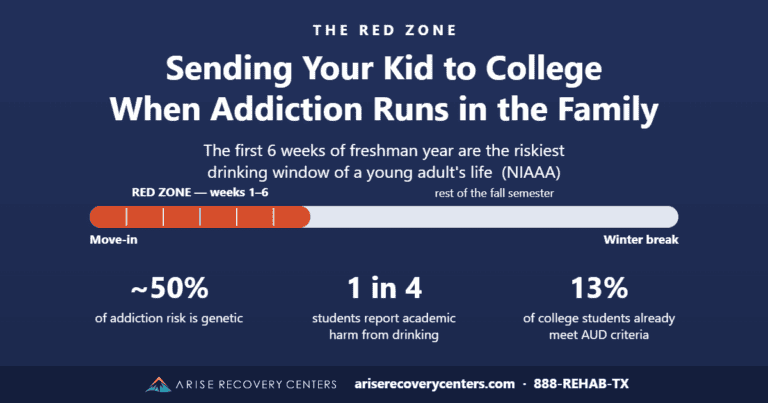
- The window: The first six weeks of freshman year — what campus health people call the “red zone” — carry the highest risk for harmful drinking of the whole college experience, per NIAAA.
- The inheritance: Research consistently attributes roughly half of a person’s risk for alcohol problems to genetics. Family history is one of the strongest predictors we have.
- What doesn’t work: One awkward “talk,” pretending the family history doesn’t exist, or assuming a dry dorm will handle it.
- What does: Naming the genetics plainly, a standing “call me no matter what” rule, and a regular contact cadence through September — because parents who talk about alcohol measurably change outcomes.
- And remember: risk is not destiny. Most kids with family history never develop a problem. You’re managing a probability, not a prophecy.
Why the first six weeks are called the red zone
New freedom, no supervision, instant social pressure, and a campus culture that treats blackout stories as comedy — all landing on an 18-year-old brain in the same month. NIAAA flags the first six weeks of freshman year as a particularly vulnerable window, when expectations and social pressure drive drinking before classes get hard enough to compete. The habits formed in that window have a way of becoming “just what I do on Thursdays.”
The national numbers on what college drinking costs each year, from NIAAA: about 1,519 students ages 18–24 die from alcohol-related unintentional injuries, about 696,000 are assaulted by another student who’d been drinking, and roughly 1 in 4 report academic damage from alcohol. About 13% of college students already meet criteria for alcohol use disorder — most of them undiagnosed, unassessed, and 19 years old.
~50%
The share of alcohol use disorder risk that research attributes to genetics. If addiction runs in your family, your student didn’t inherit a problem — they inherited shorter odds. That’s worth saying out loud.
The conversation almost no parent has — and the 3-sentence script
Here’s the pattern we see from the inside: families with addiction history are often the least likely to talk about it, because the topic is soaked in shame, grief, or an ugly divorce. So the kid heads to campus knowing there’s “some stuff with Uncle Mike” but never hearing the one fact that’s actually about them. Secrecy doesn’t protect your student — it just sends them into the red zone without the single most useful piece of information they own.
And this isn’t a ceremony. It’s three sentences in the car, over text, on a call — delivered like you’d deliver any other family medical history:
The family-history script
“Addiction runs in our family — you know about [name]. That means your odds of a drinking problem are meaningfully higher than your roommate’s, through no fault of yours.”
“It doesn’t mean you can’t ever drink. It means alcohol will probably feel better to you than it does to other people — and that’s exactly the trap.”
“If you’re ever in trouble — drunk, somewhere you shouldn’t be, scared — call me. No lecture, no punishment. I will always come get you. That rule has no expiration date.”
That’s it. You’re not asking for a pledge. You’re handing them data and an exit door. NIAAA’s own research notes that students who choose not to drink often say it’s because their parents talked with them about alcohol — the talk is a real protective factor, not a formality.
The red-zone calendar: what to actually do, week by week
Weeks 1–2 · Move-in
Have the script conversation
Before or at drop-off. Set the “call me no matter what” rule. Agree on a light contact rhythm — a couple of texts and one call a week beats daily check-ins that feel like surveillance.
Weeks 3–4 · Peak red zone
Watch the patterns, not the party
Rush events, first football weekends. One wild story isn’t the signal. The signals: every story involves alcohol, morning classes start disappearing, or they only call when they need something.
Weeks 5–6 · First exams
Listen for the swap
Stress arrives. Listen for drinking as the coping tool — “I needed it after that midterm.” Coping-drinking is a different animal than party-drinking, and it’s the one that follows people for decades.
The red zone runs roughly from move-in through mid-October. It ends because routines, grades, and consequences catch up — not because the risk was imaginary.
Normal college drinking vs. warning signs — an honest table
Let’s be straight: about half of college students drank in the past month and about 27% binge drank, per NIAAA. If the bar for panic is “my kid had beer at a party,” you’ll burn your credibility by October. The skill is telling ordinary (still risky, but ordinary) college behavior from a developing problem:
| Within normal range (still worth watching) | Warning sign (worth acting on) |
|---|---|
| Drinks at parties on weekends; has stories | Drinks before going out (“pregaming to pregame”), drinks alone, or can’t tell a story that doesn’t involve alcohol |
| Occasionally oversleeps, misses one class | Pattern of missed morning classes; grades sliding by week 6; drops from a team, job, or group they loved |
| Calls home a bit less as they settle in | Goes dark for stretches; only calls when they need money; roommate or friends reach out to you |
| Tried alcohol at an event; embarrassed after overdoing it once | Blackouts, injuries, an ER visit, a citation — or laughing off any of those as “everyone does it” |
| Can take or leave a dry weekend | Gets irritable or anxious when a weekend has no drinking plan; needs alcohol to handle stress, sleep, or social settings |
One row on the right = pay attention and talk. Two or more, or anything involving blackouts or injuries = time for a professional assessment, not another talk. With family history, act one row earlier.
Overrated vs. underrated: the freshman-parent edition
↓ Overrated
- The one big talk. A single lecture in August is a box checked, not a strategy. Risk peaks over six weeks — coverage has to match.
- “Not my kid.” The honor student with family history is exactly who the red zone eats. Grades have never been a liver function test.
- Dry campuses and strict rules as protection. Rules move drinking off-campus; they don’t move it out of your kid’s life.
- Keeping the family history vague to protect their innocence. Vague warnings get filed under “parents worry.” Specific ones get remembered at a party.
↑ Underrated
- Naming the genetics. “Your odds are different” is the one sentence only you can deliver, and it costs nothing.
- The “call me no matter what” rule. It has saved more college kids than every campus policy combined. It only works if you honor it — no lecture on the drive home.
- Contact cadence as data. A weekly call tells you tone, sleep, and mood. You’re not monitoring; you’re keeping a baseline.
- Roommates, GPA, and money as signals. When the roommate texts you or the first semester GPA lands a full point below high school, that’s information — treat it like it.
If the warning signs show up — what escalation actually looks like
Escalation is not dragging a 19-year-old to rehab because they got drunk at a tailgate. It looks like this: a calm conversation naming the specific pattern (“three of your last four calls, you’d been drinking”), then a professional assessment — not a punishment, an information-gathering step. An assessment tells you whether this is normal college stupidity, a risky pattern worth structured support, or an emerging disorder that deserves real treatment. Most of the time it’s the first or second — and hearing that from a clinician instead of a parent changes everything about how it lands.
If it’s the third: outpatient treatment exists precisely so a college student doesn’t have to choose between getting help and staying enrolled. IOP schedules run mornings or evenings around classes, and treatment is confidential — it doesn’t show up on a transcript. Many families do the assessment over a school break so nothing about campus life has to be explained to anyone. And if you’re reading this as the parent wondering whether you’re overreacting or enabling, we wrote about the helping-vs-enabling line — it pairs with this one.
Worried about a college student — or about the family pattern repeating?
Tell us what you’re seeing. We’ll tell you straight whether it sounds like college or something more — free, confidential, no obligation, and no one gets enrolled in anything for asking. Reach out to us or our mental health partner, Saltwood Mental Health, today, or Call 888-REHAB-TX
Frequently asked questions
Is addiction really hereditary?
Partly, yes. Large twin and family studies consistently estimate that genetics account for roughly half of the risk for alcohol use disorder, with similar or higher estimates for some other substances. The other half is environment, timing, stress, and choices — which is why family history raises the odds but decides nothing. Most people with a family history never develop a substance problem.
What is the “red zone” in college?
Campus health professionals use “red zone” for the opening weeks of the fall semester — roughly move-in through mid-October — when new students face the highest risk of heavy drinking and related harms, including sexual assault. NIAAA specifically flags the first six weeks of freshman year as a vulnerable window driven by social pressure and new freedom.
Should my kid with family history never drink at all?
That’s a decision for your family — and ultimately for them, since most college drinking happens regardless of the rules set at home. What the science supports: people with strong family history have better odds the later they start drinking and the more deliberately they treat it, and they should know that alcohol may register as more rewarding for them than for their peers. Some choose abstinence for exactly that reason; others set hard personal limits. The non-negotiable is that they know their odds.
How do I tell normal college drinking from a real problem?
Pattern beats incident. One sloppy night is college; drinking alone, drinking before events, coping-drinking after stress, missed morning classes, blackouts, injuries, or friends reaching out to parents are patterns. Two or more of those — or any blackout or injury — is the point where a professional assessment beats another parental talk, especially with family history in play.
Can a college student go to treatment without dropping out?
Usually, yes. Outpatient levels of care — from weekly therapy up through intensive outpatient (IOP, typically 9–12 hours a week) — are built to fit around a class schedule, with morning or evening tracks. Treatment records are confidential and separate from academic records. Many students start with an assessment over a break.
What if my student refuses to talk about it?
Don’t force a confrontation you can’t win from 200 miles away. Keep the contact cadence going, keep honoring the “call me no matter what” rule, and get advice yourself — a 20-minute call with a treatment provider or counselor about what you’re seeing costs nothing and often reveals whether it’s time to push or wait. Parents are allowed to be the ones who call first.
Sources: NIAAA — Fall Semester: A Time for Parents To Discuss the Risks of College Drinking (first-six-weeks vulnerability; parental-conversation protective factor); NIAAA College Drinking Prevention — Facts for Parents (deaths, assaults, academic consequences, past-month drinking 49.3%, binge drinking 27.4%, student AUD ~13%); Verhulst, Neale & Kendler — The heritability of alcohol use disorders: a meta-analysis of twin and adoption studies (heritability ~49%). Statistics compiled August 13, 2026.