
By Danny Andino, CEO, Arise Recovery Centers · Clinically reviewed by Nicholas Overbeck, LPC-S, LCDC · September 2026 · In the News
Somebody goes down. A friend gives them Narcan. They start breathing again — and then they just do not wake up. Not for an hour. Sometimes longer.
Two days later that same person is in the worst withdrawal of their life: heart racing, blood pressure through the roof, throwing up, and nothing they usually do for dope sickness touches it.
That is what medetomidine looks like, and in April the CDC issued a national health alert about it. It has not been named in Texas testing yet. It is in Chicago, Denver, and Philadelphia. It is worth knowing about before it is here.
The short version
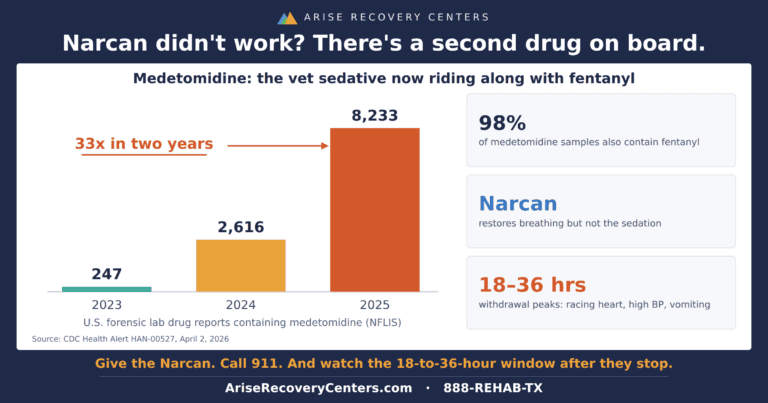
- Medetomidine (“rhino tranq,” “mede,” “dex”) is a veterinary sedative now being cut into fentanyl. Lab detections went from 247 in 2023 to 8,233 in 2025. When it shows up, fentanyl is there too 98% of the time.
- Naloxone still works on the fentanyl. It does not touch the medetomidine. So the person may breathe but stay knocked out. Give Narcan anyway, and call 911.
- The withdrawal is a different animal from opioid withdrawal. It peaks 18 to 36 hours after last use with a racing heart, dangerously high blood pressure, and vomiting that will not stop. That is an emergency room problem, not a couch problem.
- Once someone is medically stable, the treatment for the actual addiction is the same as it has always been — and it is outpatient.
What it is, and why it is in the supply
Medetomidine is approved for one thing: sedating and relieving pain in dogs. It is not approved for humans in any form. It belongs to the same drug family as xylazine (“tranq”), which is why the street name is “rhino tranq” — it is a lot stronger. Dealers add it because it stretches fentanyl and makes the high last longer.
The numbers from the national forensic lab system tell the story on their own.

Where is it? Mostly the Northeast (52% of 2025 detections) and Midwest (31%). The South, which includes Texas, is at 17% and climbing. The West is under 1%. Texas is not named in the CDC data yet, which is the good news. Xylazine took about two years to go from a Philadelphia problem to a Texas problem. There is no reason to expect this one to be different.
Why Narcan “doesn’t work” (it does — on half the problem)
An overdose on fentanyl plus medetomidine looks different from a plain fentanyl overdose. The CDC describes heart rates as low as 32 beats a minute, very low blood pressure, and sedation so deep it can last for hours. In the Chicago cluster in May 2024, 178 people overdosed in one stretch, and fentanyl was in every medetomidine-positive sample.
Naloxone reverses the fentanyl. That restarts breathing, which is the part that kills fastest. It does nothing for the medetomidine, so the person may keep breathing but stay unconscious. People have watched that happen and concluded Narcan failed. It did not. It did its job, and there is a second drug on board.
Give the naloxone. Call 911. Roll them on their side. Stay.
Breathing but not waking up is exactly the picture medetomidine makes. It is not a reason to skip Narcan or to skip the call — it is the reason to make the call.
Medetomidine is not the only new additive. Cychlorphine, a lab-made opioid now in Texas, does respond to naloxone, but it can take more than the usual one or two doses, and fentanyl test strips miss it. Here is what to know about cychlorphine.
The withdrawal is the part nobody warns you about
This is what put 165 people in Philadelphia hospitals in five months, and it is the reason this article exists. Opioid withdrawal is miserable but rarely dangerous. Medetomidine withdrawal can damage the heart or the brain.
| Fentanyl withdrawal | Medetomidine withdrawal | |
|---|---|---|
| Starts | 8–24 hours after last use | Within hours; peaks 18–36 hours after last use |
| Feels like | Bad flu: sweats, aches, diarrhea, anxiety, yawning, goosebumps | Heart over 100, blood pressure dangerously high, tremor, chest pain, vomiting that will not stop, drifting in and out |
| Danger | Rarely life-threatening | Can cause stroke or heart damage |
| What helps | Buprenorphine, methadone, comfort meds — often outpatient | Buprenorphine does not fix it. Needs clonidine or dexmedetomidine, usually in a hospital, often the ICU |
| Where to be | Home, a clinic, or detox | Emergency room |
Sources: CDC HAN-00527 (April 2, 2026); Philadelphia and Pittsburgh case series cited in the advisory. Timelines are typical patterns, not a schedule.
The trap is that people who use fentanyl have a routine for withdrawal. They know how to tough it out, or they know where to get something to take the edge off. With medetomidine on board, toughing it out is how you end up with a blood pressure of 220 and a stroke. And the usual fix — more fentanyl — keeps the medetomidine coming too.
Go to the ER if
Someone in withdrawal has a racing heart, chest pain, cannot stop vomiting, is confused or drifting in and out, or has a blood pressure reading that would scare a nurse. Say the word “medetomidine” at triage. Not every ER in Texas has seen it yet. Naming it gets the right treatment faster.
Three things to know if you or someone you love uses fentanyl
1. Test strips have a blind spot
Fentanyl test strips will not show medetomidine. Medetomidine strips exist, but the CDC notes they can miss the version that is actually in the supply. Treat any fentanyl as if it might have it in it.
2. “Nodding” is now harder to read
Deep sedation that lasts hours used to mean one thing. Now it can mean two. If someone is not rousable, do not wait to see if they sleep it off. Narcan, 911, recovery position.
3. The crash comes later
If someone stops — on purpose, or because they were in the hospital, or because they ran out — the 18-to-36-hour window is when to watch them. That is when the blood pressure spikes.
Rule of thumb: fentanyl withdrawal makes you feel like you are dying. Medetomidine withdrawal can actually do it. If the symptoms are cardiac — heart, chest, blood pressure — it is not a wait-it-out situation.
What happens after the hospital
Here is the part that gets lost. Surviving the overdose and getting through the withdrawal safely is medicine’s job. What comes next is ours, and it does not change because the supply got scarier.
The addiction is still to opioids. The treatment is still counseling and a structured program, with medication when appropriate, coordinated with a prescriber. In practice that looks like a day program or intensive outpatient for a few weeks, stepping down to supportive outpatient as things stabilize, while you sleep in your own bed and keep your job. Here is how the levels of care fit together.
If anything, a medetomidine scare is one of the better reasons to start. A person who just learned that the next bag could put them in the ICU on the way in and on the way out has a very concrete argument for not buying the next bag. Treatment turns that moment into a plan before it fades. We wrote about how relapse actually unfolds — the window after a hospital stay is exactly the kind of stage-one moment where a phone call does the most good.
For families
If your person was recently reversed with Narcan and “took forever to wake up,” or ended up in the ER for withdrawal that seemed way out of proportion, they may have already met this drug. That is worth saying out loud to them, without a lecture: “The stuff going around now can stop your heart coming off it. I want you around.” Then keep naloxone in the house and in the car, and know where the nearest ER is.
Opioid addiction is not mostly a young person’s problem. Among privately insured patients, about 8 in 10 people diagnosed in 2025 were between 31 and 65. Here are the newest opioid addiction statistics.
Overrated vs. underrated
Overrated
- “Narcan doesn’t work anymore.” It works on the fentanyl, which is what stops breathing. Use it every time.
- “It’s not in Texas.” Not in the published data yet. Xylazine was not either, until it was.
- Waiting for a test strip to tell you. Strips miss it. Assume it is there.
Underrated
- Saying the word at the ER. “Medetomidine” at triage changes the treatment plan.
- The 18-to-36-hour window. That is when to watch someone who just stopped, whatever the reason.
- Using the scare. The week after a hospital stay is the easiest week to start treatment. It gets harder from there.
What to actually do this week
If you use fentanyl, or someone you love does
- Naloxone in reach, and more than one dose. It still works on what kills fastest.
- Never use alone. With medetomidine in the picture, the person who calls 911 matters more than ever.
- If someone is reversed and still will not wake up, they go to the hospital. No exceptions.
- Know the withdrawal signs that mean ER: racing heart, chest pain, vomiting that does not stop, blood pressure way up, confusion. Say “medetomidine.”
- When they are stable, make the call that week. That is the window. Verifying insurance takes about two minutes and does not commit anyone to anything.
Arise Recovery Centers provides outpatient addiction treatment across Texas — day programs, intensive outpatient, and supportive outpatient — at 12 locations in DFW, Houston, and Austin. We are not an emergency room, and we will say so plainly: if the situation in this article is happening right now, call 911. When it is over, reach out to us or our mental health partner, Saltwood Mental Health, today.
Frequently asked questions
What is medetomidine?
A sedative approved only for veterinary use in dogs, in the same drug family as xylazine but much stronger. It is being added to illicit fentanyl. Street names include “rhino tranq,” “mede,” and “dex.” Its human cousin, dexmedetomidine, is used in hospitals for procedural sedation.
Does Narcan work on medetomidine?
Naloxone reverses the fentanyl, which restores breathing, but it does not reverse medetomidine. The person may breathe but remain deeply sedated with a very slow heart rate and low blood pressure. Give naloxone anyway and call 911.
Is medetomidine in Texas?
As of the CDC’s April 2026 advisory, Texas was not named. In 2025, 52% of forensic lab detections were in the Northeast, 31% in the Midwest, 17% in the South, and under 1% in the West. Detections nationally rose from 247 in 2023 to 8,233 in 2025, so the reasonable assumption is that it is coming.
What does medetomidine withdrawal feel like?
It can begin within hours of last use and peaks 18 to 36 hours later: heart rate over 100, severe high blood pressure, tremor, chest pain, fluctuating alertness, and intractable nausea and vomiting. Unlike opioid withdrawal, it can be life-threatening and often requires hospital or ICU care.
Does buprenorphine or methadone treat medetomidine withdrawal?
They treat the opioid part. The medetomidine part needs alpha-2 agonist therapy such as clonidine or dexmedetomidine, plus blood pressure management, which is why this is usually handled in a hospital.
Do fentanyl test strips detect medetomidine?
No. Medetomidine-specific strips exist, but the CDC notes they can produce false negatives for the form that is actually in the drug supply.
What should I do if someone is reversed with Narcan but will not wake up?
Call 911, keep them on their side, and stay with them. Prolonged sedation after naloxone is the classic sign of medetomidine. Tell the paramedics and the ER staff you suspect it.
What treatment comes after a medetomidine overdose or withdrawal?
Once a person is medically stable, the treatment is for opioid use disorder: counseling in a structured outpatient program, with medication when appropriate, coordinated with a prescriber — day treatment, intensive outpatient, or supportive outpatient depending on need.
This article is for education, not diagnosis, and does not replace advice from a medical professional. Anyone experiencing the overdose or withdrawal symptoms described here needs emergency care. Data current as of the CDC advisory of April 2, 2026.