
By Danny Andino, CEO, Arise Recovery Centers · Clinically reviewed by Nicholas Overbeck, LPC-S, LCDC · September 2026 · In the News
On July 31, Texas started enforcing a rule that makes delta-8 THC a controlled substance. The gummies and vapes that sat next to the register at more than 14,000 registered hemp retailers came off the shelf.
The headlines were about the shops. This is about the people who were using those products every day, and what the next three weeks look like for them.
The short version
- Delta-8 is now illegal to sell in Texas. Regular hemp products with under 0.3% delta-9 THC are still legal. THC vapes and THCA flower were banned earlier.
- If you have been using delta-8 daily, stopping can bring real withdrawal: irritability, anxiety, bad sleep, no appetite. It is in the DSM-5. It is not in your head.
- It is also temporary. Symptoms usually peak between day two and day six and fade over two to three weeks.
- Most people ride it out. The ones who should get help are the ones who have tried to stop before and could not, or who are reaching for something else to replace it.
What actually changed
Texas did not pass one big ban. It happened in three pieces over a year, and the last piece landed this summer.
| Product | Status in Texas | Since |
|---|---|---|
| THC vapes (any cannabinoid) | Banned | September 1, 2025 (SB 2024) |
| THCA flower (“legal weed”) | Banned | March 2026 (DSHS rules) |
| Delta-8 THC gummies, edibles, tinctures | Banned | July 31, 2026 (DSHS enforcement after the Texas Supreme Court ruling of May 1) |
| Hemp products under 0.3% delta-9 THC | Still legal | 2019 Texas hemp law |
| CBD (non-intoxicating) | Still legal | — |
Sources: Texas Supreme Court, Sky Marketing Corp. v. DSHS (May 1, 2026); DSHS enforcement effective July 31, 2026; SB 2024 (Sept. 2025). Rules are still moving — check DSHS for the current list.
The practical version: the strong stuff is gone from the counter. Weaker delta-9 hemp gummies are still there. And there is a lot of leftover product in people’s drawers.
A second, federal change is coming for THC drinks. Starting December 11, 2026, hemp products are capped at 0.4 milligrams of total THC per container, and most THC seltzers are 5 to 25 times over that line. Here is what the THC drinks ban changes and what to do.
Who this actually hits
Delta-8 was never niche. In 2023, 11% of 12th graders reported using it (NIDA, Monitoring the Future). Adults who would never buy from a dealer bought it at the smoke shop, and plenty used it every night for sleep or anxiety.
NIDA estimates 22% to 30% of people who use cannabis have cannabis use disorder, and the strongest predictor is how often you use. Daily is the top of that scale. A lot of people who lost their supply on July 31 lost something their body had adjusted to.
Older adults are not immune. A September 2026 study found that 1 in 9 adults over 65 who use cannabis meet the criteria for cannabis use disorder, and near-daily use was one of the biggest warning signs.
Cannabis withdrawal is real. It is also short.
For years people were told weed is not addictive and you cannot withdraw from it. Neither is true. The DSM-5 lists cannabis withdrawal as its own diagnosis: three or more of these, starting within about a week of stopping.
Mood
Irritability, anxiety, low mood
Short fuse. Restless. Nervous for no reason. Flat. NIDA also lists anger and aggression.
Sleep & appetite
Insomnia, vivid dreams, not hungry
Sleep is the big one, and strange dreams tend to show up late and hang around longest.
Physical
Headache, sweating, stomach pain, shakiness
Uncomfortable, not dangerous. Cannabis withdrawal does not carry the medical risk that alcohol or benzo withdrawal does.
How common is it? A 2020 meta-analysis in JAMA Network Open pooled 47 studies and 23,518 people: about 17% of cannabis users in the general population had withdrawal symptoms, rising to 47% among regular or dependent users and 54% among people in outpatient treatment. If you were a daily user, call it a coin flip.
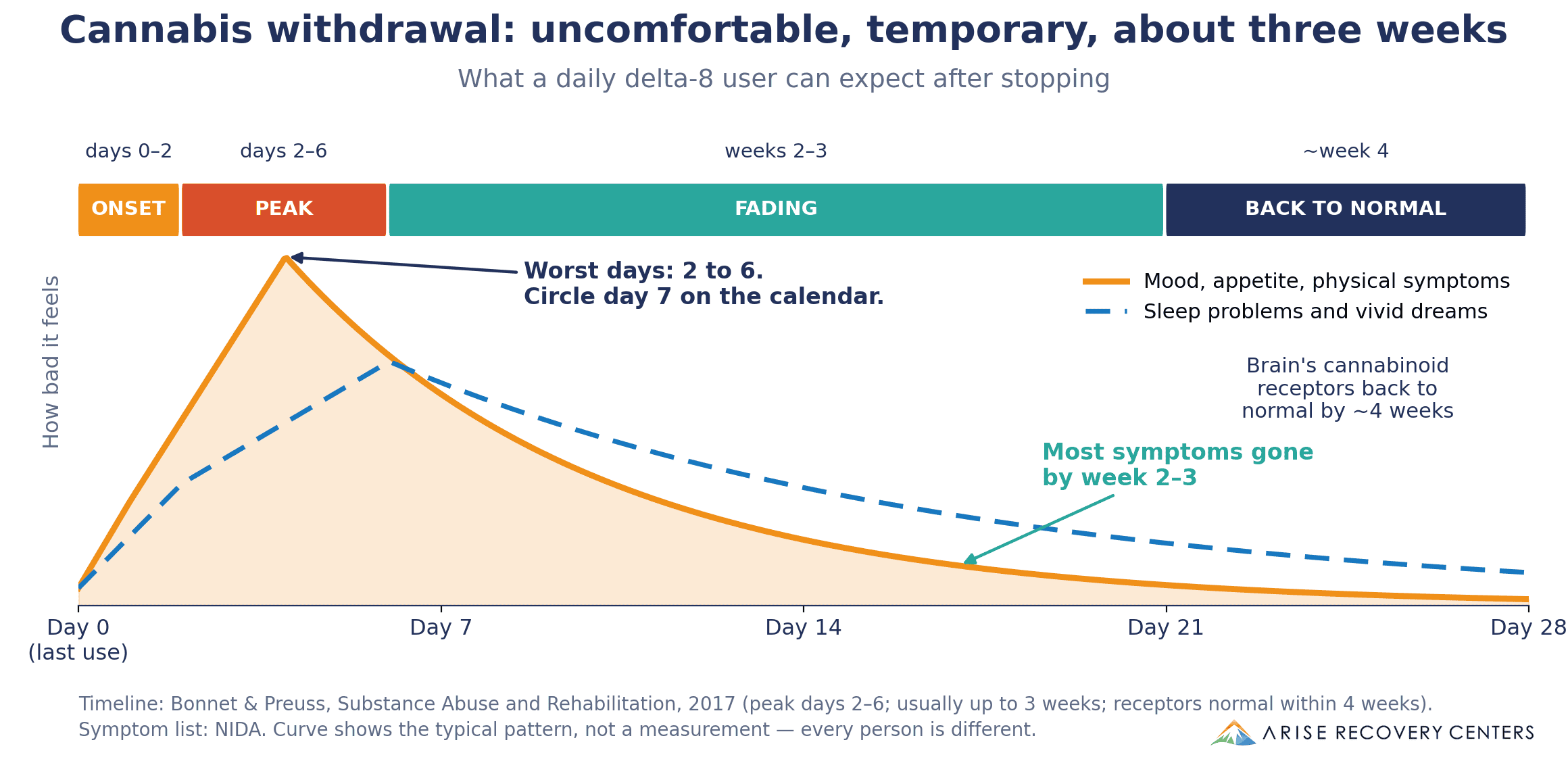
Withdrawal peaks around day two to six and is mostly gone in two to three weeks. Your brain’s cannabinoid receptors are back to normal by about week four.
That is the whole arc. Uncomfortable, temporary, and very treatable. Nobody needs a hospital for it — they need a plan for three weeks.
The three ways this goes
When a daily supply disappears overnight, people do one of three things.
1. Ride it out
This works for most people. Expect a rough week, protect your sleep, eat even when you are not hungry, and know that day five is not the new normal.
2. Swap it for something else
This is the one to watch. The ban did not touch delta-9 hemp gummies, alcohol, or whatever a friend is selling. Some people who cannot sit through the irritability and the insomnia will reach for the nearest thing that works. We saw exactly this pattern when Texas banned 7-OH. A swap is not a solution. It is the same problem with a new label.
3. Get help
The ban removed the product. It did not remove the reason someone was using it every day. If delta-8 was doing a job — sleep, anxiety, getting through the evening — that job still needs doing, and that is what treatment is actually for.
Rule of thumb: if you have tried to stop before and could not, the ban did not fix that. If you have used every day for more than a year, or you are already looking for a replacement, that is the signal to call.
For parents
One in nine high school seniors used delta-8 in 2023. If your teenager is suddenly irritable, not sleeping, and not eating, and the timing lines up with the end of July, that may be withdrawal, not attitude. Ask before you assume. “Were you using the gummies from the smoke shop?” is a fair question, and it is a better opener than a search of their room.
What treatment for this looks like
There is no FDA-approved medication for cannabis withdrawal, and you do not need one. NIDA’s review points to behavioral treatment — cognitive behavioral therapy, motivational enhancement, and contingency management — as what works for cannabis use disorder.
That is outpatient work: a few evenings a week of intensive outpatient, or supportive outpatient if things are more stable, while you keep going to work and sleeping in your own bed. Medical detox is almost never needed for cannabis alone. “Treatment” does not mean going away for a month.
One real safety point
Low mood during withdrawal is common and passes. If it turns into thoughts of hurting yourself, that is not withdrawal to wait out. Call or text 988. And if you are stopping alcohol or benzodiazepines at the same time, talk to a medical professional first — those withdrawals can be dangerous in a way cannabis is not.
Delta-8 is the gentle end of what is changing in the Texas drug supply. At the other end, a veterinary sedative called medetomidine is now riding along with fentanyl — and that one sends people to the ICU.
Overrated vs. underrated
Overrated
- “It’s just weed, you can’t withdraw.” Roughly half of regular users do. It is in the diagnostic manual.
- Waiting for the ban to get overturned. Maybe it will. Your sleep is bad tonight.
- Switching to delta-9 gummies as a “taper.” Without a plan and an end date, that is not a taper. It is a new supply.
Underrated
- The calendar. Day two to six is the worst of it. Circle day seven. Most people are through the peak by then.
- Sleep hygiene, seriously. Insomnia is the symptom that drives people back. Fix the bedroom before you fix anything else.
- Telling someone the timing. “I quit delta-8 on the 31st and I’m a mess this week” buys you patience from the people around you.
What to actually do this week
If you were a daily user and you have stopped
- Mark the date you stopped. Count forward. Days two through six are the hard ones. Week three is the finish line for most people.
- Protect sleep like it is the whole plan. Same bedtime, no screens in bed, no alcohol as a substitute — it wrecks the sleep you are trying to rebuild.
- Eat on a schedule, not on appetite. Appetite comes back. Skipping meals makes the irritability worse.
- Do not replace it. Not with the delta-9 gummies, not with drinks, not with something from a friend. If you cannot get through a week without replacing it, that is the answer to the next question.
- If you have already relapsed or swapped, call. That is not failure. It is information, and it is exactly what an outpatient program is built for.
Arise Recovery Centers provides outpatient addiction treatment across Texas — day programs, intensive outpatient, and supportive outpatient — at 12 locations in DFW, Houston, and Austin. If you are not sure whether what you are feeling is a rough week or something that needs help, this guide to levels of care walks through it, and you can verify your insurance online in about two minutes. It is confidential and does not commit you to anything. If you or someone you love is struggling with substance use, reach out to us or our mental health partner, Saltwood Mental Health, today.
Frequently asked questions
Is delta-8 illegal in Texas now?
Yes, to sell. On May 1, 2026, the Texas Supreme Court upheld a Department of State Health Services rule classifying delta-8 THC as a controlled substance, and DSHS began enforcing it July 31, 2026. THC vapes were banned in September 2025 and THCA flower in March 2026. Hemp products under 0.3% delta-9 THC and CBD remain legal.
Can you really go through withdrawal from delta-8?
Yes. Delta-8 is a form of THC, and cannabis withdrawal is a recognized DSM-5 diagnosis. A 2020 meta-analysis in JAMA Network Open found withdrawal symptoms in about 47% of regular or dependent cannabis users.
What are the symptoms of cannabis withdrawal?
NIDA lists irritability, anger, anxiety, restlessness, decreased appetite or weight loss, depressed mood, insomnia, strange dreams, headaches, sweating, stomach pain, and tremor. The DSM-5 requires three or more, beginning within about a week of stopping.
How long does cannabis withdrawal last?
Symptoms usually peak between the second and sixth day and fade over two to three weeks. Sleep problems and vivid dreams can linger a little longer. Research shows the brain’s cannabinoid receptors return to normal within about four weeks of stopping.
Is cannabis withdrawal dangerous?
Uncomfortable, but not medically dangerous the way alcohol or benzodiazepine withdrawal can be. Medical detox is rarely needed for cannabis alone. If withdrawal brings thoughts of self-harm, call or text 988.
Do I need rehab to quit delta-8?
Most daily users can stop on their own with a plan for the first three weeks. Treatment makes sense if you have tried to quit before and could not, if you are replacing it with another substance, or if delta-8 was managing anxiety, sleep, or another problem that is now unmanaged. That treatment is outpatient, not residential.
What treatment works for cannabis use disorder?
NIDA points to behavioral treatments: cognitive behavioral therapy, motivational enhancement therapy, and contingency management. There is no FDA-approved medication for cannabis use disorder. These therapies are delivered in outpatient programs.
My teenager has been using delta-8. What should I do?
Ask directly and calmly about timing and how much. Withdrawal in a teen can look like a sudden mood and sleep problem. If use was daily, or if you see them switching to something else, get an assessment. If your teen is 18 or older, we can help directly; for younger teens, your pediatrician can point you to an adolescent program.
This article is for education, not diagnosis, and it does not replace advice from your own treatment team. Laws described here were current as of September 2026 and may change.