

When researchers went through every alcohol-induced death recorded in the United States between 1999 and 2024, one group stood out. Not the group most people would guess.
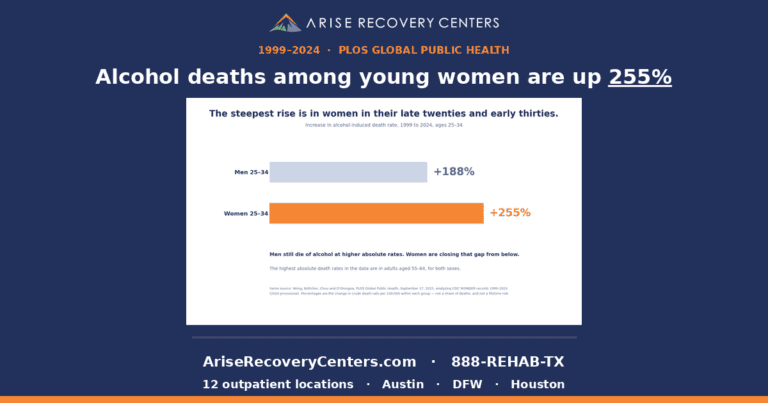
Women between 25 and 34 saw their alcohol death rate rise 255% over that period. It is the steepest climb of any age-and-sex group in the data. Men the same age rose 188%.
This is not a story about women drinking like reckless college students. Most of what is driving it has little to do with how much anyone is drinking. It has to do with what the same amount of alcohol does to a female body, and how quickly.
The good news is that this is treatable, it is treatable on an outpatient basis, and the signs show up early enough to act on.
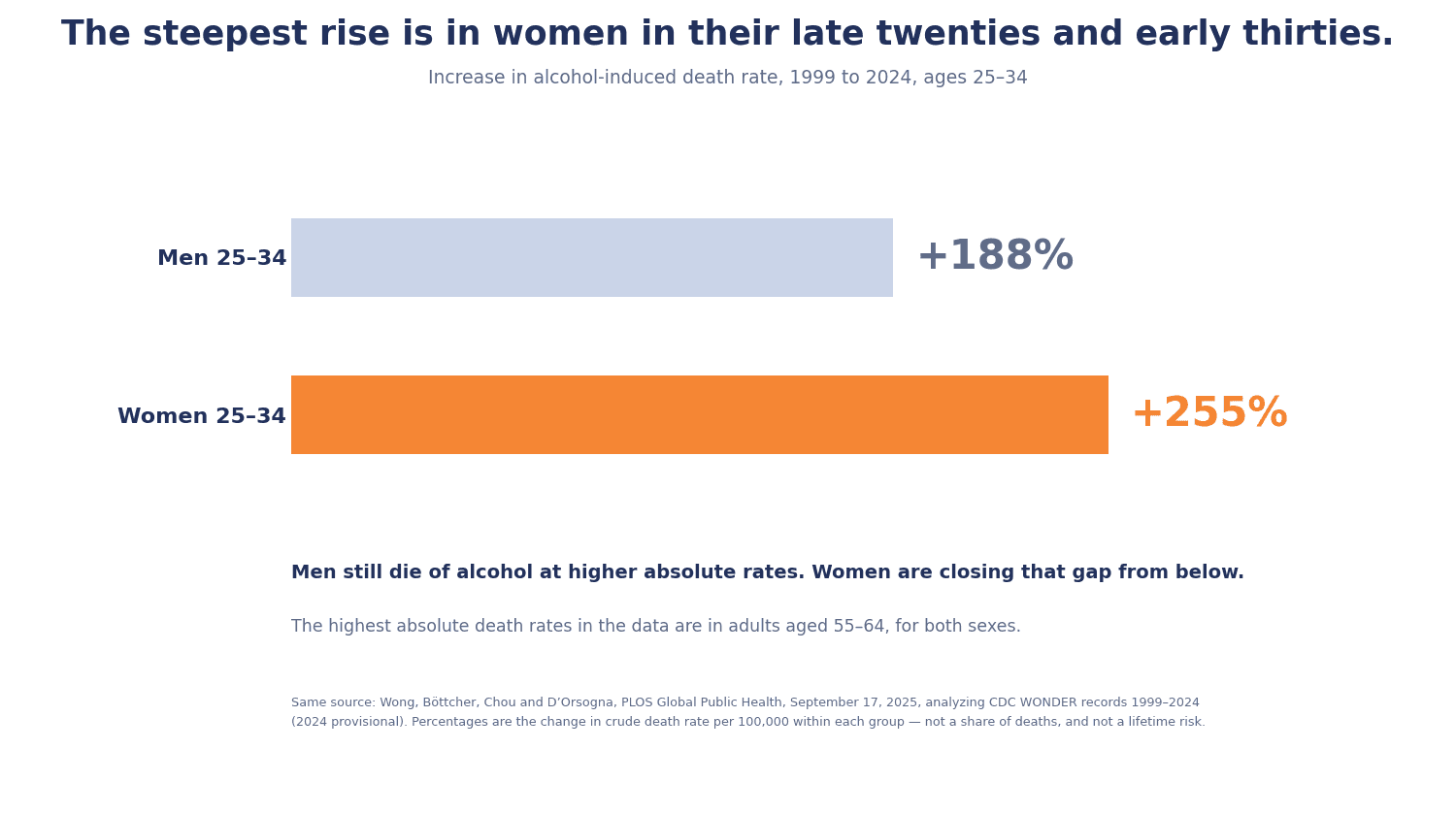
Change in crude death rate per 100,000 within each group, 1999–2024.
The short version
• Alcohol-induced deaths among women 25–34 rose 255% from 1999 to 2024. Men the same age rose 188%.
• Men still die from alcohol at higher absolute rates. The highest absolute rates of all are in adults 55–64. What is moving fastest is the trend among younger women.
• Women reach higher blood alcohol levels than men from the same drinks, and develop cirrhosis in roughly 20 years rather than 35.
• In one large analysis, one to two drinks a day raised cirrhosis risk in women and did not in men — at or below the limit federal guidelines used to recommend.
• Even one drink a day raises a woman’s breast cancer risk by an estimated 5% to 15%.
• In January 2026 the federal government removed the sex-specific drink limits entirely.
What the data shows, and what it does not
The analysis was published in PLOS Global Public Health in September 2025. It covers every death in CDC’s national records from 1999 through 2024 that is fully attributable to alcohol. That means alcoholic liver disease, alcohol poisoning, and alcohol use disorder. It is a deliberately narrow category.
Three things are worth saying before anyone runs with the 255%.
Men still die more. In absolute terms, male alcohol death rates remain higher at every age. Women are closing that gap from below, not overtaking.
The highest absolute rates are not in young people. They are in adults aged 55 to 64, for both sexes. The 25–34 group is where the increase is steepest, which is a different claim.
Overall alcohol deaths have fallen from their peak. The national rate hit 16.3 per 100,000 in 2021, or 54,258 deaths, and has declined since.
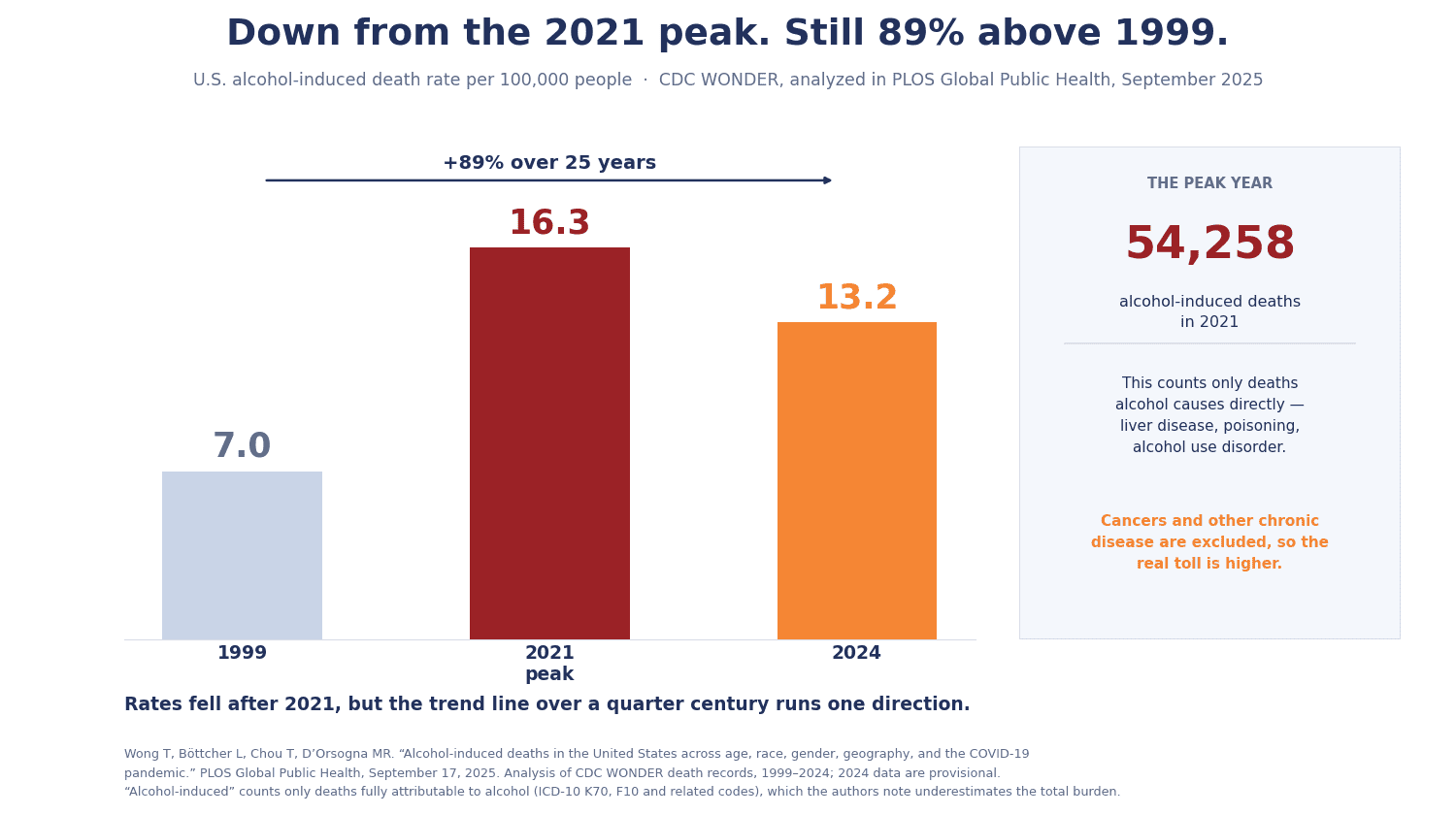
Rates per 100,000. 2024 figures are provisional.
That decline is real. But 2024 still sat 89% above 1999. And because this measure leaves out cancers and most chronic disease, the study’s authors note that it underestimates the true burden. CDC’s broader estimate, which counts those other causes, is roughly 178,000 alcohol-related deaths a year.
Why the same drinking does more damage
Start with something mechanical. Alcohol distributes through the water in your body. Women carry proportionally less body water than men. The same two drinks therefore produce a higher blood alcohol concentration in a woman than in a man of the same weight. The dose is effectively larger before anything else happens.
Over years, that difference compounds into a different disease course.
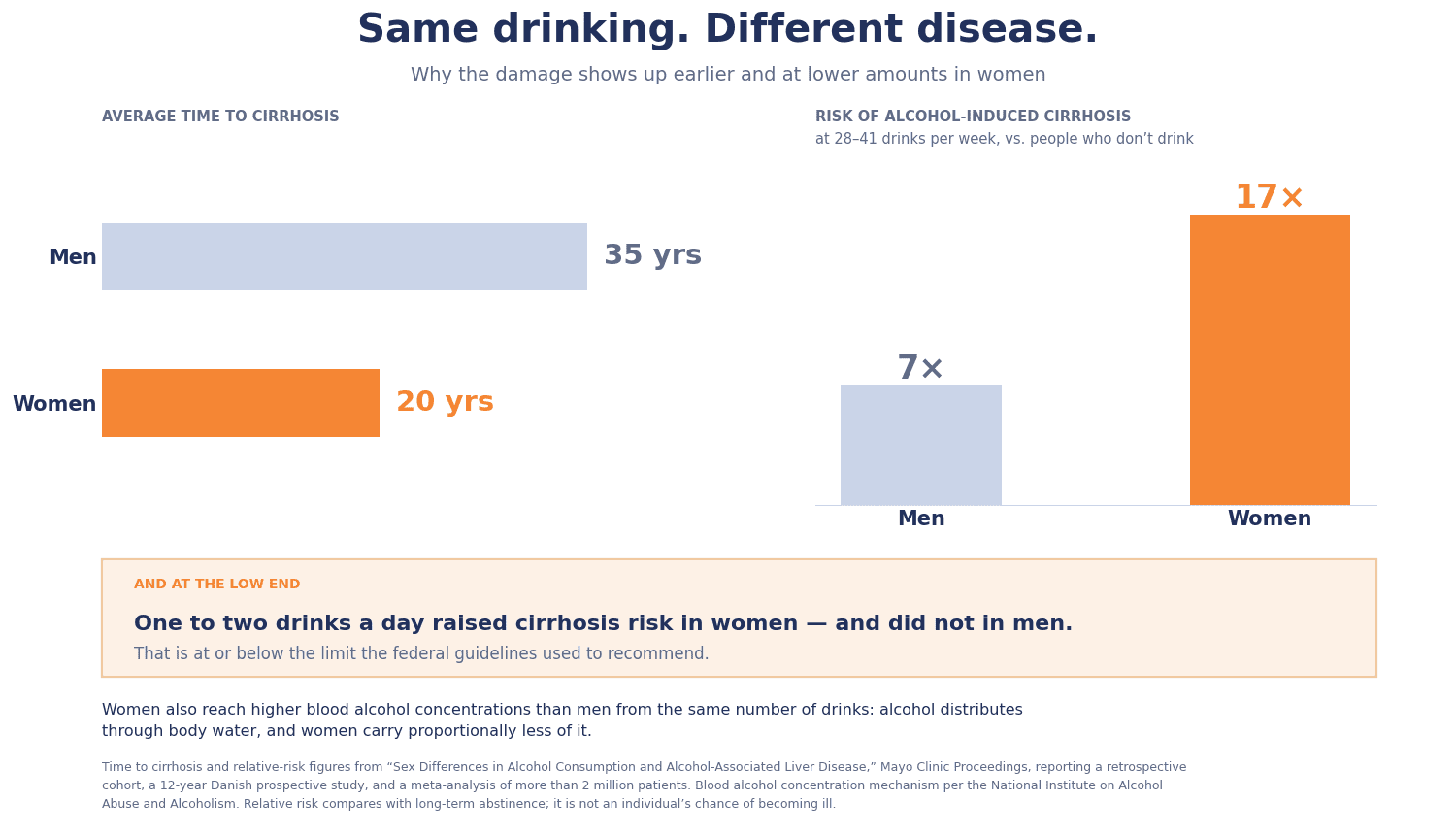
Figures reported in Mayo Clinic Proceedings. Relative risk compares with long-term abstinence.
The bottom panel of that chart is the most practical fact in this article. In a meta-analysis of more than two million patients, one to two drinks per day was associated with increased cirrhosis risk in women, and was not in men.
One to two drinks a day was, until January, what the federal guidelines described as moderate drinking. A woman drinking exactly within the recommendation was in a risk category the recommendation did not describe.
The same pattern shows up in the population data. Between 1998 and 2012, liver disease rose 240% among women aged 15 to 39, compared with 90% among men the same age.
The clinical name for getting sick faster
In our field there is a term for this: telescoping. Women typically start drinking later than men. But they move faster from first heavy use to alcohol use disorder, and faster again to the point of needing treatment. The whole arc compresses.
One finding is worth sitting with. Women tend to drink less than men and still arrive at comparable severity of alcohol use disorder. Less drinking, same disease.
We see this at intake. A woman describes a history that sounds milder than a man’s on paper. Fewer years, lower quantities, no dramatic incidents. Then her liver values or her withdrawal symptoms do not match the story she is telling. She is not minimizing. The arithmetic is simply different for her.
What this means practically
If you are a woman measuring your drinking against your husband’s, your brother’s, or your friends’ as a way of deciding whether it is a problem, that comparison is not neutral. The same intake carries more risk for you, and the damage tends to arrive sooner.
What changed in behavior
Biology has not changed since 1999. Part of the trend is that women’s drinking has moved toward men’s.
Between 2001 and 2013, high-risk drinking rose 58% among women against 16% among men. Alcohol use disorder prevalence rose 84% among women against 35% among men.
The recent picture is genuinely mixed. A study published in JAMA in April 2025 examined binge drinking across nearly 268,000 U.S. adults. The authors found that past-month binge drinking among young adult women in 2021–2023 was higher than among men, reversing the 2017–2019 pattern, while men in other age groups continued to binge and heavy drink at higher rates.
Here is the nuance most coverage dropped. Binge drinking declined for both sexes in that window. It simply declined faster among young men. Young women did not start drinking dramatically more. That is a real signal, but it is not a generation of women spiraling.
The risk almost nobody has been told about
One alcohol-related harm falls on women specifically, and awareness of it is poor.
According to the National Institute on Alcohol Abuse and Alcoholism, even one drink per day can raise a woman’s risk of breast cancer by an estimated 5% to 15% compared with not drinking. That is an increase in relative risk, not an individual’s odds of getting cancer. But it begins at the first drink, not at some threshold of heavy use.
In December 2024, the U.S. Surgeon General issued a formal advisory on alcohol and cancer:
- Alcohol is causally linked to at least seven cancers: breast in women, colorectal, esophageal, liver, mouth, throat, and voice box.
- It is the third leading preventable cause of cancer in the U.S., behind tobacco and obesity.
- It accounts for roughly 100,000 cancer cases and about 20,000 cancer deaths a year in this country.
- Fewer than half of Americans know there is any link.
The advisory recommended adding cancer risk to the warning label on alcoholic beverages.
And then the government removed the number
Everything above argues for guidance that treats women differently from men, because the evidence says the risk is different.
On January 7, 2026, the federal Dietary Guidelines for Americans went the other way. The limits that had stood since 1990, two drinks a day for men and one for women, were deleted. Not raised, not lowered. Removed.
This is the complete alcohol section of the new guidelines, all 68 words:
Limit Alcoholic Beverages
• Consume less alcohol for better overall health.
• People who should completely avoid alcohol include pregnant women, people who are recovering from alcohol use disorder or are unable to control the amount they drink, and people taking medications or with medical conditions that can interact with alcohol. For those with a family history of alcoholism, be mindful of alcohol consumption and associated addictive behaviors.
The second bullet is sound and we would not change it. The first no longer answers the question people actually ask, which is less than what. And the new guidance draws no distinction between men and women, at the moment the mortality data is diverging between them.
The document no longer defines a standard drink either, and does not mention cancer.

Both sections quoted in full from the 2025–2030 Dietary Guidelines for Americans, pages 4 and 5.
For context on how this came about: Reuters reported on January 8, 2026 that officials at HHS had drafted a proposal going the opposite direction, cutting the men’s limit from two drinks to one and citing cancer risk, and that the proposal did not survive. Major alcohol producers have campaigned on the issue since 2021, and industry groups publicly welcomed the new guidelines. HHS has said its policies were “driven by evidence and gold-standard science.”
The study the government commissioned to set those limits was published independently in June 2026. It recommends one drink a day for everyone. Here is what it found, and why it was shelved.
We are a treatment provider, not a policy shop. But the practical part is worth saying plainly. When an official number disappears, it is not replaced by nothing. It is replaced by whatever the drinker already believed. And for women, the old number may already have been too high.
Update: A September 2026 study in The Lancet Regional Health found breast cancer is the leading alcohol-caused cancer death in U.S. women at every age. We broke down the numbers here.
Update: An October 2026 Cleveland Clinic study found heavy drinking turns the brain’s own immune cells against its wiring. Here is what it found, and how the brain recovers.
What to actually do with this
- Use one drink a day as a ceiling, not a target. It is still CDC’s definition of moderate drinking for women and the most useful benchmark available.
- Learn what a standard drink is. 14 grams of pure alcohol: 12 oz of 5% beer, 5 oz of 12% wine, or 1.5 oz of 80-proof spirits. A generous pour of wine at home is often two. A 16 oz craft IPA at 7.5% is two.
- Count by the week. CDC defines heavy drinking as 8 or more drinks a week for women. Weekly totals are harder to rationalize than individual evenings.
- Stop benchmarking against the men in your life. It is the most common and most misleading comparison women make about their own drinking.
- Take family history seriously. It is the strongest line in the new federal guidance and the one most people skim past.
If you look at that list and recognize yourself, that is useful information, not a verdict. Most people who cut back or stop do it without ever setting foot in a hospital, and the earlier you look at it the more options you have.
One safety note that matters
If you drink heavily every day, do not stop abruptly on your own. Alcohol is one of the few drugs where unmanaged withdrawal can be dangerous. If you are drinking daily and want to stop, talk to a medical professional first about how to do it safely. That is a conversation measured in days, and this guide to whether you need detox walks through the signs.
Young women are not the only group worth watching. Heavy drinking among adults 50 to 64 rose more than 36% from 2018 to 2024, even as the country overall drinks less.
Where this leaves you
The number that moved fastest over the last twenty-five years belongs to women who are, in most cases, working, raising children, and holding their lives together. That is exactly the group least likely to see themselves in the word “alcoholic,” and most likely to measure their drinking against a husband or a friend and conclude they are fine.
The biology says that comparison is wrong. The mortality data says it is getting more wrong. And the sooner someone looks at it honestly, the smaller the intervention needs to be.
Frequently asked questions
How many drinks a day is safe for a woman?
There is no amount that carries zero risk, and as of January 2026 the federal Dietary Guidelines no longer give a number. The most useful benchmark is still CDC’s definition of moderate drinking for women: no more than one drink a day, treated as a ceiling rather than a target. Given that one to two drinks a day was associated with increased cirrhosis risk in women in a large meta-analysis, staying below that line is the safer read.
Why does alcohol affect women more than men?
Alcohol distributes through body water, and women carry proportionally less of it than men. The same number of drinks therefore produces a higher blood alcohol concentration in a woman of the same weight. Women also develop alcohol-related liver disease sooner and at lower levels of drinking, and research shows a faster progression from heavy drinking to alcohol use disorder, a pattern clinicians call telescoping.
Are alcohol deaths among women really rising?
Yes. An analysis of CDC records published in PLOS Global Public Health in September 2025 found that alcohol-induced death rates among women aged 25 to 34 rose 255% between 1999 and 2024, the steepest increase of any age-and-sex group. Men still die from alcohol at higher absolute rates, and overall rates have fallen since a 2021 peak, but the long-term trend among younger women is the sharpest in the data.
Does one drink a day really increase breast cancer risk?
According to the National Institute on Alcohol Abuse and Alcoholism, even one drink a day can raise a woman’s breast cancer risk by an estimated 5% to 15% compared with not drinking. The U.S. Surgeon General’s December 2024 advisory identified alcohol as causally linked to at least seven cancers, including breast cancer in women, and as the third leading preventable cause of cancer in the United States.
What did the 2026 Dietary Guidelines change about alcohol?
Released January 7, 2026, the 2025–2030 Dietary Guidelines removed the daily limits of two drinks for men and one for women that had been in place since 1990. They replaced them with the guidance to “consume less alcohol for better overall health,” with no numeric limit, no standard-drink definition, and no reference to cancer risk. The guidance no longer distinguishes between men and women.
How do I know if I am drinking too much?
Count a full week rather than a single night. CDC defines heavy drinking as eight or more drinks a week for women and fifteen or more for men, and binge drinking as four or more on one occasion for women and five or more for men. Other signals matter as much as the count: drinking more than you planned, needing more for the same effect, hiding it, or feeling shaky, sweaty, or anxious the morning after.
Is it dangerous to stop drinking suddenly?
It can be, for people who drink heavily every day. Alcohol is one of the few substances where unmanaged withdrawal can cause seizures and other medical emergencies. If you drink daily, talk to a medical professional before stopping so it can be done safely. This is not a reason to postpone quitting. It is a reason to make one phone call first.
Can alcohol use disorder be treated without going to inpatient rehab?
For many people, yes. Outpatient treatment lets you keep working and keep parenting while you get care, with day or evening groups scheduled around your life. Arise Recovery Centers provides partial hospitalization, intensive outpatient, and supportive outpatient programs at twelve locations in Texas. The right starting level depends on your drinking history and medical picture, which is what an assessment is for.
Getting help
Arise Recovery Centers provides outpatient addiction treatment across Texas — day programs, intensive outpatient, and supportive outpatient — at 12 locations in DFW, Houston, and Austin, with evening groups so people can keep working and keep parenting. If you are not sure whether what you are describing is a problem, this guide to levels of care walks through it, and you can verify your insurance online in about two minutes. It is confidential and does not commit you to anything.
If you or someone you love is struggling with alcohol, reach out to us or our mental health partner, Saltwood Mental Health, today.
You can also read our look at why alcohol kills more Texans each year than every illicit drug combined.
Sources
- Wong T, Böttcher L, Chou T, D’Orsogna MR. “Alcohol-induced deaths in the United States across age, race, gender, geography, and the COVID-19 pandemic.” PLOS Global Public Health, September 17, 2025.
- “Sex Differences in Alcohol Consumption and Alcohol-Associated Liver Disease.” Mayo Clinic Proceedings.
- National Institute on Alcohol Abuse and Alcoholism, Women and Alcohol.
- “A narrative review on alcohol use in women: insight into the telescoping hypothesis from a biopsychosocial perspective.” PubMed Central.
- Shuey B, Wen H, Suda KJ, et al. “Sex-Based Differences in Binge and Heavy Drinking Among US Adults.” JAMA, April 16, 2025.
- Office of the U.S. Surgeon General, Alcohol and Cancer Risk: The U.S. Surgeon General’s Advisory, December 19, 2024.
- U.S. Departments of Health and Human Services and Agriculture, Dietary Guidelines for Americans, 2025–2030, released January 7, 2026, pages 4–5.
- Centers for Disease Control and Prevention: standard drink sizes, binge and heavy drinking definitions, deaths from excessive alcohol use.
- Reuters, “Exclusive: The Trump Administration killed a draft proposal to halve alcohol limits, sources say,” January 8, 2026.
This article is for general information and is not medical advice. If you are concerned about your drinking or someone else’s, speak with a qualified clinician.