
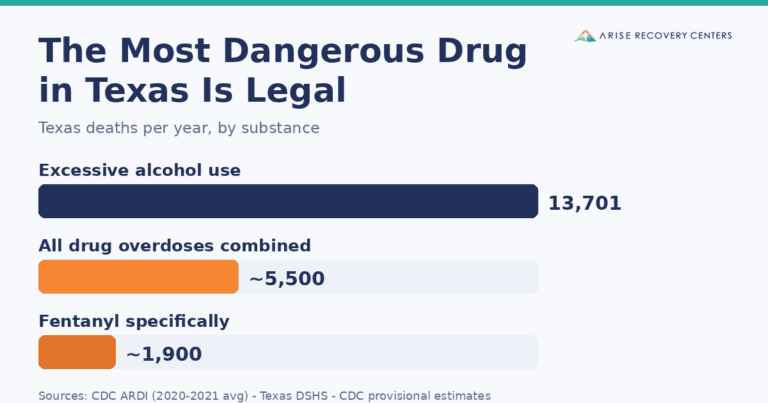
Ask a Texan to name the most dangerous drug in the state and you’ll hear one word: fentanyl. It’s a reasonable guess — and it’s wrong. The substance behind the most alcohol deaths in Texas, the most hospital beds, and the most quiet family damage is sold in every grocery store, toasted at every wedding, and advertised during every Cowboys game. Alcohol kills more Texans every year than every illicit drug combined — roughly two and a half times over. It just does it slowly enough that nobody holds a press conference.
Last reviewed and updated July 2026.
This article is general education, not medical advice. Decisions about stopping or reducing drinking — especially heavy daily drinking — belong with a licensed medical professional.
The numbers nobody puts on a billboard
Fentanyl deserves the attention it gets. From August 2023 to July 2024, more than 1,900 Texans died from fentanyl poisoning (Texas DSHS) — a genuine crisis, even as those numbers have started falling. All drug overdoses combined — fentanyl, meth, cocaine, everything — claimed about 5,500 Texans a year at the 2023 peak (CDC estimate) — and have been falling since.
Now the number nobody quotes: excessive alcohol use kills an average of 13,701 Texans every year (CDC Alcohol-Related Disease Impact data). Nationally it’s about 178,000 American deaths a year (CDC, 2024) — up 29% in just five years, and more than double the country’s total drug overdose deaths.
A few more Texas numbers worth sitting with: about 1 in 6 Texas adults (16.9%) binge drinks at least monthly. Nearly 70% of the Texans alcohol kills are men. And 84% are adults 35 and older — not college kids, but people with mortgages, careers, and kids who notice.
Why the deadliest drug gets a pass
Three reasons, and none of them are about chemistry.
It’s legal, so it feels safe. Our brains use a shortcut: dangerous things get banned, so anything sold openly must be fine. But legal status reflects history and politics, not toxicology. Alcohol is causally linked to liver disease, seven types of cancer, heart damage, and — unlike almost every illicit drug — a withdrawal syndrome that can itself be fatal.
It kills slowly, so nothing triggers alarm. A fentanyl death takes minutes and makes the news. An alcohol death usually takes 20 years of Tuesdays and makes an obituary that says “after a long illness.” Same substance-driven death; entirely different public reaction.
Everyone drinks, so your drinking never stands out. When the whole culture drinks, the bar for “a problem” quietly moves to worse than everyone around me — and in some rooms, that bar is very high. This is why people struggling with alcohol wait years longer to seek help than people struggling with other substances, and why fewer than 1 in 10 Americans with alcohol use disorder ever receive treatment (NIAAA).
Overrated vs. underrated: how we misjudge alcohol
This is part of our running series on what’s overrated and underrated in recovery. With alcohol, the misjudgments stack up on both sides:
| Overrated | Underrated |
|---|---|
| The “rock bottom” imageWaiting to look like the stereotype — morning vodka, lost job, DWI — before the word “problem” applies. | Gray-area drinkingThe nightly two-to-four that’s quietly climbing. Most alcohol harm happens here, in people who’d never call themselves alcoholics. |
| Willpower & white-knuckling“I can stop whenever I want” — usually tested alone, in secret, and briefly. | A real assessmentOne honest hour with a professional tells you more than five years of wondering. |
| Comparing down“I drink less than my brother / my boss / my college self” — the most popular way to fail a screen you never took. | Your own dataSleep, memory, mood, money, marriage. What alcohol costs you is the only comparison that matters. |
| Quitting alone, instantlyDramatic, cinematic — and for heavy daily drinkers, medically dangerous (see below). | Medical detox & outpatient careUnglamorous, covered by most insurance, and it works while you keep your job and your privacy. |
And if you want the official number the government would not print: the federal Alcohol Intake and Health Study, shelved and then published independently in June 2026, puts the line at one drink a day for everyone. Here is what it found.
One more number that belongs on that list: alcohol now causes about 23,000 U.S. cancer deaths a year, double the 1990 figure, and under 55 the cancer is colorectal or breast, not liver.
The 4-question self-screen (2 minutes, nobody watching)
Clinicians have used a four-question screen for decades because it works. Answer honestly — this is for you, not for anyone else.
| # | Have you ever… | Yes / No |
|---|---|---|
| 1 | Felt you should cut down on your drinking? | Y / N |
| 2 | Been annoyed when people criticized your drinking? | Y / N |
| 3 | Felt guilty about your drinking? | Y / N |
| 4 | Had a drink first thing in the morning (an eye-opener) to steady nerves or shake a hangover? | Y / N |
Two or more yeses is considered clinically significant — worth a conversation with a professional. Even one yes is information. (Adapted from the CAGE questionnaire; a screen is a flashlight, not a diagnosis.)
For scale: the NIAAA defines binge drinking as 5+ drinks in about two hours for men, 4+ for women — and heavy drinking as more than 4 drinks a day or 14 a week for men (3 and 7 for women). If those numbers made you do quick math on your own week, that’s worth noticing too.
One question that cuts through everything
And one more insider heuristic, the same one we’ve said about every substance: people who don’t have a problem generally don’t spend time wondering whether they have a problem. The wondering is data. Not a verdict — data. Nobody Googles “do I drink too much” recreationally.
That principle shows up in its most public form after a DUI arrest — where the instinct is to argue about labels instead of looking at the pattern. We unpack that in is a DUI a sign of alcoholism?, including what the BAC number quietly reveals about tolerance.
The one thing you should never do cold turkey
Here’s where alcohol breaks the rules people assume about drugs: for a heavy, daily drinker, stopping abruptly and alone can be more immediately dangerous than continuing. Alcohol withdrawal can involve seizures and delirium tremens (DTs) — a medical emergency that can be fatal without treatment. Quitting opioids feels terrible; quitting alcohol, for a heavy daily drinker, can kill. Almost nobody knows that, because it doesn’t fit the “it’s just beer” story.
The safe version is boring and effective: a medical assessment, a supervised detox if needed, then structured outpatient treatment — therapy and support on a schedule that fits around work and family. That’s exactly what we do across our Texas locations, and our complete guide to outpatient rehab walks through how the levels of care work. Most people are surprised to learn treatment for alcohol is covered by most insurance plans — you can verify your insurance online in about two minutes, confidentially.
One more thing worth knowing: there is a real medication conversation happening around alcohol right now. In a 2026 Lancet trial, participants taking semaglutide — the drug in Ozempic — went from about 17 heavy drinking days a month to about 5. Everyone in that trial was also in therapy, and the therapy-only group got to about 9. Here is what that research actually shows, including the part the headlines left out.
Outpatient alcohol treatment across Dallas–Fort Worth, Houston & Austin — keep your job, your privacy, and your life while you get help. Call 1-888-734-2289 (1-888-REHAB-TX) Free and confidential. You may also find additional resources and help through our mental health partner, Saltwood Mental Health in Dallas.
Frequently asked questions
Yes, by a wide margin. CDC data attributes an average of 13,701 Texas deaths per year to excessive alcohol use, while all drug overdoses combined claimed about 5,500 Texans at their 2023 peak — fentanyl specifically about 1,900. Alcohol’s toll is larger but quieter, because nearly two-thirds of it comes from chronic causes like liver disease, cancer, and heart disease rather than sudden overdoses.
Two quick tools: the four-question CAGE screen (cut down, annoyed, guilty, eye-opener — two yeses is clinically significant), and NIAAA’s limits — more than 4 drinks a day or 14 a week for men (3 and 7 for women) counts as heavy drinking. And a rule of thumb from inside the field: people who don’t have a problem rarely spend time wondering if they do. The wondering itself is worth taking seriously.
For heavy, daily drinkers — yes, genuinely dangerous. Alcohol withdrawal can cause seizures and delirium tremens, which can be fatal without medical care. That makes alcohol different from most substances, where withdrawal is miserable but rarely deadly. Anyone drinking heavily every day should get a medical assessment before stopping; supervised detox followed by outpatient treatment is the safe route.
Usually not. Most people with alcohol problems — especially those caught before a crisis — do well in outpatient treatment: structured therapy several hours a week while living at home and keeping their job. After any needed medical detox, levels like PHP and IOP step down in intensity as you stabilize. Most insurance plans cover it, and verifying takes about two minutes.
Legal doesn’t mean safe — part two: the “gas-station opioid” the DEA just banned, and why the ban is only the start.