

By Danny Andino, CEO, Arise Recovery Centers · Clinically reviewed by Nicholas Overbeck, LPC-S, LCDC · November 2026 · Overrated or Underrated
The Great American Smokeout is Thursday, November 19. If you are in early recovery and you smoke, you have probably heard a rule about it already: one addiction at a time. Get sober first. Deal with the cigarettes later.
It sounds like common sense. The research says it is backwards. Quitting smoking does not put your sobriety at risk. Holding on to cigarettes is linked to more relapse, not less.
The short version
- Quit-smoking help during addiction treatment was linked to a 25% better chance of staying sober long term. That finding comes from a review of 19 clinical trials (Journal of Consulting and Clinical Psychology, 2004).
- People in recovery from a drug problem who kept smoking had about twice the odds of relapse three years later. That is from a national study of 5,515 U.S. adults (Journal of Clinical Psychiatry, 2017).
- Smoking does not calm stress for long. People who stay smoke-free for six weeks or more report less anxiety, depression and stress than people who keep smoking (Cochrane review, 2021).
- You do not have to wait a year. Treatment is a good time to start, because counseling and medical help are already around you.
- Help is cheap or free. Most private health plans cover quit-smoking medicine and counseling at no cost. Texas’s quitline, 1-877-YES-QUIT, offers free coaching and up to 8 weeks of patches, gum or lozenges.
Why people hold on to the cigarettes
Nobody keeps smoking in early recovery because they think it is healthy. They keep it because it feels like the one thing holding them together. These are the reasons we hear most:
- “One addiction at a time.” Quitting everything at once feels like too much. It is the most common advice people get.
- “It is the only thing that calms me down.” Early recovery is stressful, and a cigarette feels like relief.
- “Everyone outside the meeting smokes.” Smoke breaks are where a lot of recovery friendships start.
- “If I quit smoking, I will drink.” This is the real fear underneath the others.
Every one of these makes sense. But researchers have tested the biggest fear directly, and the results point the other way.
What the research actually found
In 2004, researchers at the University of California, San Francisco pooled 19 randomized trials. Each one offered quit-smoking help to people in addiction treatment or recovery.
Getting that help during treatment was linked to a 25% greater chance of staying off alcohol and drugs long term. The authors concluded that it seemed to strengthen sobriety, not threaten it.
A 2017 study came at the question from the other side. Researchers followed 5,515 U.S. adults whose drug use disorder was already in remission. They checked back three years later.
People who kept smoking had about twice the odds of relapse as people who had quit. Among people who did not smoke at the start, those who picked up cigarettes had nearly five times the odds.
A study like this shows a strong link, not proof that cigarettes cause relapse. But it is the opposite of a safety net.
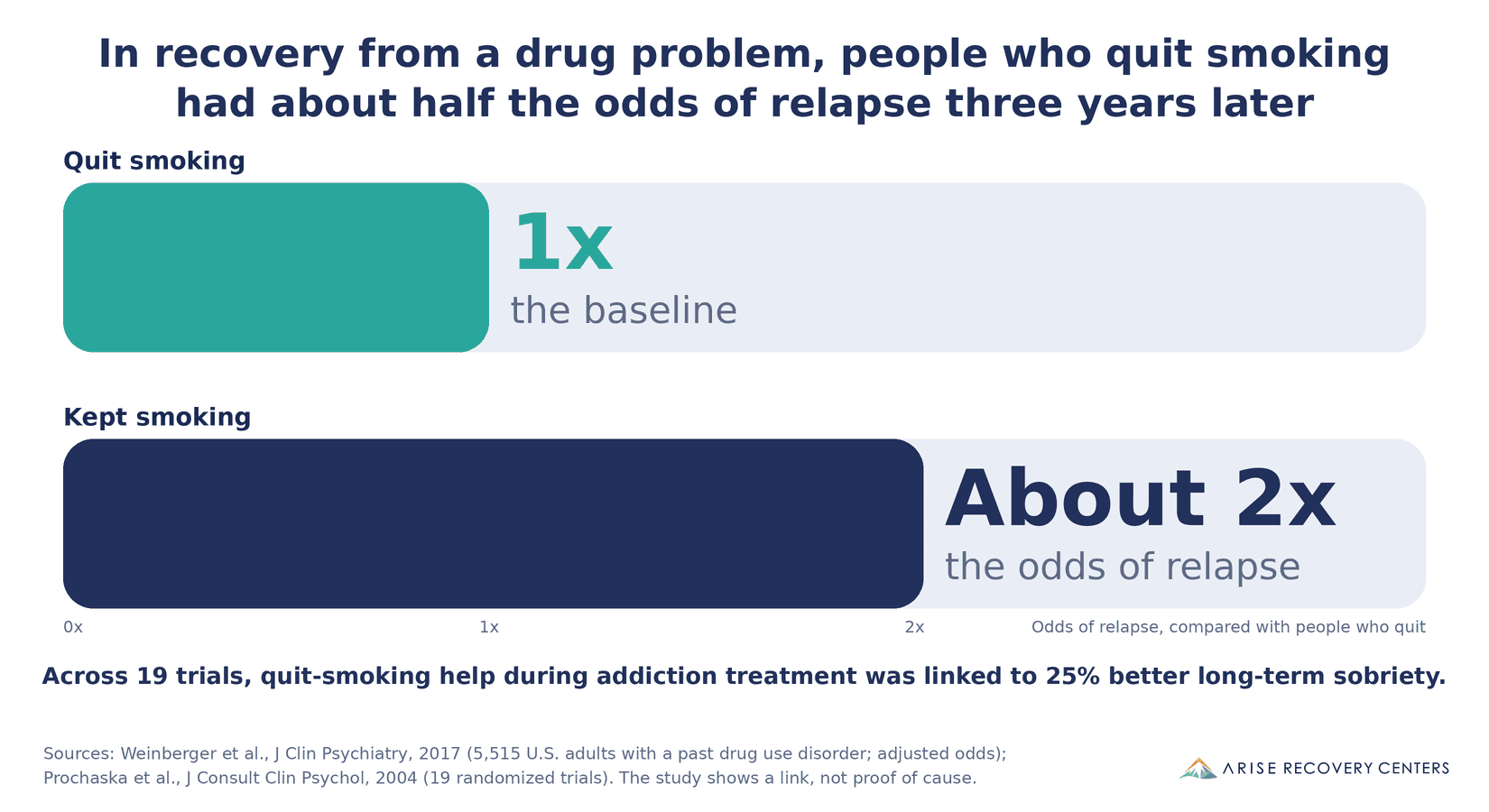
Quitting smoking will not cost you your sobriety.
Across 19 trials, quit-smoking help during addiction treatment was linked to a 25% better chance of staying sober long term.
The stress myth
The most common reason people give for smoking is stress. It feels true. You light up, and within minutes you feel calmer.
Researchers think much of that calm is relief from nicotine withdrawal. Nicotine wears off fast. Between cigarettes, you slide into a mild craving: restless, irritable, on edge. The next cigarette relieves the craving the last one created.
A 2021 Cochrane review pulled together 102 studies and nearly 170,000 people. People who stayed smoke-free for at least six weeks had less anxiety, depression and stress than people who kept smoking. The benefit held for people with mental health conditions, too.
The hard part is short. The National Cancer Institute says withdrawal is usually strongest in the first days or weeks, then fades. Quit-smoking medicine makes that stretch easier.
The number that surprises people in recovery
Mayo Clinic researchers once followed 845 people who had been treated for alcohol or drug addiction. Over the years, 214 of them died.
About half of those deaths, 51%, came from tobacco-related causes like heart disease, emphysema and lung cancer. About 36% came from alcohol-related causes (JAMA, 1996, with the journal’s published correction).
Many of them beat the drinking and were hurt more by the cigarettes they kept. Sobriety gives you your life back. Quitting smoking helps you keep it longer.
Smoking has dropped to about 1 in 11 U.S. adults, according to preliminary CDC survey data for 2025. Among adults with a drug or alcohol use disorder, it was still more than 1 in 3 (2019 federal survey data, JAMA, 2022).
Overrated vs. underrated
Overrated
- “One addiction at a time.” In 19 trials, quit-smoking help during treatment did not hurt sobriety. It was linked to better sobriety.
- A cigarette for stress. Most of the calm is relief from the craving the last cigarette created.
- Waiting a full year to quit. The fear behind waiting, that quitting will trigger a relapse, is not what the trials found.
- Picking up smoking to get through early recovery. In the 2017 study, people who started smoking had nearly five times the odds of relapse.
Underrated
- Doubling up on nicotine replacement. A patch plus gum or a lozenge works better than one alone. It is medicine, not a relapse.
- Prescription quit medicine. The FDA removed varenicline’s boxed warning in 2016 after a safety trial of about 8,000 people.
- Your insurance. Most private plans must cover quit-smoking medicine and counseling at no cost, for two quit attempts a year.
- Getting any help at all. In 2022, only about 4 in 10 U.S. adults who tried to quit used counseling or medicine (CDC).
Your quit plan, step by step
| Step | What to do | Why it helps |
|---|---|---|
| 1. Say it out loud | Tell your counselor and your doctor that you smoke, and how much. | Quitting becomes part of your recovery plan instead of an afterthought. |
| 2. Pick a date | The Great American Smokeout is Thursday, November 19. Or choose a date with your counselor. | A date gives you time to line up medicine. Varenicline, for example, usually starts a week before you quit. |
| 3. Use medicine | Ask your doctor about a patch plus gum or a lozenge, varenicline or bupropion. Get a prescription even for over-the-counter patches. | On most private plans, a prescription is what gets your quit medicine covered at no cost. |
| 4. Get free coaching | Call 1-877-YES-QUIT or visit YesQuit.org. | Texans 18 and older get free quit coaching plus up to 8 weeks of patches, gum or lozenges. |
| 5. Plan for week one | Add an extra meeting, session or check-in call that first week. | Smokefree.gov says the first week is when people are most likely to slip. |
| 6. If you slip, restart | One cigarette does not erase your progress. Set a new date and keep going. | Quitting often takes more than one try. Most private plans cover two quit attempts a year. |
Sources: U.S. Preventive Services Task Force (2021); federal ACA coverage guidance (2014), upheld in Kennedy v. Braidwood (2025); Texas Department of State Health Services; National Cancer Institute, Smokefree.gov; CDC, MMWR (2024).
Where outpatient care fits in
Quitting smoking is easier when the rest of your recovery has support behind it. That is what outpatient treatment is for.
Arise Recovery Centers provides outpatient drug and alcohol treatment at 12 locations in DFW, Houston and Austin: a day program, intensive outpatient and supportive outpatient. If you smoke, tell us at your assessment. Your counselor can work quitting into your relapse prevention plan, alongside your doctor or the quitline.
Relapse rarely comes out of nowhere. These are the three stages of relapse and the early signs to watch for. For more in this series, see whether non-alcoholic beer in recovery is overrated or underrated.
This guide to levels of care explains the options. You can schedule a free consultation or verify your insurance online in about two minutes. Both are confidential and do not commit you to anything.
Safety note: Nicotine replacement, varenicline and bupropion are safe for most adults. Check with a doctor or pharmacist first if you are pregnant, have heart disease or take other prescription medicines.
Frequently asked questions
Should I quit smoking in early recovery?
For most people, yes, and you do not have to wait. A review of 19 clinical trials found that quit-smoking help during addiction treatment was linked to a 25% better chance of staying off alcohol and drugs long term. Tell your treatment team you smoke so they can build quitting into your plan.
Will quitting smoking make me relapse?
The research points the other way. In the 19 trials, quit-smoking help during treatment was linked to better sobriety, not worse. In a national study of adults in recovery from a drug use disorder, people who kept smoking had about twice the odds of relapse three years later as people who quit.
Does smoking help with cravings for alcohol or drugs?
There is no good evidence that it does. People in recovery who kept smoking had more relapse, not less. For many people, smoking and drinking go together, so one can be a reminder of the other.
Is it true you should not make big changes in your first year of recovery?
That is a common saying in recovery circles, not a research finding about smoking. The trials that tested quit-smoking help during addiction treatment found it was linked to better long-term sobriety. Talk with your counselor about timing that fits you.
Does nicotine replacement count as a relapse?
No. Nicotine patches, gum and lozenges are FDA-approved medicines for quitting smoking. Used as directed, they are treatment. Using a patch plus a faster form like gum or a lozenge works better than one alone.
Is vaping a good way to quit smoking in recovery?
Vapes are not FDA-approved quit aids, and the U.S. Preventive Services Task Force points people to proven quit medicines first. The CDC says e-cigarettes may help adults who smoke if they completely replace cigarettes. Smoking even a few cigarettes a day is still dangerous, so using both does not solve the problem.
Does insurance cover quit-smoking medicine?
Most private health plans must cover it at no cost. Federal guidance calls for counseling and all FDA-approved quit medicines, including over-the-counter patches and gum when prescribed, for two quit attempts a year. Ask your doctor for a prescription, even for over-the-counter products.
Where can I get outpatient drug and alcohol treatment in Texas?
Arise Recovery Centers offers a day program, intensive outpatient and supportive outpatient at 12 locations in DFW, Houston and Austin. If you smoke, tell us at your assessment so your counselor can factor it into your plan. A free consultation is confidential and does not commit you to anything.
This article is education, not medical advice.
Sources: Prochaska JJ, Delucchi K, Hall SM, “A Meta-Analysis of Smoking Cessation Interventions With Individuals in Substance Abuse Treatment or Recovery,” Journal of Consulting and Clinical Psychology, 2004;72(6):1144–1156. Weinberger AH, Platt J, Esan H, Galea S, Erlich D, Goodwin RD, “Cigarette Smoking Is Associated With Increased Risk of Substance Use Disorder Relapse,” Journal of Clinical Psychiatry, 2017;78(2):e152–e160. Taylor GMJ, et al., “Smoking Cessation for Improving Mental Health,” Cochrane Database of Systematic Reviews, 2021, CD013522. Hurt RD, et al., “Mortality Following Inpatient Addictions Treatment: Role of Tobacco Use in a Community-Based Cohort,” JAMA, 1996;275(14):1097–1103, and published correction. Han B, Volkow ND, et al., “Trends in Prevalence of Cigarette Smoking Among US Adults With Major Depression or Substance Use Disorders, 2006–2019,” JAMA, 2022. Centers for Disease Control and Prevention, National Health Interview Survey early release of 2025 estimates, May 2026. VanFrank B, et al., “Adult Smoking Cessation — United States, 2022,” MMWR, 2024. U.S. Preventive Services Task Force, “Interventions for Tobacco Smoking Cessation in Adults, Including Pregnant Persons,” January 2021. U.S. Departments of Labor, Health and Human Services, and the Treasury, ACA Implementation FAQs Part XIX, May 2, 2014. Kennedy v. Braidwood Management, Inc., U.S. Supreme Court, June 27, 2025. U.S. Food and Drug Administration, Drug Safety Communication on Chantix (varenicline) and Zyban (bupropion), December 16, 2016. Texas Department of State Health Services, Texas Tobacco Quitline. National Cancer Institute, Smokefree.gov, “Managing Nicotine Withdrawal.” CDC, “About Electronic Cigarettes.” American Cancer Society, Great American Smokeout.