

By Danny Andino, CEO, Arise Recovery Centers · Clinically reviewed by Nicholas Overbeck, LPC-S, LCDC · November 2026
On Tuesday, Houston voters told their police department to put marijuana possession at the bottom of the list. Prop A passed with more than 70% of the vote. The same night, Massachusetts voters kept legal weed by about 3 to 1.
Whatever you think of those votes, one thing did not change. Cannabis does the same thing to a brain that gets it every day. And the number of Americans with a cannabis problem is still going up.
The short version
- Houston’s Prop A makes misdemeanor marijuana possession the Houston Police Department’s lowest enforcement priority. It also bans no-knock warrants.
- It does not legalize marijuana. Possession is still illegal under Texas law, and the measure covers only Houston police.
- In 2025, 19.3 million Americans had a marijuana use disorder. That makes it the most common drug use disorder in the country, behind only alcohol.
- From 2021 to 2025, alcohol and opioid use disorders went down. Marijuana use disorder went up.
- Most people who use cannabis never develop a problem. About 3 in 10 people who used it in the past year have one.
- Two warning signs in a year is enough for a diagnosis. The treatment is talk therapy, and outpatient care is built for it.
What Prop A does, and what it doesn’t
Prop A, called the Houston Freedom Act, passed about 71% to 29% in unofficial returns. It tells Houston police to treat Class A and Class B misdemeanor marijuana possession as their lowest priority. It also bans no-knock search warrants and requires the city to report on marijuana enforcement.
Here is what it does not do. It does not make marijuana legal. Possession is still a crime under Texas law, and officers can still enforce it. It also applies only to the Houston Police Department. Sheriff’s deputies, state troopers and suburban police departments are not covered.
So if you live in Houston, the odds of an arrest for a small amount just went down. Your health risk did not.
The number nobody voted on
Every year, the federal government runs the National Survey on Drug Use and Health. The 2025 results came out July 27. They found 19.3 million Americans age 12 and older had a marijuana use disorder in the past year.
That is more than twice the number with stimulant and opioid use disorders combined. Only alcohol use disorder, at 25.7 million, is more common. And of the big ones, it is the one moving the wrong way. From 2021 to 2025, alcohol and opioid use disorders fell. Marijuana use disorder rose.
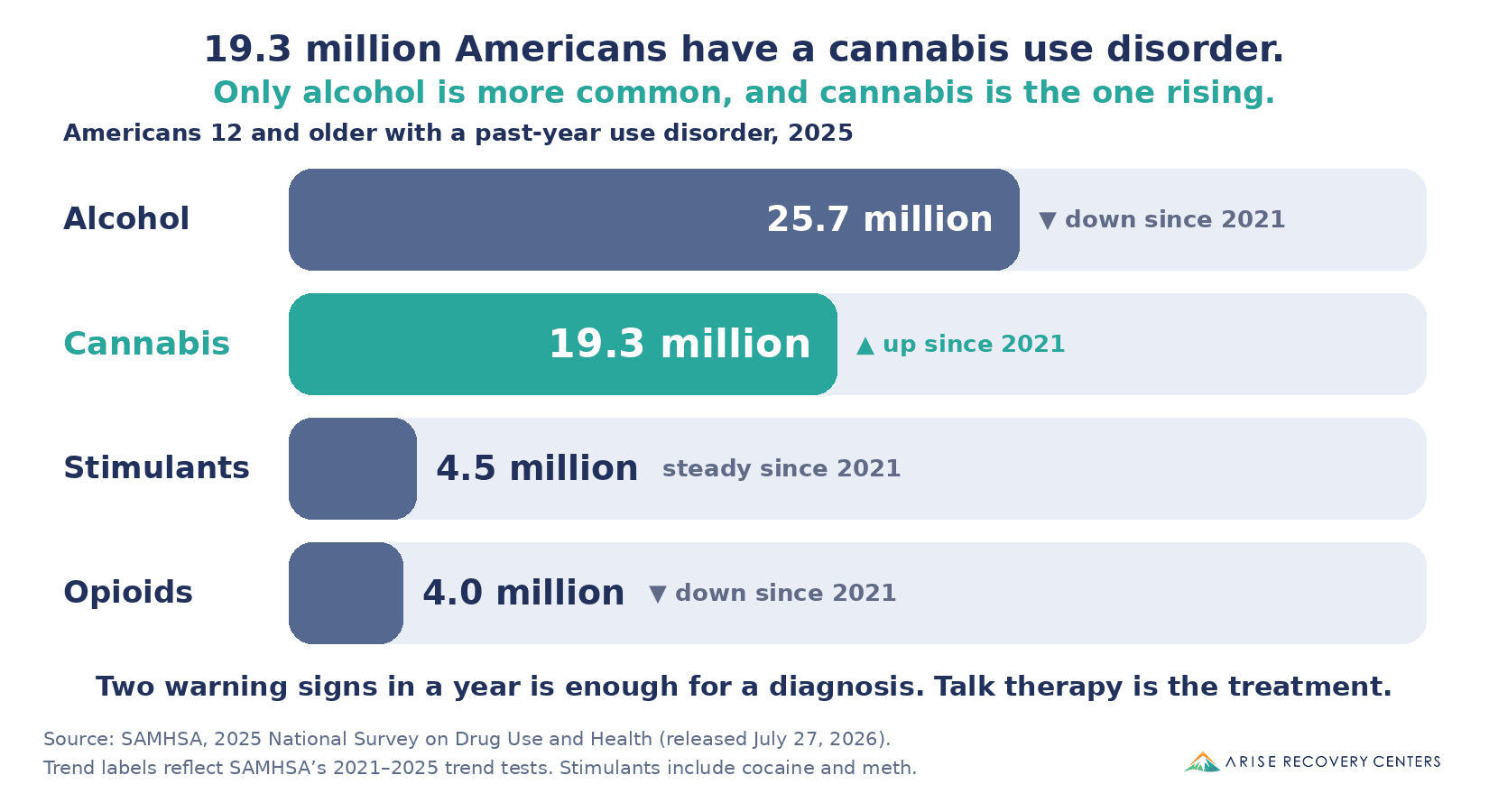
Most people who use cannabis never develop a problem. But plenty do. About 61.6 million Americans used marijuana in the past year, so 19.3 million is roughly 3 in 10. The National Institute on Drug Abuse (NIDA) puts it at 22% to 30%.
The strongest predictor is how often someone uses. Strength matters too. NIDA reports the THC in seized cannabis quadrupled between 1995 and 2022, from about 4% to about 16%. Some dispensary products top 40%.
From the inside: the front door is moving
For decades, a court date was one of the most common ways people got to cannabis treatment. In federal treatment data from 2002, 58% of marijuana admissions came through the justice system. It was the single biggest source of referrals.
That door has been closing for years. A 2023 Temple University study in the Journal of Addiction Medicine looked at young adults. Court referrals to cannabis treatment fell faster after legalization, most likely because arrests fell. The authors called the drop in treatment, during a time of rising risk, “a key health concern.” They pointed to screening in doctors’ offices as a better way in.
Whatever you think about arrests, the practical point is simple. If police are stepping back, the early warning has to come from somewhere else. A spouse. A parent. A doctor. Or you.
You do not need a court order to get help.
Most people who got treatment for a substance use disorder in 2025 got it as outpatients. You keep your job, your home and your schedule.
The warning signs, in plain English
Doctors diagnose cannabis use disorder when someone has at least 2 of 11 signs in a year. Two or three is mild, the earliest stage. These are the ones families usually notice first:
- Using more, or longer, than planned. “Just one” turns into the whole night.
- Trying to cut back and not being able to.
- The day arranging itself around it. Getting it, using it, recovering from it.
- Cravings. A strong urge that is hard to ignore.
- Needing more for the same effect.
- Feeling rough when you stop. Irritable, anxious, can’t sleep, no appetite.
- Giving things up. Skipping work, family or hobbies to use.
- Using anyway. Even when it is causing problems at home, at work or with your mood.
The quickest self-check is a count. Ask “how many days a week?” instead of “do I use?” Near-daily use is the line worth a closer look. If you are worried about someone else, our guide to helping without enabling is a good place to start.
Overrated vs. underrated
Overrated
- “It’s basically legal now.” Not in Texas. And legal was never a health test. Alcohol is legal, and it is still the most common use disorder.
- “You can’t get addicted to weed.” 19.3 million Americans have the disorder.
- Switching to delta-8 or a THC drink. Same THC, same brain. Texas banned delta-8, and a federal ban on THC drinks hits December 11.
Underrated
- Counting days. How often is the strongest predictor of a problem.
- Planning for two rough weeks. Withdrawal is real, and it is temporary.
- Telling your doctor. Researchers point to the doctor’s office as a better way in.
What treatment actually looks like
There is no FDA-approved medicine for cannabis use disorder. The treatment is talk therapy, and it works. NIDA points to three approaches: cognitive behavioral therapy, motivational enhancement therapy and contingency management, which rewards progress.
Withdrawal is the part people dread. Expect irritability, anxiety, poor sleep, low appetite and strange dreams. It usually peaks in the first week and fades within two to three weeks. Uncomfortable, then it passes.
That is what outpatient care is built for. You get therapy a few hours a week, or more if you need it, while your brain resets. You go home at night. Here is what the warning signs look like in older adults, if you are worried about a parent.
Where outpatient care fits in
Arise Recovery Centers provides outpatient drug and alcohol treatment at 12 locations in DFW, Houston and Austin. In the Houston area, that means North Houston, West Houston, Sugar Land and The Woodlands. We offer a day program, intensive outpatient and supportive outpatient. If an assessment points to a higher level of care, we say so and help you find it.
This guide to levels of care explains the options, and here is more on outpatient rehab in Houston. You can schedule a free consultation or verify your insurance online in about two minutes. Both are confidential and do not commit you to anything.
Safety note: If you also drink heavily every day or take sedatives like Xanax, do not stop everything at once on your own. Alcohol and sedative withdrawal can be dangerous. Talk to a doctor first, or read whether you need detox before rehab.
Frequently asked questions
Does Houston Prop A legalize marijuana?
No. Prop A makes Class A and Class B misdemeanor marijuana possession the Houston Police Department’s lowest enforcement priority. Possession is still illegal under Texas law, officers can still enforce it, and the measure applies only to Houston police.
Is marijuana legal in Texas?
Recreational marijuana is not legal in Texas. Misdemeanor possession can still bring jail time and fines under state law. Texas does run a limited medical program for certain conditions.
How many people have cannabis use disorder?
In 2025, 19.3 million Americans age 12 and older had a marijuana use disorder, according to SAMHSA’s National Survey on Drug Use and Health. It is the most common drug use disorder in the country, behind only alcohol. That works out to about 3 in 10 people who used marijuana in the past year.
What are the signs of cannabis use disorder?
Doctors look for 11 signs, and 2 or more in a year is enough for a diagnosis. Common ones are using more than planned, failing to cut back, cravings, needing more for the same effect, withdrawal when you stop, and giving up activities to use.
How long does weed withdrawal last?
Symptoms usually start within a day or two of stopping, peak in the first week and fade within two to three weeks. The most common are irritability, anxiety, trouble sleeping, low appetite and vivid dreams.
Is there medication for cannabis use disorder?
There is no FDA-approved medication for cannabis use disorder. NIDA says cognitive behavioral therapy, motivational enhancement therapy and contingency management can all be effective.
Can I get treatment for marijuana without leaving work?
Yes. Supportive and intensive outpatient programs meet for set hours each week, so most people keep their jobs. A day program takes more time and is used when someone needs more support.
Where can I get outpatient treatment for marijuana in Houston?
Arise Recovery Centers offers a day program, intensive outpatient and supportive outpatient at four Houston-area locations: North Houston, West Houston, Sugar Land and The Woodlands. A free consultation is confidential and does not commit you to anything.
This article is education, not medical advice.
Sources: KPRC Click2Houston, “Houston voters approve Proposition A, changing marijuana enforcement and no-knock warrant policies,” November 4, 2026 (unofficial returns). Houston Public Media, “Houston pass Prop A, deprioritizing marijuana enforcement, banning no-knock warrants,” November 4, 2026. NBC Boston, “Here’s what Mass. voters decided on the 9 statewide ballot questions,” November 4, 2026 (AP results). Substance Abuse and Mental Health Services Administration, “Release of the 2025 National Survey on Drug Use and Health,” July 27, 2026. National Institute on Drug Abuse, “Cannabis (Marijuana).” SAMHSA, DASIS Report: Differences in Marijuana Admissions Based on Source of Referral: 2002, June 2005. Mennis J, Stahler GJ, McKeon TP, “Criminal Justice Referrals to Cannabis Use Disorder Treatment among Adolescents and Young Adults following Recreational Cannabis Legalization in the United States,” Journal of Addiction Medicine, 2023;17(6):725–728. Bonnet U, Preuss UW, “The cannabis withdrawal syndrome: current insights,” Substance Abuse and Rehabilitation, 2017;8:9–37.