

Medically reviewed by Nicholas Overbeck, LPC-S, LCDC, Arise Recovery Centers · Updated June 2026
When people compare outpatient programs, they weigh what’s easy to see — the therapy approach, the staff, the philosophy, the building. Those matter. But the single most underrated factor in choosing care is outpatient rehab location — plainly, how close it is. In Atomic Habits, James Clear’s third rule is almost insultingly simple: make it easy. We don’t repeat the behaviors that take the most willpower — we repeat the ones that take the least friction. The closer and easier something is, the more we actually do it; the farther and harder, the faster we quit.
You see it everywhere people have to show up on a schedule. Gym-goers who live closer work out far more often; students with long commutes miss more classes and post lower grades. The pattern is consistent: every extra chunk of travel time quietly shaves attendance, and the drop-off accelerates once a one-way trip pushes past about 30 minutes.
Outpatient rehab runs on the exact same wiring — except the stakes aren’t a wasted gym fee, they’re your recovery. Closer is simply better: the shorter the trip, the more likely you are to keep making it. But there are only so many licensed programs in any given area, so a center five minutes from your door usually isn’t an option — and most sessions meet on weekday schedules that put you on the road during peak traffic. The realistic goal isn’t the closest possible option — it’s staying within about 30 minutes, a sweet spot you can actually sustain for dozens of trips.
This article is general education, not medical advice. A licensed clinician can help you choose the level of care and format that fit your situation.
In this article
Outpatient isn’t one appointment — it’s dozens
This is the part people underestimate. A single therapy visit is easy to get to. A full course of outpatient care is a different animal: the higher levels meet several days a week for weeks at a time. Here’s what each phase typically looks like on its own.
| Phase | Days per week | Typical length | Approx. visits |
|---|---|---|---|
| PHP (partial hospitalization) | ~5 days | ~3–4 weeks | ~20 |
| IOP (intensive outpatient) | ~4 days | ~8–12 weeks | ~32 |
| SOP (supportive outpatient) | ~2 days | ~8 weeks | ~16 |
SOP (supportive outpatient) is a lighter step-down that usually follows an intensive phase — a normal add-on to the regimen, not a course on its own.
A typical course is one intensive phase plus a supportive step-down, which lands most people around 40–50 trips. Moving through all three phases consecutively isn’t the norm — but when it happens, the total can climb to as many as 70 sessions:
| Common pathway | Round trips | How common |
|---|---|---|
| PHP, then SOP step-down | ~40 trips | Common |
| IOP, then SOP step-down | ~50 trips | Most common |
| Full step-down (PHP → IOP → SOP) | ~70 trips | Less common |
Either way, you’re committing to dozens of repeat trips to the same building over several months. So ask the Atomic Habits question: which version are you more likely to actually finish — the one about 20 minutes from home, or the one nearly an hour away in rush-hour traffic?
Why outpatient rehab location predicts who finishes
This isn’t just a gym analogy — it’s one of the better-documented patterns in addiction care. Federal reviews of treatment engagement find that transportation and distance are among the most common barriers to care, linked directly to late and missed appointments and premature dropout. The effect is measurable: in one study of more than 1,700 outpatient clients, those who traveled less than a mile to treatment were about 50% more likely to complete it than those who traveled farther. Put that against 40-plus visits and the gym math repeats itself: the close-enough program isn’t just more convenient — it’s the one you keep showing up for when motivation dips and life gets loud.
The same “distance decay” shows up across the recurring commitments people are actually able to keep:
| Weekly commitment | Sweet spot (one-way) | Drop-off point | What the distance does |
|---|---|---|---|
| Gym / fitness | ~10–15 min | ~20 min | Visit frequency can fall by roughly half once the trip gets long |
| In-person classes | ~20–30 min | ~45 min | Long commutes eat study time and energy; attendance and grades slip |
| Outpatient rehab (IOP/PHP) | ~30 min | ~45+ min | Distance is a top barrier to care — more missed sessions, higher dropout |
Thresholds are general patterns from habit and access research, not hard rules — your real schedule matters more than any single number.
What the drive actually costs you: time and money
Distance has a price beyond willpower — gas, miles on your car, and hours you don’t get back. With the national gas average around $4.05 a gallon (mid-2026) and the IRS valuing the all-in cost of driving — fuel, maintenance, tires, and depreciation — at 72.5 cents per mile in 2026, a typical ~50-trip course adds up:
| Round trip to facility | ~50 trips (miles) | Gas only (~$0.16/mi) | True vehicle cost (IRS 72.5¢/mi) | Hours behind the wheel |
|---|---|---|---|---|
| 10 miles (close) | ~500 | ~$80 | ~$365 | ~22 hrs |
| 30 miles | ~1,500 | ~$245 | ~$1,090 | ~50 hrs |
| 50 miles (far) | ~2,500 | ~$405 | ~$1,815 | ~75 hrs |
Gas-only assumes ~25 mpg; “true vehicle cost” uses the 2026 IRS rate, which folds in maintenance and wear. Hours assume typical rush-hour round trips.
Even on the conservative gas-only line, the far program costs hundreds more. Count what it actually costs to run a car and the gap between a 10-mile and a 50-mile round trip is roughly $1,400 over a single course. And the hours are the bigger number: 50 miles round trip in rush hour is around 75 hours behind the wheel — nearly two work-weeks. Valued modestly at $20–30 an hour, that’s another $1,500–$2,250 of time better spent at work, with family, or in a support meeting.
Make it easy: anchor treatment to your real life
The fix is the same one Clear prescribes for any habit: reduce the friction in advance. Don’t pick the program that’s most impressive on paper and hope you’ll power through the drive. Pick the one your future, tired self can still get to on a Tuesday.
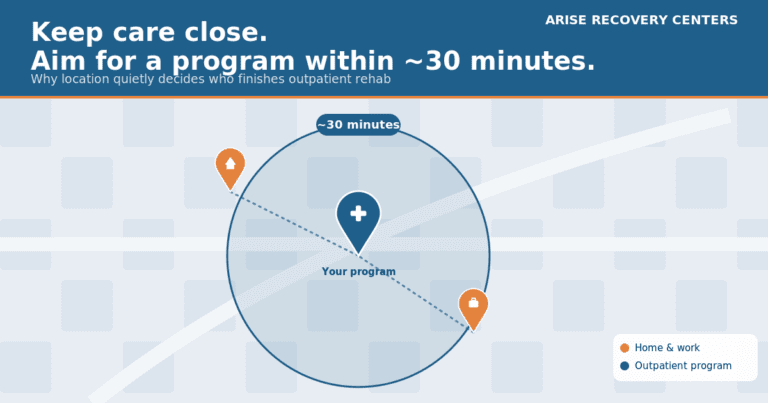
Rule of thumb: the 30-minute test. Aim for a program within about a 30-minute drive of home or work, and ideally on a route you already travel. Once the rush-hour trip pushes past ~45 minutes, treat it as a yellow flag — look at another location or an evening schedule before you commit, not after you’ve missed your third session.
This is habit-stacking applied to recovery. A center that sits between your home and your job turns treatment into part of a trip you’re already making, instead of a separate errand your brain can talk you out of. When the path of least resistance leads to the door, you walk through it.
Where telehealth fits
None of this means you must white-knuckle a long drive — telehealth is a real tool when it’s used in the right place.
For individual and make-up sessions, telehealth shines. In substance use care, virtual treatment generally delivers retention and outcomes comparable to in-person, and for opioid use disorder it has kept rural patients in care at rates on par with in-person treatment. A focused one-on-one hour translates to a screen with little lost.
For the group component of PHP and IOP, in-person is worth the drive whenever it’s reasonably within reach. Group works through connection and accountability — exactly what degrades on video. In head-to-head comparisons, people in online groups felt less connected to the other members than those in the room. It’s the same gap seen in education: community-college students in online courses persist less and earn lower grades than their in-person peers — roughly a 7-point drop in course completion and a third of a grade point.
The exception is access: if you’re rural or genuinely commute-challenged, a virtual group you’ll actually attend beats an in-person one you won’t. For most people, the sweet spot is hybrid — in-person for group, telehealth for the flexible pieces.
Frequently asked questions
How often will I have to go to outpatient rehab?
It depends on the level of care. Partial hospitalization (PHP) usually meets about five days a week, intensive outpatient (IOP) about four, and supportive outpatient (SOP) about two. A typical course — one intensive phase plus a supportive step-down — comes to roughly 40–50 visits over a few months.
Does location really affect whether outpatient rehab works?
Yes. Distance and transportation are repeatedly identified as among the most common barriers to addiction treatment, and they’re tied to missed appointments and dropout. In one study of more than 1,700 clients, those living within a mile of care were about 50% more likely to complete treatment than those farther away.
How far is too far for outpatient rehab?
There’s no hard cutoff, but a useful rule of thumb is to stay within about a 30-minute drive of home or work. Once a rush-hour trip stretches past ~45 minutes — several times a week, for months — missed sessions and dropout become much more likely. If that’s your only option, an evening schedule or telehealth for some sessions can help.
Can I just do outpatient rehab online instead?
Telehealth works well for individual and make-up sessions and can be the right call when distance would otherwise be a dealbreaker. For the group component of PHP and IOP, in-person tends to offer more accountability and connection. Many people do best with a hybrid: in-person for groups, virtual for the flexible pieces.
The takeaway
When you compare outpatient programs, give location the weight it deserves. How far is it from home or work? What’s the commute like at the hour your sessions actually meet? Is there an evening option? The best program on paper isn’t the best program for you if you can’t realistically get there a few dozen times.
Arise Recovery Centers runs 12 outpatient locations across Dallas–Fort Worth, Austin, and Houston — on purpose, so care stays close to where people live and work. Find the location nearest you, or verify your insurance in a couple of minutes at ariserecoverycenters.com, or call 1-888-734-2289 (1-888-REHAB-TX).
You can also call SAMHSA’s free, confidential National Helpline at 1-800-662-HELP (4357), 24/7 in English and Spanish.
This article is educational and isn’t a substitute for professional medical advice. Program lengths are typical ranges, not guarantees. If you’re in immediate danger, call or text 988 or call 911.