

By Danny Andino, CEO, Arise Recovery Centers · Clinically reviewed by Nicholas Overbeck, LPC-S, LCDC · Updated September 2026
Most people assume addiction treatment is its own separate bill. Its own coverage. Its own deductible. Its own pile of money you have to find somewhere.
That is not how it works — and the truth is a lot better news than most people expect.
The short version
- Your health plan is not allowed to keep a separate deductible for addiction treatment. Federal law requires it be combined with your medical deductible.
- That means every dollar you have already spent this year on any medical care has already been applied to what you would owe for treatment.
- After the deductible you pay a share — averaging about 20% — and once you hit your out-of-pocket maximum you owe nothing more.
- Two phone calls tell you your real number. Most people never make them.
The rule almost nobody knows
There is a federal law that settles this. It is called the Mental Health Parity and Addiction Equity Act, and on the money question it is simple: your plan has to treat addiction care the same way it treats any other medical care.
That means one deductible and one out-of-pocket maximum, shared across everything. Your plan is not allowed to make you start over just because the care is for drinking or drugs.
What that actually means for you
The knee surgery in March. The emergency room visit in June. The MRI, the physical therapy, the delivery, the specialist copays. Every one of those already counted toward what you would pay for outpatient treatment today.
People who have had an expensive medical year often assume that makes treatment less affordable. It is usually the opposite.
The two numbers that decide what you pay
Your deductible is what you pay before your plan starts splitting the bill with you. Your out-of-pocket maximum is the hard ceiling — hit it and your plan pays 100% of covered in-network care for the rest of the plan year. You cannot be charged more than that number, no matter what treatment costs.
Most people’s ceiling sits nowhere near the legal maximum. Among workers with employer coverage, about half land somewhere between $3,000 and $6,000 for single coverage. Federal rules do set a hard cap — $10,600 for an individual and $21,200 for a family in 2026 — but only about 1% of covered workers have a limit anywhere close to it.
Every dollar you have already spent on medical care this year has already been applied to treatment.
Same deductible, same ceiling, one running total. The surgery, the ER visit, the specialist copays — all of it counts, and none of it has to be paid twice.
Both numbers do reset at the start of your plan year — January 1 for most people — which is worth knowing when you are deciding when to begin.
What a deductible actually costs the average person
“Deductible” is abstract until you put a number on it. KFF’s 2025 Employer Health Benefits Survey is the annual benchmark for what American workplace coverage actually looks like. It puts the average deductible for single coverage at $1,886, and shows where everyone else falls around it.
Deductible — where workers actually land
12%
54%
34%
Two-thirds of workers — 66% — have either no deductible or one under $2,000.
Single coverage. Source: KFF, 2025 Employer Health Benefits Survey. The $1,886 average is among workers who have a deductible.
So for most people the working number is somewhere under $2,000. Real money — but nothing like the figure people picture when they imagine what treatment costs.
If you buy your own coverage through the Marketplace, the numbers run higher. KFF puts the average 2026 Marketplace deductible at $3,786, up from $2,759 the year before. A standard silver plan averages $5,304.
But there is a big exception worth knowing about. If your income is at or under 150% of the federal poverty level, you likely qualify for cost-sharing reductions — and the average silver deductible for that group is $80. Not a typo. If money is the thing stopping you, this is the first question to ask.
The second number: your out-of-pocket maximum
The deductible is the first gate. The out-of-pocket maximum is the ceiling — the most you can be made to pay for covered in-network care in a plan year. Hit it, and your plan covers 100% of the rest.
Almost everyone with workplace coverage has one, and most land lower than people expect. Half of workers sit between $3,000 and $6,000, which works out to a typical ceiling of roughly $4,400.
Out-of-pocket maximum — where workers actually land
28%
51%
21%
Nearly 8 in 10 workers — 79% — have a ceiling under $6,000.
Single coverage. Shares from KFF, 2025 Employer Health Benefits Survey. The ~$4,400 typical figure is our estimate, weighted from those published bands — KFF does not publish an average. Federal rules cap it at $10,600 for 2026, but only about 1% of workers are anywhere near that.
Two people with the same insurance and the same treatment plan can owe very different amounts. Neither one knows which they are until somebody asks.
That is the whole argument for making the call. Not optimism, not pessimism — just finding out which number you actually have, and how much of it is already spent.
Once you reach your out-of-pocket maximum, treatment costs you nothing more.
Not a smaller bill — no bill. Your plan covers 100% of covered in-network care for the rest of your plan year, however long treatment runs.
It is also worth knowing that a deductible resets rather than rolls over, so what you have already put toward this year’s counts only against this year’s care.
How the money actually works
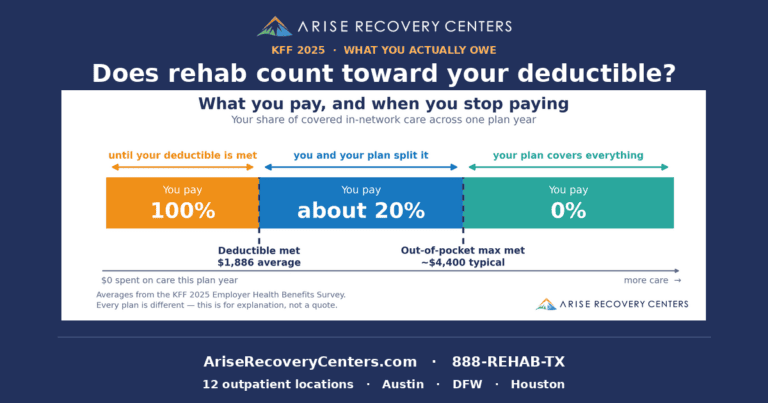
Insurance is not all-or-nothing. It moves through three stages, and you only carry the full weight in the first one.
Stage 1
You pay, up to your deductible
This is the part people picture when they think about cost. Average: $1,886. Then it ends.
Stage 2
You and your plan split it
You pay a share — averaging about 20%. Your plan pays the other 80%.
Who pays what
Stage 3
Your plan pays everything
Once your out-of-pocket maximum is met, covered in-network care costs you nothing more for the rest of the plan year.
That third stage is the one almost nobody knows about. There is a hard ceiling on what you can be asked to pay, and once you reach it your plan covers 100% of covered in-network care until your plan year resets.
A worked example, using the averages
Say a course of outpatient treatment is billed at $18,000.
You pay
$4,400
Your plan pays
$13,600
Illustration using the average deductible ($1,886), the average coinsurance rate (20%), and a typical out-of-pocket maximum (~$4,400). Your own three numbers are the ones that decide it.
Your plan carries roughly three dollars for every one you do. And whatever you have already spent this year on any other medical care comes off that $4,400 before treatment starts.
Overrated vs. underrated
Overrated
- The program’s sticker price. It is rarely what you actually pay.
- Waiting for January to “start fresh.” Fresh means your deductible is full again.
- Shopping for the cheapest program. Out-of-network cheap can cost more than in-network expensive.
Underrated
- How much of your deductible is already gone. One phone call.
- Your out-of-pocket maximum. If you have hit it, covered in-network care is paid at 100%.
- Confirming in-network status first. Out-of-network dollars usually count toward neither number.
What to actually do — one afternoon
Call the number on the back of your insurance card and ask three things
- “How much of my deductible and my out-of-pocket maximum have I met this year?” Write both numbers down.
- “When does my plan year reset?” Most reset January 1, but plenty of employers run a July or October plan year. Do not assume.
- “Is this provider in-network for outpatient substance use treatment?” Ask about the specific level of care.
Rule of thumb: already hit your out-of-pocket maximum? Covered in-network treatment costs you nothing more this plan year. Met your deductible but not your max? You are paying about 20 cents on the dollar while your plan pays the other 80.
Three things that trip people up
Your premiums do not count. Only what you pay for actual care counts toward the deductible and the out-of-pocket max.
Out-of-network usually does not count either. Ask whether a program is in-network before you start, not after.
Your plan year may not start in January. Plenty of employers run a July or October year. One question answers it.
And if you have not touched your deductible at all — start anyway. Outpatient care is billed session by session, not as one lump sum at the door. Nobody is going to ask you for the whole number up front. The people who do well in treatment are rarely the ones who found the perfect month to begin; they are the ones who began.
The part that matters more than the money
We are not going to pretend cost is the only thing standing between someone and treatment. It usually is not. But it is the reason people say out loud, because it sounds more reasonable than the real ones.
So take that one off the table. Make the call, get your two numbers, and decide with real information instead of a guess. If you have had a heavy medical year, there is a good chance the thing you have been putting off is already most of the way paid for.
Arise Recovery Centers provides outpatient addiction treatment across Texas. You can verify your insurance online in about two minutes, confidentially, and it does not commit you to anything.
Not sure what level of care you would even need? Our guide to choosing between PHP, IOP, and outpatient walks through it. And why the price of rehab matters less than you think covers the rest of the cost picture. If you have questions about addiction treatment costs, reach out to us or our mental health partner, Saltwood Mental Health, today.
Frequently asked questions
Does addiction treatment count toward my regular deductible?
Yes. Federal law requires your plan to use the same deductible and the same out-of-pocket maximum for addiction treatment as it uses for any other medical care. It cannot run a separate one.
What is the average deductible people are working against?
KFF’s 2025 Employer Health Benefits Survey puts the average at $1,886 for single coverage. About 12% of workers have no deductible at all, 54% have one under $2,000, and 34% have $2,000 or more.
What is the most I could pay out of pocket in 2026?
For plan years beginning in 2026, federal rules cap in-network out-of-pocket maximums at $10,600 for self-only coverage and $21,200 for family coverage. Most plans land well below that.
After I meet my deductible, how much do I pay?
A share, not all of it. The average coinsurance rate is about 20%, so your plan picks up roughly 80% of what is left. That continues until you reach your out-of-pocket maximum — after which covered in-network care costs you nothing more for the rest of the plan year.
What is a typical out-of-pocket maximum?
About $4,400 for a typical worker with single coverage. Half sit between $3,000 and $6,000, and nearly 8 in 10 are under $6,000, based on KFF’s 2025 survey bands. Federal rules cap it at $10,600 for 2026, though only about 1% of plans come close. One call to member services gives you your own figure.
My deductible resets January 1. Should I wait until then to start?
No. Starting sooner is almost always better clinically, and if you have already spent against this year’s deductible, waiting means paying that money over again. Timing is a reason to move now, not a reason to delay.
I have not met my deductible at all. Is treatment still affordable?
Often, yes. Outpatient care is billed per session rather than as one lump sum, many plans apply copays rather than full cost, and most programs will discuss payment arrangements. Ask before assuming.
Does my plan year always start on January 1?
No. Individual marketplace plans generally follow the calendar year, but employer plans frequently start in July, October, or another month entirely. Confirm your reset date rather than assuming.
Does what I pay for out-of-network treatment count?
Usually not. Out-of-network spending typically does not apply to your in-network deductible or out-of-pocket maximum. Confirm network status before you start.
Coverage varies by plan, so your own numbers are the ones that count. If you drink heavily every day, talk to a medical professional before stopping on your own — alcohol withdrawal can be dangerous.
Related reading: alcohol deaths among young women are up 255%, and why the same drinking carries more risk for women.