
By Danny Andino, CEO, Arise Recovery Centers · Clinically reviewed by Nicholas Overbeck, LPC-S, LCDC · September 2026 · In the News
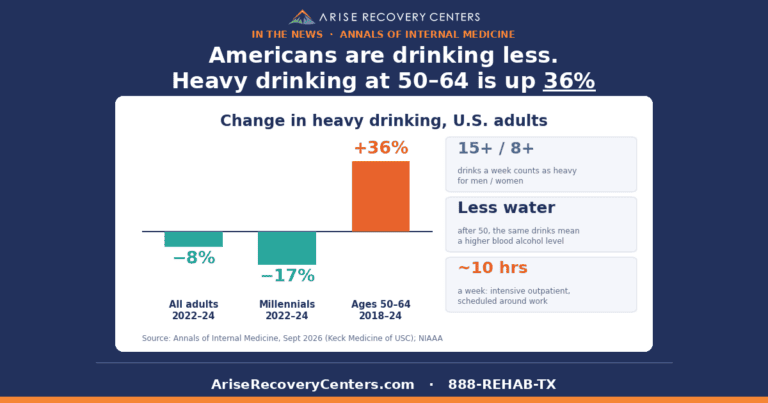
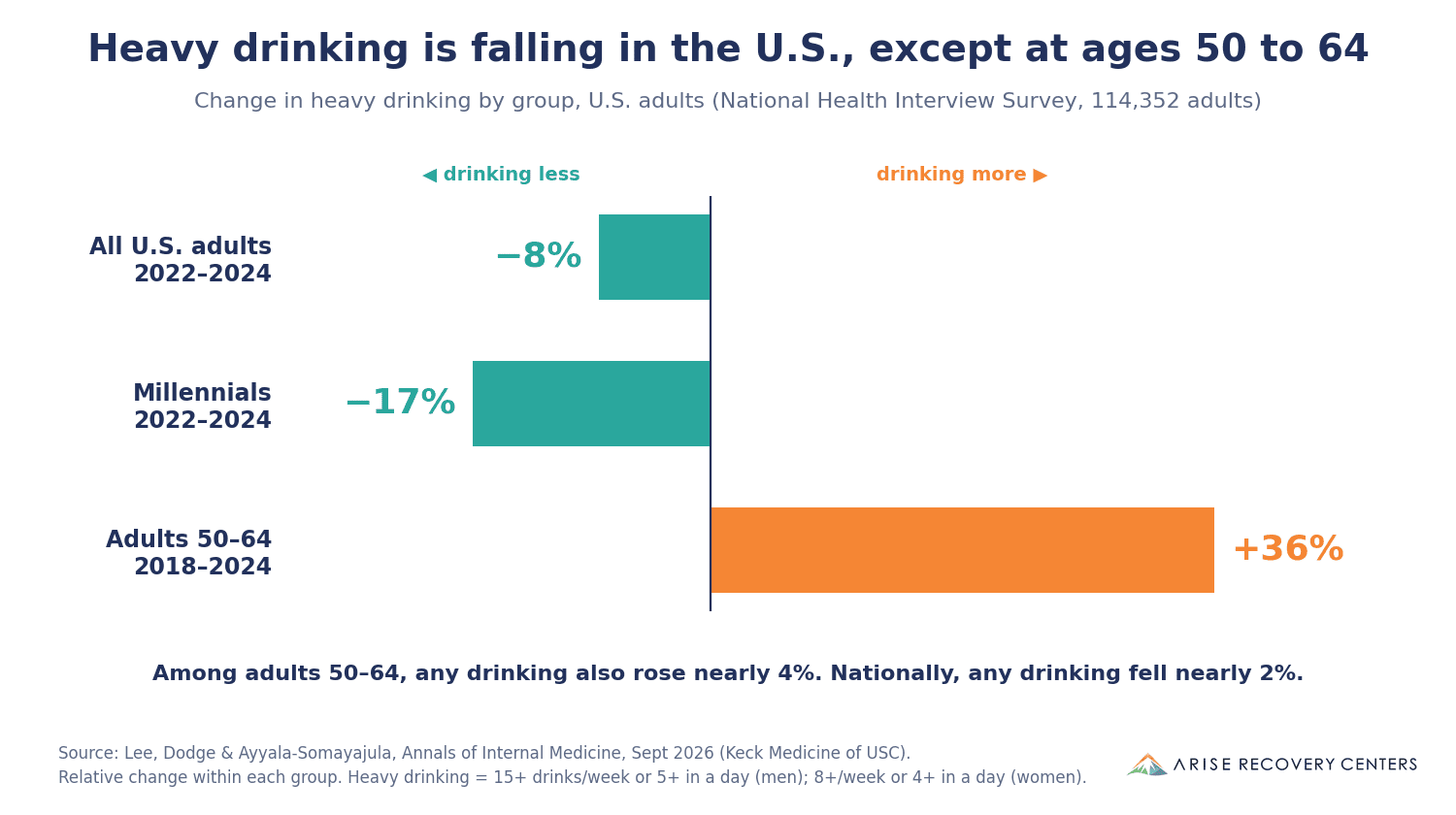
For the first time since the pandemic started, Americans are drinking less. Heavy drinking fell more than 8% between 2022 and 2024, and younger adults led the way.
One group went the other way. Among adults 50 to 64, heavy drinking rose more than 36% between 2018 and 2024.
The short version
- A Keck Medicine of USC study of 114,352 adults, published in Annals of Internal Medicine in September 2026, found U.S. drinking is finally falling. It is still above pre-pandemic levels.
- Adults 50 to 64 are the exception. Any drinking rose nearly 4% and heavy drinking rose more than 36% from 2018 to 2024.
- “Heavy” in this study means 15 or more drinks a week for men, or 8 or more for women. Five or more drinks in a day for men, or four for women, also counts.
- The same amount of alcohol hits harder at 55 than at 25. It mixes with more medications, too.
- Drinking habits can change at any age. Outpatient treatment is built to fit around a job.
What the study found
Researchers led by hepatologist Dr. Brian P. Lee used the CDC’s National Health Interview Survey. They tracked drinking from 2018 through 2024.
| Group | What changed | Years |
|---|---|---|
| All U.S. adults | Down Any drinking down nearly 2%. Heavy drinking down more than 8%. | 2022–2024 |
| Gen Z | Down Any drinking down more than 5%, the biggest drop of any generation. | 2022–2024 |
| Millennials | Down Heavy drinking down 17%, the biggest drop of any generation. | 2022–2024 |
| Adults 50–64 | Up Any drinking up nearly 4%. Heavy drinking up more than 36%. | 2018–2024 |
Source: Lee, Dodge and Ayyala-Somayajula, Annals of Internal Medicine, September 2026, as reported by Keck Medicine of USC. Percentages are relative changes within each group.
This fits the bigger picture. Gallup’s August 2026 poll found only 54% of U.S. adults drink at all, which ties last year’s record low. The overall trend is good news. It just is not reaching people in their fifties and early sixties.
“The encouraging national decline should not overshadow the fact that some groups continue to be at increased risk,” Dr. Lee said. He pointed to cirrhosis and alcohol-related cancers as the main concern for this age group.
Why the same drinks hit harder at 55
This is not about willpower. The body changes with age. According to the National Institute on Alcohol Abuse and Alcoholism (NIAAA), there are three main reasons.
Body
Less water, higher blood alcohol
With less muscle and less body water, the same two drinks leave a higher blood alcohol level than they did at 30.
Medications
More prescriptions, more risk
Alcohol plus sleep aids or pain medicine “can be deadly,” NIAAA warns. Plus aspirin, it raises the risk of stomach bleeding.
Health
It worsens what you already have
Blood pressure, diabetes, sleep, chronic pain, depression and anxiety all tend to get worse with regular heavy drinking.
Cancer is part of this too. As we covered earlier this month, alcohol-caused cancer deaths have doubled since 1990.
What we hear at intake
The study does not measure why this age group is drinking more. At intake, though, we hear the same stories over and over.
- The pandemic habit that never went away. The 5 p.m. drink turned into three, and nothing ever reset it.
- Peak pressure. Top of your career, aging parents, kids leaving or coming back home.
- Sleep and pain. A nightcap for sleep or a sore back becomes something you do every night.
- Nobody asks. People worry about a 22-year-old’s drinking. A 58-year-old with a nice wine rack rarely gets a second look.
Treatment for drinking usually does not mean a month away. It means about 10 hours a week of outpatient care, scheduled around your job.
That matters, because most people who need help never get it. Only 7.5% of U.S. adults with an alcohol use disorder got any treatment in 2024 (NIAAA, 2024 National Survey on Drug Use and Health). Picturing a month away from work and family is one of the reasons.
Overrated vs. underrated
Overrated
- “I’ve always drunk like this.” The amount may be the same, but your body is not. The same amount carries more risk now.
- “It’s only wine.” A 5-ounce glass is one drink, and a restaurant pour is often closer to two.
- “I never miss work.” Most heavy drinkers in midlife don’t. Holding it together is not the same thing as being fine.
Underrated
- Counting one full week. Most people guess low. Writing it down for seven days settles the question.
- Telling your doctor what you actually drink. It changes which medications are safe for you.
- Outpatient programs. Intensive outpatient is scheduled around a work week, not instead of it.
What to actually do
If this sounds like you, or someone you love
- Count one week honestly. Men at 15 or more drinks a week, or women at 8 or more, are in this study’s heavy-drinking range. So is regularly having 5 or more (men) or 4 or more (women) in one day.
- Look at your medicine cabinet. Sleep aids, pain medicine, anxiety medicine and blood thinners are the ones to ask a pharmacist about.
- Try cutting back for two weeks. If it is easy, great. If it is harder than you expected, that tells you something useful.
- If you drink heavily every day, do not stop cold on your own. Alcohol withdrawal can be medically dangerous. Talk to a doctor first. That is a reason to make a call, not a reason to wait.
- Get an assessment. It tells you whether you need intensive outpatient (about 10 hours a week at Arise), a lighter supportive program, or just a plan.
Arise Recovery Centers provides outpatient alcohol and drug treatment at 12 locations in DFW, Houston and Austin: a day program, intensive outpatient and supportive outpatient. This guide to levels of care explains the options. You can verify your insurance online in about two minutes. It is confidential and does not commit you to anything.
Frequently asked questions
Is drinking going down in the U.S.?
Yes, for the first time since the pandemic. A Keck Medicine of USC study in Annals of Internal Medicine (September 2026) found any alcohol use fell nearly 2% and heavy drinking fell more than 8% from 2022 to 2024. Drinking is still above pre-pandemic levels. Gallup’s August 2026 poll found 54% of adults drink, tying a record low.
Which age group is drinking more?
Adults aged 50 to 64. In the same study, any alcohol use in this group rose nearly 4% and heavy drinking rose more than 36% between 2018 and 2024. Younger adults went the other way. Gen Z drinking fell more than 5%, and millennial heavy drinking fell 17%.
How much drinking counts as heavy drinking?
The study defined heavy drinking as 15 or more drinks a week or 5 or more in a day for men, and 8 or more a week or 4 or more in a day for women. This matches the CDC’s weekly thresholds. One drink is 12 ounces of beer, 5 ounces of wine or 1.5 ounces of liquor.
Why does alcohol affect you more as you get older?
According to NIAAA, older adults have less muscle and less body water. The same number of drinks produces a higher blood alcohol level. Older adults are also more sensitive to alcohol’s effects on balance and coordination, more likely to take medications that interact with it, and more likely to have conditions that alcohol makes worse.
What medications should not be mixed with alcohol?
NIAAA warns that alcohol combined with sedating drugs like sleep aids or pain medications can be deadly. Combined with aspirin, it raises the risk of stomach or intestinal bleeding. Anxiety medications, blood thinners and many others also interact. Ask your pharmacist about everything you take.
Is it too late to change my drinking in my 50s or 60s?
No. Drinking patterns can change at any age, and cutting back lowers risk. Many people start by counting a week and trying two weeks of cutting back. If that is harder than expected, an assessment with an outpatient program is a practical next step.
Is it dangerous to stop drinking suddenly?
It can be, if you drink heavily every day. Alcohol withdrawal can cause seizures and other medical emergencies. If you drink daily, talk to a medical professional before stopping so it can be done safely.
Can I get treatment for drinking without leaving my job?
Yes. Outpatient treatment is scheduled around work and family. At Arise Recovery Centers, intensive outpatient is about 10 hours a week and supportive outpatient is about 4, at 12 locations in DFW, Houston and Austin. Verifying your insurance online takes about two minutes and does not commit you to anything.
This article is for education, not diagnosis, and it does not replace advice from your own doctor or treatment team.
Sources: Lee BP, Dodge J, Ayyala-Somayajula D. Annals of Internal Medicine, September 2026 (DOI 10.7326/ANNALS-26-01824), and Keck Medicine of USC news release, September 21, 2026. Gallup, “Americans’ Drinking Remains at Record Low,” August 20, 2026. NIAAA, “Older Adults” and “Alcohol Treatment in the United States” (2024 NSDUH). CDC, alcohol use definitions.