
By Danny Andino, CEO, Arise Recovery Centers · Clinically reviewed by Nicholas Overbeck, LPC-S, LCDC · September 2026 · National Recovery Month
Most people picture relapse as a single moment. A bad night. A drink in a hand. One decision that undoes everything.
That is not how it works — and knowing how it actually works gives you weeks to do something about it.
The short version
- Relapse is a process, not an event. Clinicians describe three stages: emotional, mental, and physical. The drink or the drug is the last step, not the first.
- The first stage often starts weeks or months before anyone uses. Its signs are ordinary: skipping meals, skipping meetings, going quiet.
- Catch it at stage one or two and the fix is a phone call, not a crisis.
- If you have already used: you are not back at zero. Reaching out inside the first few days is the move that matters most.
The three stages, in plain English
Dr. Steven Melemis laid this out in the Yale Journal of Biology and Medicine in 2015, and it is the framework most treatment teams still use. His line is worth memorizing: “Relapse happens gradually. It begins weeks and sometime months before an individual picks up a drink or drug.”
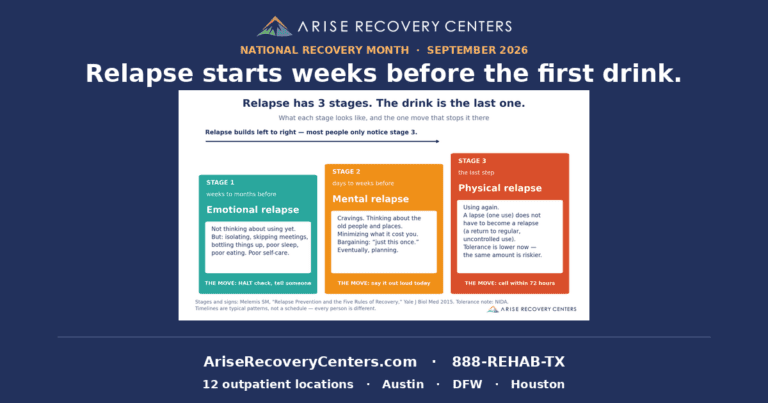
Stage 1 · weeks–months out
Emotional relapse
You are not thinking about using. But you are bottling things up, isolating, skipping meetings, sleeping badly, eating badly. The common thread is poor self-care.
The move: the HALT check — hungry, angry, lonely, tired. Fix the one you can fix today, and tell one person how you are actually doing.
Stage 2 · days–weeks out
Mental relapse
Now there is a tug-of-war. Cravings. Thinking about the old people and places. Minimizing what it cost you. Bargaining — “just on vacation,” “just this once.” Eventually, planning.
The move: say it out loud to your counselor, sponsor, or someone in your program. Today. Secrets are the fuel here.
Stage 3 · the last step
Physical relapse
Using. Melemis separates a lapse (one use) from a relapse (a return to regular, uncontrolled use). One does not have to become the other.
The move: call within 72 hours. Do not wait to “get it together” first. Getting it together is what the call is for.
Stages and signs from Melemis SM, “Relapse Prevention and the Five Rules of Recovery,” Yale J Biol Med, 2015. Timelines are typical patterns, not a schedule — every person is different.
The drink is the last step, not the first. Two earlier stages give you weeks to act — and a phone call at either one is usually enough.
You do not need to be in crisis to call your counselor. “I have been skipping group and not sleeping” is exactly the call they want.
Why stage one is the one that matters
Almost nobody recognizes emotional relapse while it is happening. Nothing feels wrong. You are not craving anything. You are just tired, and busy, and you will get back to group next week.
But this is where the slide starts, and it is also where it is easiest to stop. At stage one you are not fighting a craving. You are fixing lunch, calling a friend, going to bed on time. Boring moves. They work because the problem is still boring.
By stage two you are arguing with yourself, and that argument is exhausting. By stage three the argument is over. The whole point of knowing the stages is to move the fight to where you are strongest.
A rule of thumb families can use
Isolation plus poor self-care is the signal. If someone you love has stopped showing up — to meetings, to dinner, to texts — and looks run-down, that is stage one. You do not need to accuse anyone of anything. “You seem worn out. Want to grab lunch?” is the intervention.
One more reason the call cannot wait: the fentanyl supply has changed. A veterinary sedative called medetomidine is now cut into much of it, so a return to use after time away carries risks that did not exist a year ago.
If it already happened
Here is the part the shame gets wrong. The National Institute on Drug Abuse puts relapse rates for substance use disorders at 40 to 60% — in the same range as high blood pressure and asthma, at 50 to 70%. NIDA’s own words: relapse “serves as a sign for resumed, modified, or new treatment.” Nobody calls a blood pressure flare a moral failure. They adjust the plan.
In outpatient care, adjusting the plan usually means turning up the intensity for a few weeks, not starting over. Someone in a supportive outpatient program can step up to an intensive outpatient program. Someone in IOP can step up to a partial hospitalization day program — then step back down when things settle. Same team, same counselor, more hours. That is what the levels are for.
One real safety point
After a period of not using, tolerance drops. NIDA warns that someone who returns to their old amount “can easily overdose because their bodies are no longer adapted.” This is the reason a lapse deserves a same-week call, not a same-month one. If you or someone you love has overdosed, here is what to do next.
Overrated vs. underrated
Overrated
- The day count as the only scoreboard. It measures stage three. Stages one and two do not show up on it.
- White-knuckling. Fighting a craving alone at stage two is the hardest possible version of this.
- Waiting to “really mean it” before calling. Motivation follows the call more often than it precedes it.
Underrated
- Sleep, food, and one honest conversation. Stage one is fixed with basics, not breakthroughs.
- Telling someone you are bargaining. Said out loud, “just on vacation” sounds like what it is.
- Stepping up a level for a few weeks. It is a dial, not a demotion — and it keeps you with the same team.
What to actually do this week
Three questions, ninety seconds, be honest
- “Have I skipped meetings, meals, or sleep this week?” Yes to two of three is stage one. Fix one today.
- “Have I been thinking about the old crowd, or negotiating with myself?” That is stage two. Say it out loud to one person before tonight.
- “Have I used?” Then the 72-hour rule applies. Call your counselor or program. Not after you feel better — now.
Rule of thumb: HALT plus isolation equals call today. Not a crisis call. A “here is where I am” call. Those are the ones that keep stage one from becoming stage three.
Melemis’s five rules of recovery come down to this: change your routines, be completely honest, ask for help, take care of yourself, and don’t bend the rules. Every one of them is a stage-one tool. That is not a coincidence.
Stage two is where substitution happens, and a forced stop makes it more likely. Texas’s delta-8 ban is a live example; here is what daily users should expect and when to call. Non-alcoholic beer raises a similar question; here is who it helps and who should skip it.
Recovery Month is a good month to say this
September is National Recovery Month. The message that gets lost in the celebration is that recovery includes the people who slipped last week and picked the phone back up. They are not the failures in the story. They are the story.
If you or someone you love is somewhere on this staircase, Arise Recovery Centers provides outpatient addiction treatment across Texas — day programs, intensive outpatient, and supportive outpatient — and we can help you figure out which level fits right now. You can verify your insurance online in about two minutes; it is confidential and does not commit you to anything. And if you want the longer version of the plan, start with building a relapse prevention plan that lasts. If you or someone you love is struggling with relapse issues, reach out to us or our mental health partner, Saltwood Mental Health, today.
Frequently asked questions
What are the three stages of relapse?
Emotional relapse (poor self-care, isolating, skipping meetings — not yet thinking about using), mental relapse (cravings, bargaining, planning), and physical relapse (using again). The framework comes from Dr. Steven Melemis, Yale Journal of Biology and Medicine, 2015.
How long before someone uses does relapse actually begin?
Often weeks, sometimes months. Melemis writes that relapse “begins weeks and sometime months before an individual picks up a drink or drug.” The early signs are ordinary — sleep, food, isolation — which is why they get missed.
What does HALT mean in recovery?
Hungry, angry, lonely, tired. It is a quick self-check for the poor self-care that drives emotional relapse. If two or more apply, fix the one you can fix today and tell someone.
Is one drink or one use a relapse?
Clinicians distinguish a lapse — a single use — from a relapse, a return to regular, uncontrolled use. One does not have to become the other. The most important step after a lapse is contacting your counselor or program within a few days.
Does relapse mean treatment failed?
No. NIDA puts relapse rates for substance use disorders at 40 to 60%, similar to high blood pressure and asthma at 50 to 70%, and says relapse “serves as a sign for resumed, modified, or new treatment.” Usually that means adjusting the plan, not starting over.
Do I have to start treatment over after a relapse?
Usually not. In outpatient care, the common response is to increase intensity for a few weeks — for example moving from a supportive outpatient program to intensive outpatient, or from IOP to a day program — and then step back down. You typically stay with the same team.
Why is a relapse more dangerous than using was before?
Tolerance drops during a period of not using. NIDA warns that returning to a previous amount can lead to overdose because the body is no longer adapted to it. This is especially true for opioids.
How can family spot a relapse before it happens?
Watch for isolation plus poor self-care — someone who has stopped showing up and looks run down. You do not need to confront anyone. Reconnecting (“want to grab lunch?”) is the stage-one intervention.
This article is for education, not diagnosis, and it does not replace advice from your own treatment team. If you drink heavily every day or use benzodiazepines, talk to a medical professional before stopping on your own — withdrawal from either can be dangerous.