
By Danny Andino, CEO, Arise Recovery Centers · Clinically reviewed by Nicholas Overbeck, LPC-S, LCDC · October 2026
Cannabis use is rising faster among people over 65 than in any other age group. Most started for a reason that made sense: sleep, pain, nerves. Some started with a gummy their doctor suggested.
A study published September 28 in the journal Addiction asked how many of them now have a problem with it. The answer is about 1 in 9.
The short version
- Researchers at UC San Diego, Duke, NYU and Rutgers studied 21,189 adults age 65 and older in the federal government’s national drug use survey (2021–2024).
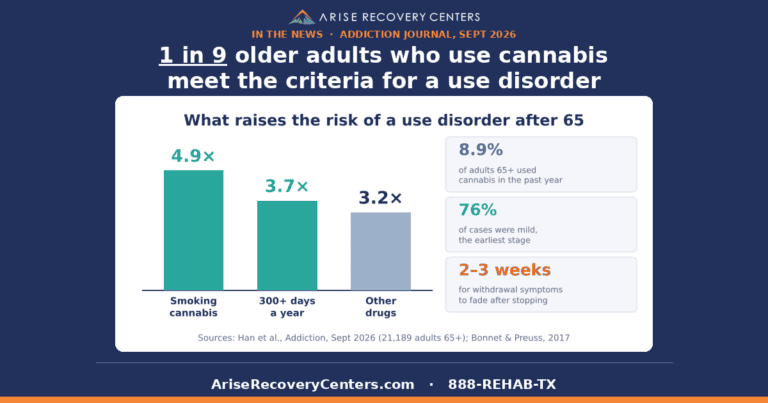
- 8.9% had used cannabis in the past year. Among them, 11.4%, about 1 in 9, met the criteria for cannabis use disorder.
- Most of those cases, 76%, were mild. That is the earliest stage.
- The two biggest tells you can see from the outside: using on 300 or more days a year, and smoking it.
- 1 in 5 older adults who used cannabis had a doctor recommend it. A recommendation does not make near-daily use risk-free.
- Cannabis use disorder is treated with talk therapy, and outpatient care is built for that.
What the study found
The study used the National Survey on Drug Use and Health, the federal government’s main yearly survey of drug use. Lead author Dr. Benjamin Han and colleagues looked only at people 65 and older.
About 9 in 100 had used cannabis in the past year. Of those, 11.4% met the criteria for cannabis use disorder. Doctors diagnose it when someone has at least 2 of 11 warning signs in a year. Two or three signs is mild, four or five is moderate, and six or more is severe.
Here is the part that matters most: 76% of the cases were mild. About 20% were moderate and 4% severe. Most older adults with a problem are at the start of it, not the end.
For context, the National Institute on Drug Abuse (NIDA) estimates that 22% to 30% of all people who use cannabis have the disorder. Older adults run lower. But 1 in 9 is not small, and the authors called for routine screening and treatment to keep mild cases from getting worse.
It is not the cannabis people remember
Many people now in their 70s last used cannabis decades ago. The product has changed. NIDA reports that the THC strength of seized cannabis quadrupled between 1995 and 2022, from about 4% to about 16%. Some dispensary products top 40%.
NIDA also warns that cannabis can interact with medicines common at this age, including the blood thinner warfarin, opioid pain medicines and anti-anxiety drugs called benzodiazepines.
And the signs look different than people expect. In the study, the most common were spending a lot of time getting, using or recovering from cannabis (74%), and craving it (68%). In plain English, the day starts arranging itself around it.
The tells
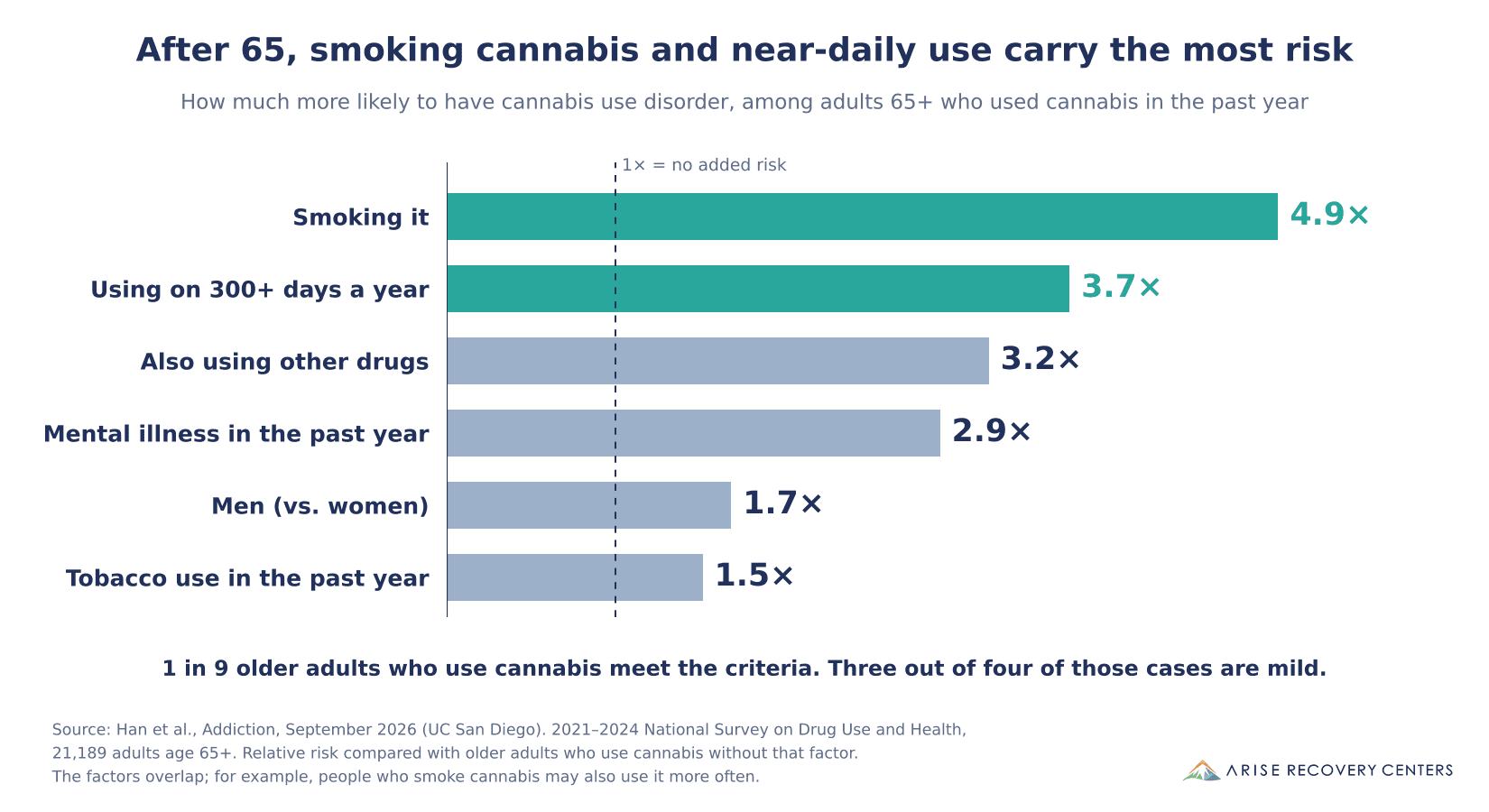
Two of these you can see from across the kitchen table: how often, and how.
Older adults who used cannabis on 300 or more days a year were 3.7 times as likely to have the disorder. That matches NIDA’s finding for people of all ages: how often someone uses is the strongest predictor.
Smoking carried the highest risk in the study, 4.9 times. Using other drugs and having a mental health condition in the past year also stood out.
Near-daily use is the line worth a closer look, at any age.
Most older adults with cannabis use disorder are in the mild stage. The study’s authors say that is the time to act, before it gets worse.
Overrated vs. underrated
Overrated
- “Her doctor recommended it, so it’s fine.” A recommendation covers a reason. It does not cover how often or how much. The FDA has not approved the cannabis plant to treat any condition.
- “You can’t get hooked on weed.” Cannabis use disorder is a recognized substance use disorder. 1 in 9 older adults who use meet the criteria.
- “At his age, why bother?” Most cases are mild. Treatment exists to keep them that way.
Underrated
- Asking how often. “How many days a week?” tells you more than “Do you use it?”
- Putting it on the medication list. Their doctor and pharmacist can only check interactions they know about.
- Knowing the sleep rebound is temporary. Trouble sleeping is a common withdrawal symptom. It usually peaks in the first week and fades within two to three weeks.
If you are worried about a parent
- Ask how often, not whether. Near-daily use is the line where a closer look makes sense.
- Get it on the medication list. Gummies and vapes count. Ask the pharmacist about interactions.
- Watch for the common signs: the day arranged around it, craving, or trying to cut back and not being able to.
- If they cut back, plan for two rough weeks. Irritability, anxiety and poor sleep are typical withdrawal symptoms, and they pass. They are not proof that the cannabis was needed.
- Get a professional assessment. NIDA lists cognitive behavioral therapy, motivational enhancement therapy and contingency management as effective treatments.
If your parent is on Medicare, Medicare Part B covers outpatient substance use disorder treatment. That includes intensive outpatient programs at hospitals, community mental health centers and federally qualified health centers. Their doctor, or FindTreatment.gov, can point you to a program that takes Medicare.
The same tells apply at any age. If you are in your 40s, 50s or 60s and recognize yourself here, help can fit around your job. If you used delta-8 every day before Texas banned it, here is what to expect.
Arise Recovery Centers provides outpatient drug and alcohol treatment at 12 locations in DFW, Houston and Austin: a day program, intensive outpatient and supportive outpatient. This guide to levels of care explains the options. You can schedule a free consultation or verify your insurance online in about two minutes. Both are confidential and do not commit you to anything.
Frequently asked questions
Can older adults get addicted to cannabis?
Yes. A September 2026 study in the journal Addiction looked at adults 65 and older who used cannabis in the past year. Of those, 11.4% met the criteria for cannabis use disorder, about 1 in 9. Most of those cases, 76%, were mild.
What is cannabis use disorder?
It is a pattern of cannabis use that causes real problems or distress. Doctors diagnose it when someone has at least 2 of 11 warning signs in a 12-month period. Examples include craving, using more than intended, and trying to cut back without success. Two or three signs is mild, four or five is moderate, and six or more is severe.
How much cannabis use is too much for a senior?
There is no official safe amount. In the 2026 study, older adults who used cannabis on 300 or more days a year were 3.7 times as likely to have cannabis use disorder. NIDA says how often someone uses is the strongest predictor of the disorder at any age.
Is medical marijuana safe for older adults?
In the study, 1 in 5 older adults who used cannabis had a doctor recommend it. The FDA has not approved the cannabis plant to treat any condition. NIDA warns it can interact with medicines common in older adults, including warfarin, opioids and benzodiazepines. Make sure every doctor and pharmacist knows about it.
What are the symptoms of cannabis withdrawal?
NIDA lists irritability, anxiety, restlessness, trouble sleeping, strange dreams, low appetite and low mood, among others. Symptoms usually peak in the first week after stopping and fade within two to three weeks. They are uncomfortable, but they pass.
How do I talk to my parent about their cannabis use?
Start with how often, not whether. “How many days a week are you using it?” is easier to answer than “Do you have a problem?” Ask them to add it to the medication list their doctor and pharmacist see. If they use almost every day, suggest a professional assessment.
Does Medicare cover treatment for cannabis use disorder?
Medicare Part B covers outpatient substance use disorder treatment. It also covers intensive outpatient programs at hospitals, community mental health centers, federally qualified health centers and rural health clinics. A doctor or FindTreatment.gov can help find a program that takes Medicare.
How is cannabis use disorder treated?
With talk therapy. NIDA lists cognitive behavioral therapy, motivational enhancement therapy and contingency management as effective. There is no FDA-approved medication for it. Outpatient care fits around work and family. At Arise Recovery Centers, intensive outpatient is about 10 hours a week and supportive outpatient is about 4, at 12 locations in DFW, Houston and Austin.
This article is education, not medical advice, and it does not replace advice from your own doctor.
Sources: Han BH, Eschliman EL, Palamar JJ, Triguero Roura M, Mauro PM. “Cannabis use and cannabis use disorder among older adults in the USA.” Addiction, published online September 28, 2026. doi:10.1111/add.70600, and UC San Diego news release, September 2026. National Institute on Drug Abuse, “Cannabis (Marijuana)” research topic page, accessed October 2026. Bonnet U, Preuss UW. “The cannabis withdrawal syndrome: current insights.” Substance Abuse and Rehabilitation, 2017;8:9–37. Medicare.gov, “Mental health & substance use disorders,” accessed October 2026.