
Walk into any family meeting about treatment and you’ll hear the same debate: Which facility has the nicest campus? Does he want it badly enough? Has she hit rock bottom yet?
Those are the wrong questions. Two decades of outcomes research points to a short list of addiction recovery success factors — and almost none of them are the ones families argue about. The real predictors are boring, unglamorous, and largely within your control. The overrated ones are dramatic, emotionally satisfying, and mostly noise.
Here’s the insider’s version: what actually moves the needle, what doesn’t, and how to tell the difference before you spend a dollar.
What’s In This Article
- The Overrated vs. Underrated Matrix
- The 3 Underrated Factors That Actually Predict Success
- The 3 Overrated Factors Everyone Fixates On
- Score Your Own Plan (5-Minute Exercise)
- Frequently Asked Questions
The Overrated vs. Underrated Matrix
Before we get into the “why,” here’s the whole argument on one screen.
| Underrated (do more of this) | Overrated (stop optimizing for this) |
|---|---|
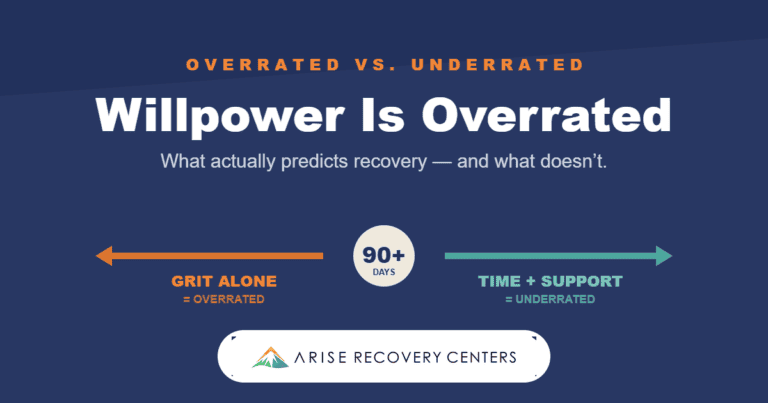
| Time in treatment. Staying engaged past the 90-day mark. | Willpower. Treated as the main engine. It isn’t. |
| Who’s around you. A social network that supports sobriety. | “Rock bottom.” Waiting for it is a strategy with a body count. |
| Treating the mental health half. Depression and anxiety don’t wait. | Amenities and brand. Pools, chefs, and marketing budgets. |
Rule of thumb: if a factor is easy to photograph, it’s probably overrated. If it’s a calendar, a phone list, or a prescription, it’s probably underrated.
The 3 Underrated Addiction Recovery Success Factors
1. Time in treatment — the single most reliable predictor
If you only remember one thing from this article, remember this: how long you stay engaged beats almost everything else.
The National Institute on Drug Abuse is direct about it. In its research-based guide, NIDA states that for residential or outpatient treatment, participation for less than 90 days is of limited effectiveness, and that most people need at least 90 days to meaningfully reduce or stop drug use — with better outcomes at longer durations (NIDA, Principles of Drug Addiction Treatment).
Ninety days is not a magic number; it’s a threshold where the curve bends. Below it, you’ve mostly detoxed and learned some vocabulary. Above it, new behaviors start holding under stress.
This is also why the dropout problem matters more than the program choice problem. A good-enough program you attend for six months will almost certainly beat a prestigious program you quit in week five. Structure your life — work, childcare, commute — around staying, not around starting.
The heuristic: Optimize for the program you’ll still be attending in month four. That usually means the one that fits your actual life, not the one that impresses people.
2. Who you spend your time with
Recovery is not a solo sport, and this isn’t a motivational poster — it’s one of the better-replicated findings in the literature. Belonging to a social network that supports abstinence is among the strongest predictors of sustained remission, and network support for drinking predicts poor outcomes (see this NIH-indexed review on social support in recovery populations).
Put bluntly: your Friday night group chat has more predictive power than your therapist’s credentials. SAMHSA’s own framework names community as one of the four dimensions of recovery, alongside health, home, and purpose.
And if you’re the family member reading this: the way you show up is part of that network math. Our guide to helping vs. enabling covers how to support sobriety without quietly funding the addiction.
Most people underrate this because it’s uncomfortable. Changing your program means changing your people, and that means losses. Nobody markets that.
The heuristic: Count how many people in your regular rotation would be genuinely glad you’re sober. If the answer is under three, that’s your first project — before anything else.
3. Treating the mental health half of the problem
Getting sober while an untreated depression or anxiety disorder keeps running is like bailing a boat without patching the hole.
SAMHSA’s 2024 National Survey on Drug Use and Health found roughly 21 million U.S. adults had both a mental illness and a substance use disorder in the past year. And SAMHSA is blunt about the follow-through: many people with co-occurring disorders receive treatment for only one condition — or for neither.
Read that again. Co-occurring conditions are common, and integrated treatment is not. That gap is where a lot of relapses live.
The heuristic: Ask any program one question — “Do you treat co-occurring mental health conditions in-house, or refer them out?” Treat “refer out” as a yellow flag, not a dealbreaker.
The 3 Overrated Factors Everyone Fixates On
4. Willpower
Addiction changes how the brain’s reward and self-control circuits talk to each other. Asking someone to willpower their way out is like asking someone with a broken leg to walk it off. Willpower is real and it matters — it gets you in the door. It is a terrible load-bearing wall.
Programs built on shame and grit produce short bursts and long relapses. Programs built on structure, medication where appropriate, and accountability produce durable change. Choose the second kind.
5. “Rock bottom”
The rock bottom myth says people can’t recover until they’ve lost everything. It is one of the most expensive ideas in this field. Waiting for a worse crisis before intervening simply means intervening on a sicker, poorer, more isolated person — if you get the chance at all. There is no research threshold of suffering below which treatment starts working.
People enter treatment for all kinds of reasons: a spouse, a judge, a boss, a scan. Motivation is something treatment builds, not something you have to arrive with.
6. Amenities and brand name
A gym, a chef, and a marketing budget are not clinical interventions. They can make a stay more tolerable — which is not nothing — but no outcome study ranks amenities among the top predictors of sobriety. Price and prestige do not reliably correlate with results.
What does correlate: licensed clinicians, evidence-based therapies, medication-assisted treatment where indicated, integrated mental health care, and a schedule you can actually keep. That last one is why proximity matters so much — a program 15 minutes away gets attended; a program 50 minutes away gets rationalized away.
Score Your Own Plan (5-Minute Exercise)
Rate your current plan honestly. Scoring 4+ “no” answers means your energy is in the wrong column.
| Question | Yes / No |
|---|---|
| Is my plan built to last past 90 days of active engagement? | |
| Do I have at least 3 people who support my sobriety? | |
| Is my depression, anxiety, or trauma being treated too? | |
| Can I get to sessions without reorganizing my entire week? | |
| Do I have a written plan for the day I want to quit the program? | |
| Have I stopped waiting for a “sign” that it’s bad enough yet? |
Relapse Isn’t the Scoreboard
One more piece of context, because it reframes everything above. NIDA compares relapse rates for substance use disorders — roughly 40–60% — to relapse rates for hypertension and asthma, which run 50–70% (NIDA, Treatment and Recovery).
Nobody says asthma treatment “failed” when someone has an attack. They adjust the plan. Relapse is a signal to resume, modify, or change treatment — not evidence that you were never serious. Judge your plan by the six factors above, not by whether the road was straight.
Frequently Asked Questions
What is the single most important factor in addiction recovery success?
Length of engagement in treatment. NIDA’s research-based guidance indicates that participation under 90 days has limited effectiveness, and that outcomes generally improve with longer durations. Staying engaged outweighs almost every other variable people optimize for.
Does willpower matter at all in recovery?
Yes, but it’s a starter, not an engine. Willpower helps you walk through the door and show up on hard days. Sustained recovery is carried by structure, clinical treatment, medication where appropriate, and a supportive social network — not by grit alone.
Do I have to hit rock bottom before treatment will work?
No. There’s no evidence for a suffering threshold below which treatment stops working. Waiting for a worse crisis only means treating someone who is sicker and more isolated. Motivation is built during treatment, not required in advance.
How do I know if a program treats co-occurring mental health conditions?
Ask directly: “Do you treat co-occurring mental health conditions in-house, or refer them out?” Given that roughly 21 million U.S. adults have both a mental illness and a substance use disorder, integrated care should be a baseline expectation — not an upsell.
Where Arise Fits
Arise Recovery Centers runs intensive outpatient (IOP) and supportive outpatient (SOP) programs across 12 Texas locations — Dallas–Fort Worth, Greater Houston, and Austin — specifically so that “I can’t make the drive” never becomes the reason someone drops out in month two. We treat co-occurring mental health conditions alongside substance use, and we build plans designed to survive past the 90-day mark.
New to outpatient care? Start with our complete guide to outpatient rehab in Texas. If cost is the thing standing in the way, verify your insurance benefits before you assume the answer. Most major plans are accepted, and we’ll confirm your copay and deductible before you begin. Or call 1-888-734-2289 (1-888-REHAB-TX) and ask us the six questions above. If our answers don’t hold up, ask another program.
Written by Danny Andino, CEO of Arise Recovery Centers.
Clinically reviewed by Nick Overbeck, LPC, LCDC.
This article is for general educational purposes and is not medical advice, diagnosis, or treatment. Statistics cited are population-level findings and do not predict any individual’s outcome. Treatment decisions should be made with a qualified healthcare professional. If you or someone you know is in crisis, call or text 988 to reach the Suicide & Crisis Lifeline.