

Medically reviewed by Chelsea Petty, LMFT — Clinical Director of DFW & Family Programming, Arise Recovery Centers · Last reviewed: June 2026
A partial hospitalization program (PHP) is the most intensive form of outpatient addiction treatment. You attend structured therapy several hours a day, most days of the week, then return home each evening — clinical support close to inpatient care, without the overnight stay. You may also see it called a High Intensity Outpatient Program (HIOP); it’s a newer name for the same level of care.
How does a PHP work?
In a PHP you typically attend treatment about 5–6 hours a day, 4–5 days a week — often 20+ hours per week. A day usually blends:
- Group therapy — the core of most days, focused on coping skills, relapse prevention, and peer support
- Individual counseling with a licensed clinician
- Psychoeducation on addiction, mental health, and recovery
- Family or specialized therapy depending on the program
Because you go home each evening, PHP lets you practice new skills in your real environment while still receiving daily clinical support.
PHP vs. IOP vs. inpatient
The main difference between levels of care is how many hours of structure you get per week and whether you stay overnight.
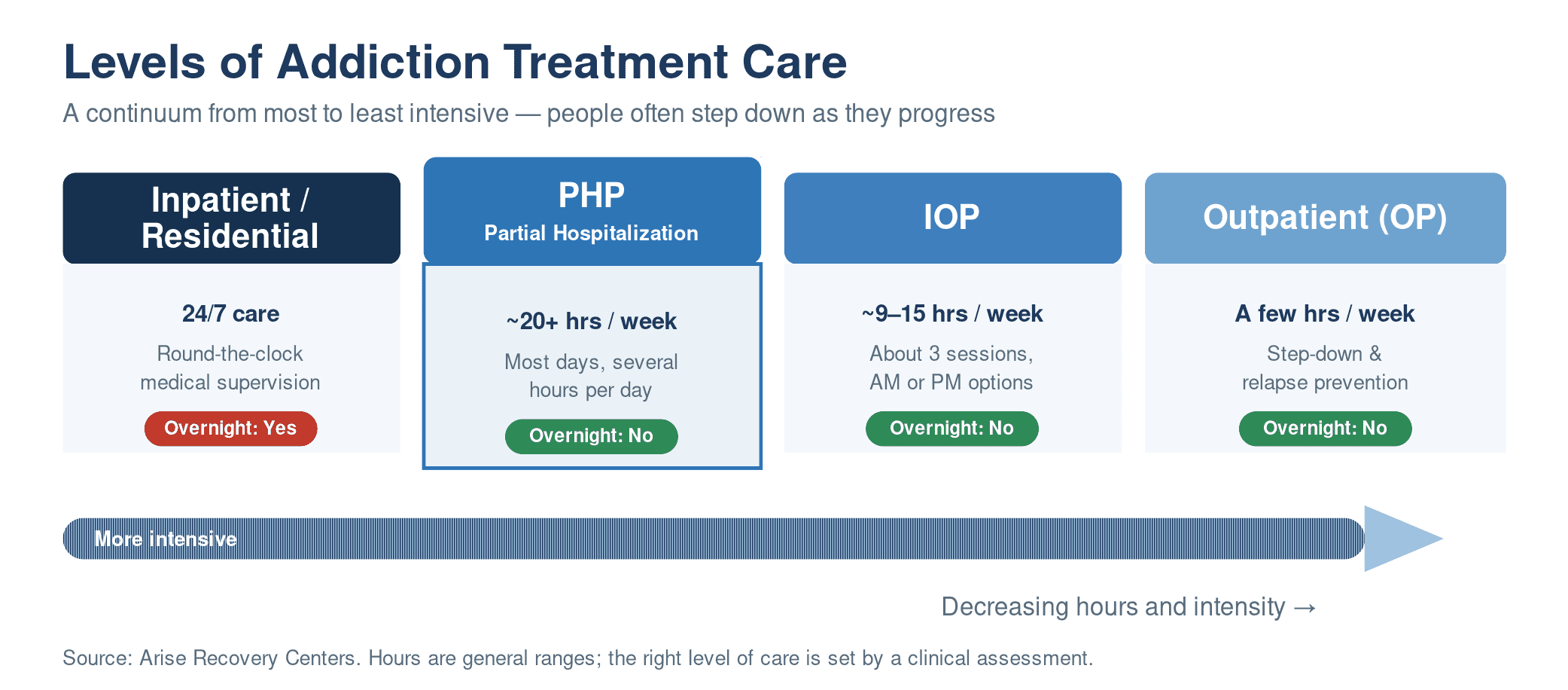
| Level of care | Typical hours | Overnight? | Best for |
|---|---|---|---|
| Inpatient / residential | 24/7 | Yes | Medical instability, detox, unsafe home environment |
| PHP (partial hospitalization) | ~20+ hrs/week, most days | No | Needs intensive daily structure, but home is safe |
| IOP (intensive outpatient) | ~9–15 hrs/week | No | Needs solid support while working or in school |
| Standard outpatient (OP) | A few hrs/week | No | Step-down, maintaining progress, relapse prevention |
People often step down this continuum as they stabilize — for example, from PHP to IOP to standard outpatient. Learn more: What is an IOP? and IOP vs. PHP.
Who is a PHP right for?
- You’re stepping down from inpatient treatment or detox and aren’t ready for a lighter schedule
- You need substantial daily structure and support, but not 24/7 medical monitoring
- You have a safe, stable home to return to each night
- You’re managing a co-occurring mental health condition alongside substance use
A clinical assessment is the only reliable way to know if PHP is the right starting point — or whether IOP or inpatient care is a better fit.
Cost and insurance
PHP costs less than inpatient care because there’s no room and board, but more than IOP because of the higher number of treatment hours. Most major health plans cover PHP as part of behavioral health benefits, though coverage, deductible, and copay depend on your plan. A quick, confidential benefits check confirms the details. Related: Outpatient rehab cost in Texas and Does insurance cover IOP & outpatient rehab?
Getting started
The first step is a short, confidential phone call and an insurance check, followed by a clinical assessment to match you with the right level of care. Call 888-REHAB-TX You may also find additional resources and help through our mental health partner, Saltwood Mental Health in Dallas.
Frequently asked questions
What is a partial hospitalization program (PHP)?
A PHP is the most intensive form of outpatient treatment — structured therapy several hours a day, most days of the week, while you return home each evening. It offers support close to inpatient care without the overnight stay.
Is a High Intensity Outpatient Program (HIOP) the same as a PHP?
Yes. “HIOP” is a newer name some providers and insurers use for partial hospitalization–level care. Whether it’s called PHP or HIOP, it refers to the same intensive, near-daily outpatient treatment where you go home each evening.
How many hours per week is a PHP?
PHP is typically around 20+ hours per week — often about 5 to 6 hours a day, 4 to 5 days a week — though schedules vary by program and individual needs.
What’s the difference between PHP and IOP?
The main difference is intensity. PHP runs roughly 20+ hours a week across most days, while IOP is about 9–15 hours a week across about three sessions. Many people step down from PHP to IOP.
Does insurance cover PHP?
In most cases, yes. The majority of major health plans cover PHP as part of behavioral health benefits, though coverage, deductible, and copay depend on your plan.
The licensee providing these services is licensed by the State of Texas. This page is for informational purposes and is not medical advice. Treatment recommendations are made only after a clinical assessment.